
Evidence & Papers' Guideline Analysis and the Pathophysiology of Surgical Timing covered the AUA/EAU-ESPU comparison and the case for "why 6 to 18 months." This piece goes a step further — how our understanding of why cryptorchidism happens in the first place has shifted over the past half-century, and how that understanding connects to real long-term outcomes (paternity rate). The actual surgical techniques are covered separately in Part 2.
A Historical Look at Pathogenesis — From Hormonal Theory to Structural Theory
The Two-Phase Model of Testicular Descent and the Heyday of Hormonal Theory
Under the model established by Hutson et al., testicular descent unfolds in two phases governed by different hormonal signals. The first is the transabdominal phase (roughly weeks 8-15 of gestation), in which INSL3, secreted by Leydig cells, causes the gubernaculum to swell and anchors the testis near the inguinal region, while testosterone drives regression of the cranial suspensory ligament (CSL), clearing space for descent. A rise in intra-abdominal pressure is also discussed as a secondary mechanical factor at this stage, thought to relatively push the testis downward as the trunk grows. The second is the inguinoscrotal phase (roughly weeks 25-35), in which testosterone acts through the genitofemoral nerve (GFN) to trigger release of calcitonin gene-related peptide (CGRP), which moves the gubernaculum from the inguinal canal down into the scrotum (Hutson & Southwell, 2015).
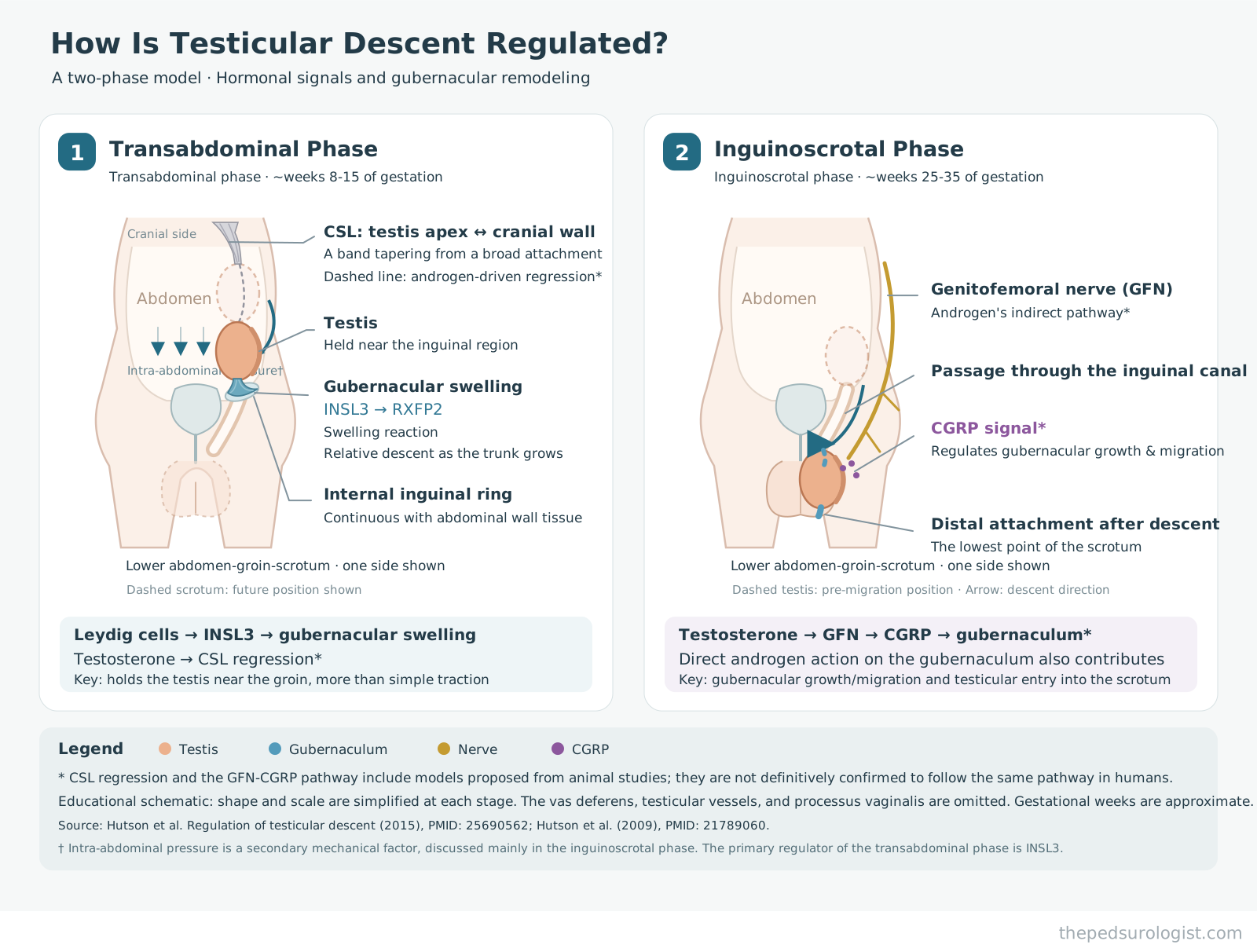
By putting hormones like testosterone and INSL3 forward as the central regulators of descent, this model fed naturally into the mid-20th-century view that cryptorchidism was the product of a systemic hormonal deficiency or signaling defect. Under this view, even a unilateral undescended testis raised the concern that the problem might not be local but systemic — as reports emerged of histological abnormalities (reduced germ cell counts, etc.) even in the contralateral, normally descended testis, a good deal of the clinical discussion of this era was shaped by pessimism that surgically correcting the undescended testis might not matter if the contralateral testis was already compromised. Hormone injections like hCG and GnRH were a natural prescription within this theoretical framework.
The Shift to Structural Theory and the Rise of Optimism
The turning point came from two directions. One was a purely anatomical observation: Han et al. (2004, J Urol) directly examined the distal gubernacular attachment in boys with cryptorchidism and found the attachment site itself was abnormal in 93% of cases — suggesting that a misplaced attachment point alone, independent of any hormonal signal, could explain the failure of descent. The other was a molecular finding, though its implications need to be stated carefully. In 1999, two independent groups reported that mice with the INSL3 gene knocked out developed bilateral cryptorchidism despite intact androgen signaling (Nef & Parada; Zimmermann et al.). This isn't evidence that "hormones aren't the cause" — INSL3 is, after all, a hormone in its own right. It's closer to showing that androgen alone cannot explain the failure of descent, that a separate signal (INSL3) governs the development of the gubernaculum itself, and that whatever the upstream signal, the point where everything ultimately converges is the development and position of the gubernaculum as a structure. In other words, Han's observation (a purely anatomical attachment defect) and the INSL3 model (a defect in a separate hormonal axis that targets the gubernaculum) together shifted understanding toward the idea that the final common pathway in cryptorchidism isn't systemic androgen deficiency, but an abnormality in the gubernaculum's own development and position.
As structural theory took hold, the clinical mood shifted too. If the problem was a local structural defect, then correcting that attachment abnormality surgically was, in principle, sufficient — a more optimistic reading became possible, and reports of fertility outcomes after early surgery grew less pessimistic than before. Hormone therapy, meanwhile, lost ground quickly for the purpose of inducing descent, as it became clear it couldn't fix a local structural problem — an observation that reinforced this shift was how often a testis brought down temporarily with hCG or GnRH re-ascended once treatment stopped. If the underlying problem were truly a systemic hormone deficiency, hormone replacement alone should have maintained a stable descent — but it usually didn't, a pattern that fit far better with the hypothesis of a genuinely misplaced attachment.
What About Unilateral Cases, Really? Large Cohorts Tell a More Hopeful Story
Hadziselimovic and colleagues' continuing position — that "even unilateral cryptorchidism is effectively a bilateral disease" — is still widely cited, but much of the evidence behind it draws on histological cohort data the same research group has been accumulating for decades (Verkauskas 2019 among others), and reads more as a repeated reaffirmation of existing observations than as fundamentally new evidence.
Large cohort studies that use actual paternity as the outcome tell a more hopeful story. Lee et al. (Children's Hospital of Pittsburgh, 1955-1974 cohort) tracked men who had attempted paternity and found that 89.7% of the corrected unilateral group achieved paternity, versus 93.2-93.7% of controls — not a statistically significant difference. Follow-up analyses extending this cohort reached the same conclusion. The most recent systematic review (2024) reaffirms this pattern: bilateral cryptorchidism consistently showed lower paternity rates, but unilateral cryptorchidism's paternity rate generally resembled that of the general population. Given that unilateral cases make up 70-90% of cryptorchidism, this reasonably good prognosis is also grounds for reassuring parents in clinic.
This contrast also explains why EAU/ESPU narrows its mention of GnRH analogues to high-risk groups such as bilateral cases, rather than "all cryptorchidism." There's no basis to declare the "bilateral disease" hypothesis flatly wrong, but at the level of clinical outcomes (paternity rate) at least, there isn't much basis for excessive pessimism about unilateral cryptorchidism either.
Prognosis — Unilateral vs. Bilateral, by Paternity Rate
The most direct indicator of long-term prognosis for boys who had surgery at the right time ultimately comes down to paternity rate. Checking whether the theoretical shift discussed above (pessimism under hormonal theory → optimism under structural theory) actually holds up in real clinical data, unilateral and bilateral disease again present starkly different pictures.
The classic Puri et al. cohort put the general population's paternity rate at 94%, versus 89% for corrected unilateral cryptorchidism and 62% for corrected bilateral cryptorchidism. The Pittsburgh cohort discussed above (Lee et al.) shows the same contrast with much greater precision — among men who attempted paternity, 93.2% of controls and 89.7% of the corrected unilateral group succeeded, not a statistically significant difference, while the corrected bilateral group succeeded only 65.3% of the time, significantly lower than both the unilateral group and controls (p<0.001). A 2024 systematic review reconfirms this same contrast — bilateral cryptorchidism consistently showed lower paternity rates across studies, while unilateral cryptorchidism held at a level comparable to the general population.
In other words, applying the statement "cryptorchidism is a risk factor for infertility" without distinguishing unilateral from bilateral disease is inaccurate. This distinction matters especially when counseling parents on prognosis — for unilateral cryptorchidism, there's ample basis to reassure parents about long-term fertility after timely surgery; for bilateral cryptorchidism, this same contrast is grounds for more active follow-up, and can be grounds for considering the adjunctive GnRH therapy EAU/ESPU mentions.
The actual surgical techniques continue in Part 2 — Surgical Treatment Choices by Position and Situation (approach selection, laparoscopy indications, atrophy rates in single- vs. two-stage surgery, and the Shehata technique).
References
- Hagberg S, Westphal O. Treatment of undescended testes with intranasal application of synthetic LH-RH. Eur J Pediatr. 1982.
- Hutson JM, Southwell BR. Regulation of testicular descent. Pediatr Surg Int. 2015;31(4):317-325.
- Han WK, et al. Structural evidence against hormonal therapy for cryptorchid testis: abnormal gubernacular attachment. J Urol. 2004.
- Nef S, Parada LF. Cryptorchidism in mice mutant for Insl3. Nat Genet. 1999.
- Zimmermann S, et al. Targeted disruption of the Insl3 gene causes bilateral cryptorchidism. Mol Endocrinol. 1999.
- Verkauskas G, Malcius D, Dasevicius D, Hadziselimovic F. Histopathology of Unilateral Cryptorchidism. Fetal Pediatr Pathol. 2019.
- Hadziselimovic F. Advocating hormonal treatment to prevent adult infertility in patients diagnosed with congenital undescended testes. 2024.
- Puri P, Nixon HH. Bilateral retractile testes — subsequent effects on fertility. J Pediatr Surg. 1977.
- Lee PA, Coughlin MT, Bellinger MF. Fertility after unilateral cryptorchidism: paternity, time to conception, pretreatment testicular location and size, hormone and sperm parameters. Horm Res. 2001;55(1):28-32.
- Lee PA, et al. Fertility after bilateral cryptorchidism. Evaluation by paternity, hormone, and semen data. J Pediatr Endocrinol Metab. 2001.
- Lee PA, Coughlin MT. The single testis: paternity after presentation as unilateral cryptorchidism. J Urol. 2002.
- Paternity After Treatment of Cryptorchidism: A Systematic Review. 2024.