
Once vesicoureteral reflux (VUR) is confirmed, should antibiotic prophylaxis be started? And if it is, should it continue until the reflux has gone? The guidelines do not give every child the same answer. The choice depends on age, infection history, reflux grade, renal status and bladder and bowel dysfunction (BBD). It also matters to be clear about what the antibiotic is expected to do, because reducing recurrent urinary tract infection and preventing new renal scars are different goals.
This article looks at continuous antibiotic prophylaxis (CAP) through four questions. The AUA and EAU/ESPU guidelines are at the centre, connected to the AAP 2026 risk-based approach and NICE's recommendations on preventing UTI.
1. Does every child with reflux need prophylaxis?
When comparing guidelines, first make sure they are talking about the same child. The same recommendation cannot apply both to all children after a first UTI and to a child already known to have high-risk reflux.
The AUA explicitly recommends CAP in particular groups. The classic case is a child under one year with a history of febrile UTI (Recommendation); infants found by screening to have grade III–V reflux are also included (Recommendation). By contrast, a child of one year or older without BBD, recurrent febrile UTI or renal cortical abnormality may be observed, with prompt treatment of any infection (Option).
EAU/ESPU does not prescribe across the board either. Symptomatic children diagnosed in the first year start with CAP regardless of grade or scarring (Weak), while close surveillance without CAP for children with low-grade reflux and no symptoms is rated Strong. The narrative text cuts both ways. Citing RIVUR reanalyses showing greater benefit in high-risk groups — uncircumcised boys, children with BBD and those with high-grade reflux — it supports a shift from "absolute CAP for dilating reflux" to "selective, risk-based CAP"; yet it also says that identifying children who do not need CAP is difficult and risky, so using CAP is the safe approach in most cases.
The AAP 2026 makes a conditional recommendation against routine CAP in low-risk reflux (low certainty of evidence). Low risk is defined as grade I–II without BBD; grade III is left as a category of uncertain risk in which CAP may be chosen according to family preference. In high-risk children CAP remains an option, with an emphasis on working with specialists. Its definition of BBD excludes functional constipation, which calls for care when comparing it with other guidelines.
NICE starts from a different question. NG224 advises against routine antibiotic prophylaxis after a first UTI. For recurrent infection, NG112 calls for assessment of the cause and, if behavioural and hygiene measures are ineffective or unsuitable, consideration of prophylaxis with specialist advice. It is not a substitute for grade-specific management of reflux.
| Clinical situation | What to take from the guidelines |
|---|---|
| After a first UTI, reflux not established | Distinguish routine CAP from CAP for specific risk groups |
| Low grade, low infection risk | Consider whether observation without CAP is appropriate |
| Young infant, infection history or high risk | Weigh the expected benefit of CAP more actively |
| BBD present | Plan BBD treatment alongside the decision on CAP |
Observation without CAP also needs a plan. Where will the child have a urine test and treatment if fever or UTI symptoms appear, and can the family use that route? The AUA's observation option assumes prompt treatment when infection occurs, and EAU/ESPU asks clinicians to consider easy, early access to care during febrile UTI.
2. What does CAP buy, and at what cost?
The first distinction in explaining the benefit of CAP is between fewer recurrent infections and prevention of renal scarring. The four randomised trials differ in both population and outcome.
| Trial | Population | Urinary tract infection | Renal scarring |
|---|---|---|---|
| RIVUR (2014) | Grade I–IV after a first or second febrile/symptomatic UTI; 607 children, 2–72 months; 2 years | 39/302 vs 72/305, HR 0.50 | New scars 8.2% vs 8.4% (any scar at outcome 11.9% vs 10.2%); no significant difference |
| Swedish (2010) | Grade III–IV, 1–2 years; 203 children; CAP, endoscopic and surveillance arms; 2 years | Febrile recurrence in girls 19% / 23% / 57%; rare in boys | New renal damage in girls 0 / 5 / 8 — difference between arms (p = 0.016) |
| PRIVENT (2009) | Under 18 with prior UTI; 576 children (42% with reflux); 1 year | 13% vs 19%, HR 0.61 | Not a primary outcome; imaging was not an entry requirement, limiting comparison of scarring |
| PREDICT (2023) | Grade III–V, 1–5 months, no prior UTI; 292 infants; 2 years | First UTI 21.2% vs 35.6%, HR 0.55 | No clear difference in new scars or eGFR |
In one line, the four trials say that results for preventing infection and for preventing renal scarring do not always agree.
The benefit seen in recurrent infection
RIVUR's "halving of recurrence" refers to a composite outcome of febrile or symptomatic UTI1. The Swedish trial showed, in the narrow group of girls aged 1–2 years with grade III–IV reflux, that CAP and endoscopic treatment reduced febrile recurrence2; PREDICT reduced the first infection itself in infants who had not yet had one5. Sixty-four per cent of the untreated group were infection-free over two years, and seven infants had to be treated for two years to prevent one infection. PRIVENT found no interaction by reflux status4, which means no evidence was found that the effect is confined to children with reflux — not that the effect was proven to be the same. Imaging was not an entry requirement and subgroup precision was limited.
The uncertainty that remains for renal scarring
RIVUR and PREDICT found no significant difference in renal scarring at two years1,5. In the Swedish trial new renal damage in girls differed between arms — 0 with CAP, 5 with endoscopic treatment and 8 with surveillance — and occurred in 22% of children with febrile recurrence versus 3% without3. This supports the possibility that, in that group of girls, preventing infection leads to preventing renal damage. But a comparison by recurrence status does not in itself prove causation, nor can it be extended unchanged to other ages and grades.
"Fewer infections but no difference in scarring" also needs qualifying. A new or worsening DMSA defect is used like a reference standard but is not a perfect one: results vary with the distinction between acute inflammation and permanent scarring, with the timing of the scan and with inter-observer variation, and definitions differ between trials. New scars within two years are few, leaving trials underpowered to show a difference. And while renal scarring is an important imaging finding of parenchymal damage, a difference in scarring does not translate directly into a difference in long-term clinical outcomes such as hypertension, proteinuria or loss of renal function — outcomes that two years of follow-up cannot assess. "No difference" in scarring should therefore be read not as evidence that preventing infection fails to protect the kidney, but as showing that improvement in renal outcomes was not demonstrated in that population over that follow-up.
Benefit is visible in individual trials, but certainty wavers when they are pooled. The AAP evidence review emphasises uncertainty about the overall effect on infection and scarring, and the risk of resistance9. That is why positive individual trials and cautious recommendations coexist.
The paragraph added in the AUA's 2017 amendment shows this shift exactly6. In the AUA's reanalysis, the de Bessa meta-analysis was not significant; adding RIVUR produced borderline significance; and adding the Hari trial (a small trial of 93 children in which infections actually increased on CAP; cited by the AUA as 2013, formally published in 201511) removed it again. This is the AUA's own pooled re-evaluation, not the conclusion of the original papers. The AUA also notes limits to generalising from RIVUR, a predominantly female population of children with a history of UTI. Comparing the 2010 J Urol summary with the 2017 text, this paragraph is the substantive change in the amendment.
Resistance and the burden of daily medication
In RIVUR, among 87 children whose first recurrence was caused by E. coli, TMP-SMX resistance was found in 63% on CAP and 19% on placebo1. This does not mean that 63% of all children on CAP had a resistant infection; it is the proportion of recurrent isolates that were resistant. In PREDICT, too, Pseudomonas and resistant organisms were more common among infections in the CAP group5.
What families are told should therefore not stop at "infections will be fewer". The expected absolute benefit, the possibility of resistance in breakthrough infection and the burden of daily medication should be set out together. Nor should protection against renal scarring or long-term loss of function be promised as certain.
3. How does BBD change the decision?
At the same grade, coexisting BBD changes both infection risk and the management plan. In RIVUR the subgroup with baseline BBD had a hazard ratio for recurrence of 0.21, a large effect of CAP1. But this was a subgroup of toilet-trained children, and the same effect cannot be expected in BBD at every age. The AAP evidence review also notes that data in children with BBD are limited.
The AUA recommends CAP from one year of age when BBD is present, for as long as it exists and is being treated (Recommendation), and advises treating BBD before antireflux surgery where possible. EAU/ESPU says to assess every child for LUTD and to treat it first if present (Strong). NICE likewise recommends managing elimination problems and constipation after UTI (NG224 1.2.10)10.
In these recommendations CAP and BBD treatment go together. Prescribing an antibiotic does not fix voiding habits or constipation, and follow-up should check not only for infection but also whether voiding and bowel symptoms have improved.
4. When to stop, or change strategy
How long to use CAP is even less clear than whom to start it in. Resolution of reflux, completion of toilet training, improvement of BBD and a period free of infection are each separate considerations.
EAU/ESPU states that there is no reliable evidence on duration and offers a practical approach of continuing until the child is toilet trained and free of LUTD. The timing of discontinuation is debated, but recurrence was more frequent in children treated for less than a year after the last febrile infection and in bilateral reflux, and the guideline adds that more than a year may help. Active surveillance for UTI is needed after stopping, and follow-up and discontinuation are decided individually with the patient and caregivers. NICE asks for prophylaxis for recurrent infection to be reviewed at least every six months — not as a fixed stopping point, but to weigh effectiveness and resistance and discuss continuing, stopping or changing. That RIVUR gave two years of treatment does not show that two years is optimal either; a trial's duration is not a recommended duration.
A febrile UTI on CAP prompts a fresh assessment: confirmation of infection, culture and sensitivities, adherence, BBD and renal status, and whether to change the prophylactic agent or intervene. The AUA recommends considering intervention with curative intent (ureteral reimplantation or endoscopic injection) after a febrile breakthrough infection (Recommendation), and allows a change of antibiotic first for a single breakthrough infection with no pre-existing or new renal cortical abnormality (Option). EAU/ESPU writes that a febrile breakthrough infection on CAP calls for moving from conservative management to considering intervention. Still, a single event should not be reduced to the same surgical threshold for every child.
The timing of surgery and the choice of procedure are covered in Part 4. The conclusion needed here is that prescribing CAP is not a fixed decision. From the start, decide what will be watched and what changes will prompt a change of strategy.
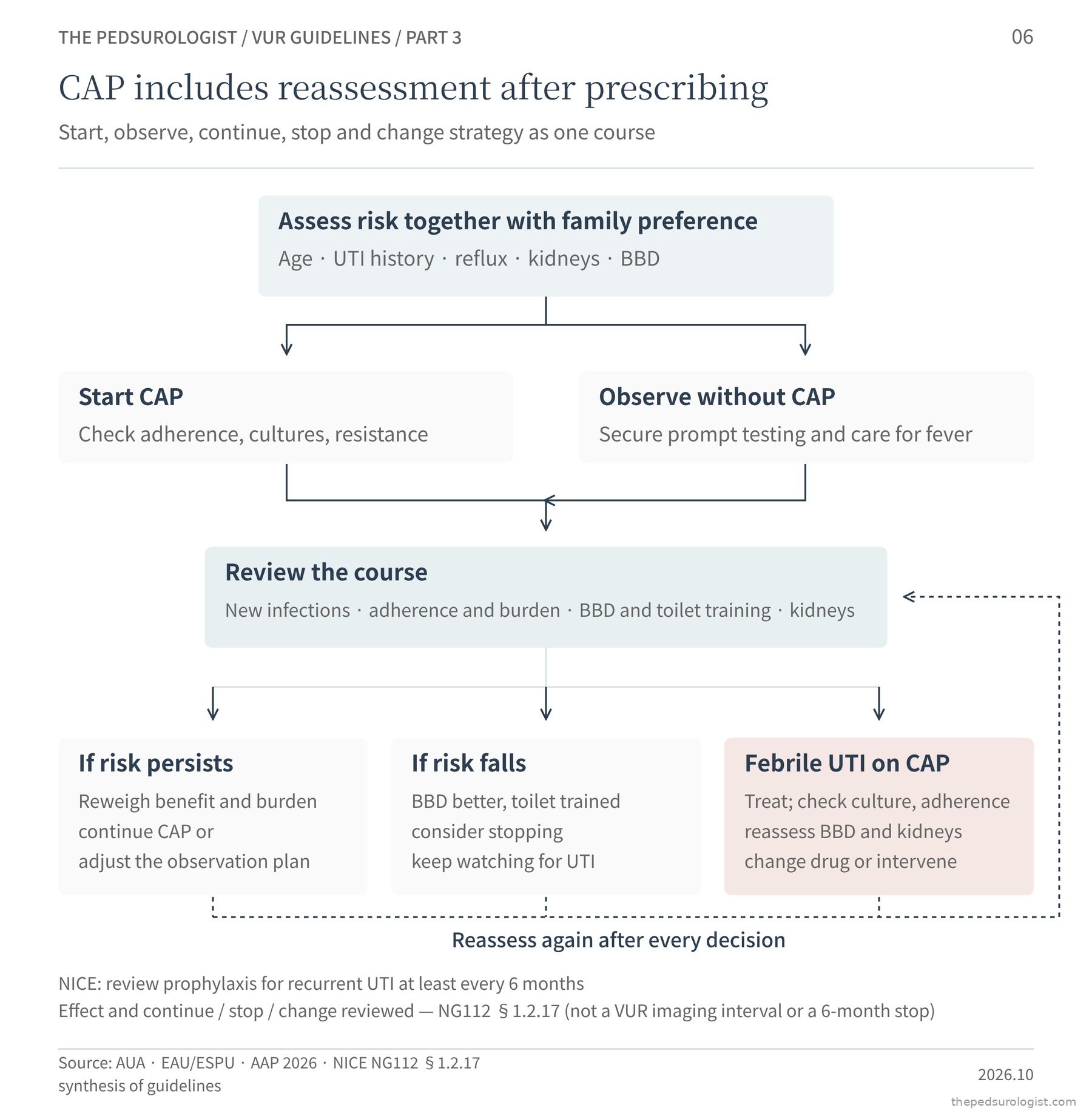
What are we trying to prevent in this child? What are the expected benefits and burdens? Under what conditions will we stop or change strategy?
Currency and scope of the evidence
- This article compares the AUA 2017 amendment, EAU/ESPU 2026, AAP 2026 and NICE NG224 and NG112. The four trials answer different clinical questions and do not support every recommendation of every guideline in the same way.
- Comparing the 2010 J Urol summary with the current 2017 text, the substantive change in the AUA amendment is the paragraph on the meta-analysis of antibiotic prophylaxis in section 2. The recommendation statements and grades were the same.
- The CAP text of the EAU/ESPU VUR chapter dates from the 2023 revision, which also added the RIVUR secondary results (two years of TMP-SMX did not affect blood counts, electrolytes or creatinine) and the uncertainty about effects on gut microbiota.
Guideline texts checked on 19 October 2026.
References
- RIVUR Trial Investigators; Hoberman A, Greenfield SP, Mattoo TK, et al. Antimicrobial prophylaxis for children with vesicoureteral reflux. N Engl J Med. 2014;370(25):2367-2376. doi:10.1056/NEJMoa1401811
- Brandström P, Esbjörner E, Herthelius M, et al. The Swedish reflux trial in children: III. Urinary tract infection pattern. J Urol. 2010;184(1):286-291. doi:10.1016/j.juro.2010.01.061
- Brandström P, Nevéus T, Sixt R, et al. The Swedish reflux trial in children: IV. Renal damage. J Urol. 2010;184(1):292-297. doi:10.1016/j.juro.2010.01.060
- Craig JC, Simpson JM, Williams GJ, et al. Antibiotic prophylaxis and recurrent urinary tract infection in children (PRIVENT). N Engl J Med. 2009;361(18):1748-1759. doi:10.1056/NEJMoa0902295
- Morello W, Baskin E, Jankauskiene A, et al. Antibiotic prophylaxis in infants with grade III, IV, or V vesicoureteral reflux (PREDICT). N Engl J Med. 2023;389(11):987-997. doi:10.1056/NEJMoa2300161
- American Urological Association. Management and screening of primary vesicoureteral reflux in children (2010, amended 2017). auanet.org
- EAU Guidelines on Paediatric Urology. Chapter 17, Vesicoureteric reflux. European Association of Urology, 2026 edition. uroweb.org
- Alverson BK, Hains DS, Downs SM, et al. Clinical practice guideline for the diagnosis and treatment of urinary tract infection in children from 8 days to 5 years of age. Pediatrics. 2026;158(4):e2026078565. publications.aap.org
- AlShenaiber L, Senerth E, Babatunde I, et al. A systematic review and meta-analysis of the prevention and management of pediatric urinary tract infection and suspected urinary tract infection: technical report. Pediatrics. 2026;158(4):e2026078568. publications.aap.org
- National Institute for Health and Care Excellence. Urinary tract infection in under 16s: diagnosis and management. NG224. nice.org.uk/guidance/ng224; Urinary tract infection (recurrent): antimicrobial prescribing. NG112. nice.org.uk/guidance/ng112
- Hari P, Hari S, Sinha A, et al. Antibiotic prophylaxis in the management of vesicoureteric reflux: a randomized double-blind placebo-controlled trial. Pediatr Nephrol. 2015;30(3):479-486 (online 2014). doi:10.1007/s00467-014-2943-z