
The first thing a parent asks in clinic is usually this. "Is my son's case a severe one?"
It is a hard question to answer. One can say where the meatus opened, but that is not the same as severity. If Part 2 showed that the ruler by which outcome is measured wavers, this instalment takes the other half — how to make the comparisons start from the same line in the first place. And that answer turns out to be an indirect answer to the parent's question too.
Meatal position does not determine severity
Classification is conventionally by meatal position — distal, midshaft, proximal — but the European guideline itself states that meatal position alone does not always determine severity. What actually separates severity is the degree of curvature, the width and quality of the urethral plate, and the size of the glans and depth of its groove.
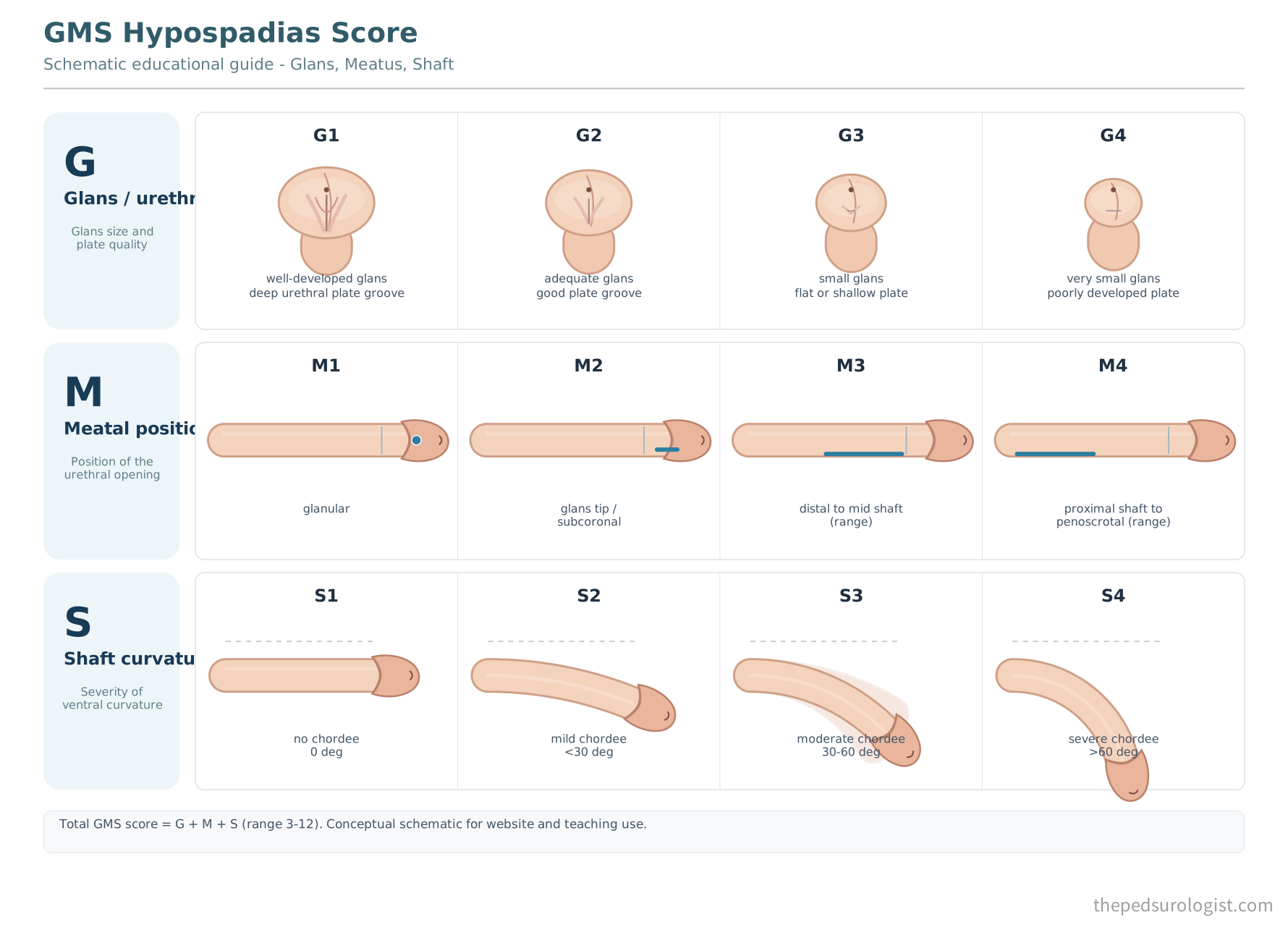
The GMS score (Glans–urethral Meatus–Shaft, Merriman et al., 2013) is the attempt to capture this multidimensionality in a single number. Each of three components is graded 1 to 4 and summed.
- G — glans size and urethral plate quality
- M — meatal location before degloving: glanular (M1), coronal sulcus (M2), distal or middle penile shaft (M3), proximal shaft, penoscrotal, scrotal or perineal (M4)
- S — degree of ventral curvature: none (S1), less than 30° (S2), 30–60° (S3), more than 60° (S4)
The original paper presents the glans grades as a criteria figure (Fig. 1) and representative photographs (Fig. 2); it does not set out wording for each grade in the text. The schematic below is a visual rendering of those criteria.
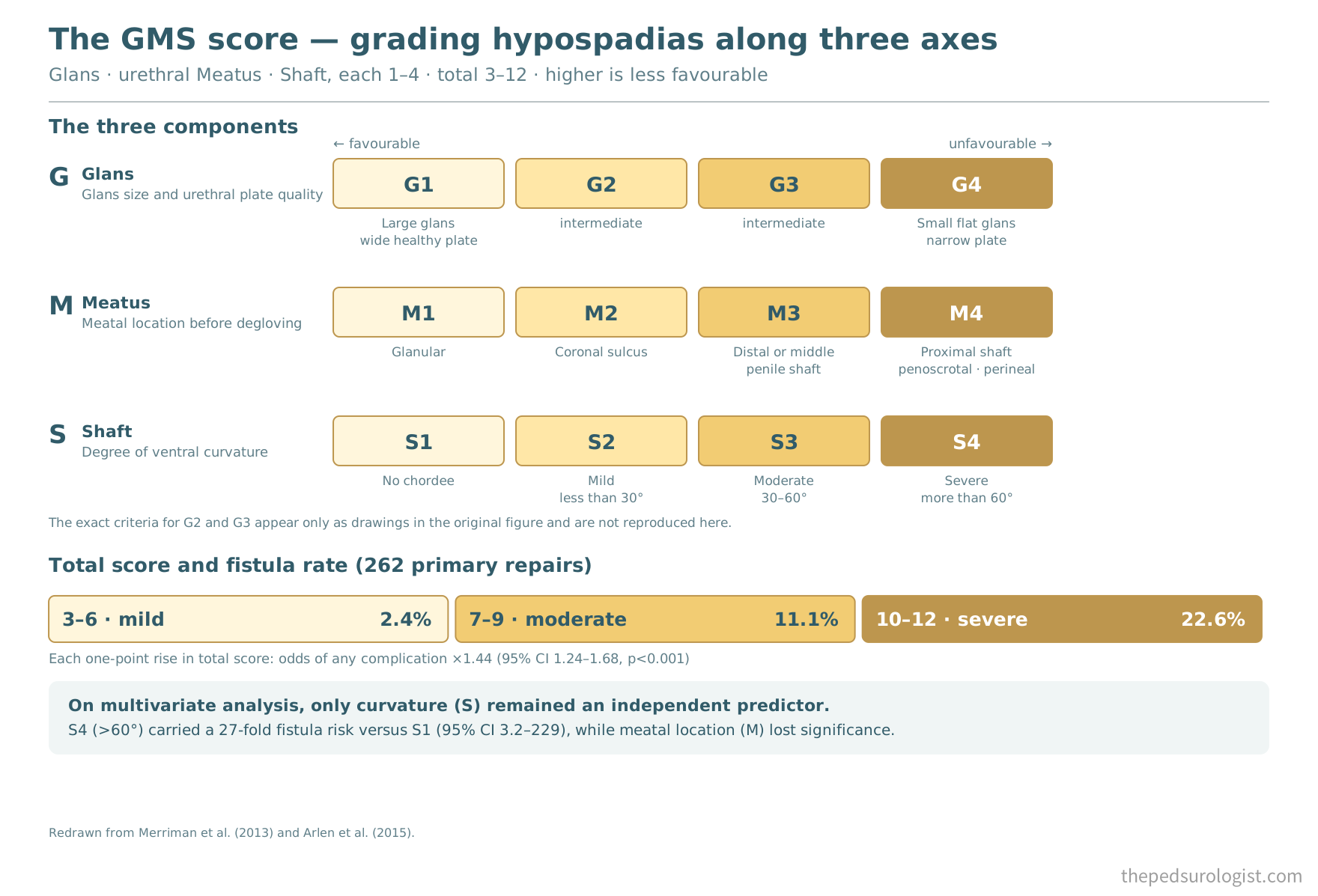
Totals run from 3 (mild) to 12 (severe), conventionally divided into 3–6 mild, 7–9 moderate and 10–12 severe. Inter-observer reliability was established first; correlation with complications followed.
What the GMS score actually tells us
A study that prospectively scored 262 boys undergoing primary repair (Arlen et al., 2015) supports the argument of this article directly.
For every one-point rise in total score, the odds of any complication rose 1.44-fold (95% CI 1.24–1.68, p<0.001). Fistula rates separated out at 2.4% in the mild group, 11.1% in the moderate and 22.6% in the severe.
The independent predictor of fistula in this study was the degree of curvature (S). Boys with curvature beyond 60° (S4) carried 27 times the fistula risk of boys with none (S1) (95% CI 3.2–229). Meatal location (M), meanwhile, did not retain significance on multivariate analysis — the very item we have used as the basis of classification.
As a confidence interval running from 3.2 to 229 makes plain, S4 patients were few and the estimate is itself unstable. The direction, however, is clear. What predicts complications is not where the meatus opened but how far the penis is bent. Distal cases are not easy because they are distal; they are easy because there is no curvature.
The limits of the GMS score
The GMS score is not a complete answer either, and its authors said so first. Merriman et al. noted that certain qualities are difficult to demonstrate photographically and that the scale carries some subjectivity; they added that although the G score covers both glans size and urethral plate quality, the photographs in the paper were chosen to emphasise differences in plate quality rather than glans size. One item measures two things, and even which of the two to show required a choice.
In an external validation of agreement among experts (2024), overall agreement was high, but the only item reaching almost perfect agreement was meatal location. Glans and urethral plate quality, and the degree of curvature, divided the raters. A scale that presents itself as objective still carries subjective elements.
This is paradoxical but unsurprising. The item that can be measured most objectively happens to be the one with the least predictive power, and the more predictive the item, the harder it is to measure. Plate quality is judged by eye and hand; curvature cannot be properly assessed without an artificial erection. Refining the instrument will not solve this. What is measured, and under what conditions — preoperative assessment and artificial erection are a subject in their own right, and a later instalment is given to them.
In short, there are two things to check when reading a paper comparing techniques: what was defined as the outcome, and how severity was matched. A study reporting only complication rates and grouping by meatal position has said "complications were few in this group of patients," not "this technique is better."
But the GMS score is only half an answer
GMS puts a number on "how bad is this," and to that extent it answers the parent. But what actually governs how the operation will go is not the three components but one of them: curvature.
On multivariate analysis, as we saw, curvature alone was independently associated with complications; neither glans and plate quality nor meatal position survived. And as Part 1 set out, it is curvature that decides whether the urethral plate is preserved or divided, and whether the repair is done in one stage or two. That the item predicting complications and the item dictating the technique are the same is unlikely to be coincidence — and these data cannot separate whether severe curvature itself drives the complications, or whether the technique chosen because of it does.
So the total score may serve as a summary of severity, but the S component deserves to be read on its own. Two boys both scoring 8 — one G3-M4-S1, the other G1-M3-S4 — are not the same patient.
What remains — on what basis does a parent choose a surgeon?
Even with instruments to match severity and measure outcome, none of it matters if the outcomes are not reported. And reporting in this field leans systematically toward optimism.
The numbers show it. About half of published papers have a follow-up shorter than one year, while roughly half of complications appear after the first year. In one tertiary centre's long-term series, 24.1% required reintervention — and only 47.4% of those declared themselves within the first year. In an international survey of nearly 500 paediatric urologists and paediatric surgeons, close to 60% reported a follow-up period under six months, and only 10% followed patients to or beyond puberty.
Long and Canning described this as a cycle. Short follow-up yields high success rates, and those rates then become the benchmark. A surgeon who follows patients long enough to see the true complication rate becomes reluctant to publish it, for fear of how it will look. A figure above 50% is intimidating to parents, the more so beside an unrealistic success rate quoted by a colleague who has not examined his own data carefully. The result is expectations that are too optimistic on both sides, a reluctance to admit a problem exists, and further hesitation about looking at the data.
What this means for parents is plain: there is no basis on which to choose. The success rates offered differ in follow-up, in the severity of the cohort, and in what was counted as an outcome, so they cannot be compared. There is even the perverse effect that the surgeon who follows longest and reports most honestly looks worst. Where honesty is penalised, honesty does not last.
The remedy is simple but laborious: record severity preoperatively in a standardised way, state the follow-up period, and define the outcome. That is the real reason instruments like GMS are needed — not to decide which technique is better, but to let one person's results be read against another's on the same scale. Until then, what a parent can carry into the consultation is not a number but a sense of what to ask.
Next
The next instalment steps back. Why does hypospadias occur, and is it really becoming more common? Embryology and prevalence, and the evidence behind the causes that have been proposed — assisted reproduction, parental age, endocrine-disrupting chemicals among them. It is an instalment about how much can currently be said in answer to the question parents ask most often in clinic: why did this happen?
References
- Merriman LS, Arlen AM, Broecker BH, Smith EA, Kirsch AJ, Elmore JM. The GMS hypospadias score: assessment of inter-observer reliability and correlation with post-operative complications. J Pediatr Urol. 2013;9(6 Pt A):707-712.
- Arlen AM, Kirsch AJ, Leong T, Broecker BH, Smith EA, Elmore JM. Further analysis of the Glans-Urethral Meatus-Shaft (GMS) hypospadias score: correlation with postoperative complications. J Pediatr Urol. 2015;11(2):71.e1-71.e5.
- Expert classification of hypospadias: an external validation and evaluation of agreement for Glans-Urethral Meatus-Shaft (GMS) and Hypospadias Objective Penile Evaluation (HOPE) scores. Pediatr Surg Int. 2024;40(1):228.
- EAU Guidelines on Paediatric Urology. Hypospadias. European Association of Urology, 2026.
- Long CJ, Canning DA. Proximal hypospadias: we are not always keeping our promises. J Pediatr Urol. 2016;12(4):206-207.
- Spinoit AF, Poelaert F, Groen LA, Van Laecke E, Hoebeke P. Hypospadias repair at a tertiary care center: long-term followup is mandatory to determine the real complication rate. J Urol. 2013;189(6):2276-2281.
- Springer A. Assessment of outcome in hypospadias surgery — a review. Front Pediatr. 2014;2:2.