
Surgery for proximal hypospadias has changed around two choices: one stage or staged, and whether to keep the urethral plate. Staged repair came first; through the 1960s–80s practice moved towards one-stage repair. Onlay flaps and TIP widened the scope for keeping the plate. In proximal cases with significant curvature, however, the limits of mobilising the plate and of straightening around it were reported, and transection came to be considered more readily, with straightening and urethral reconstruction separated into stages in severe cases.
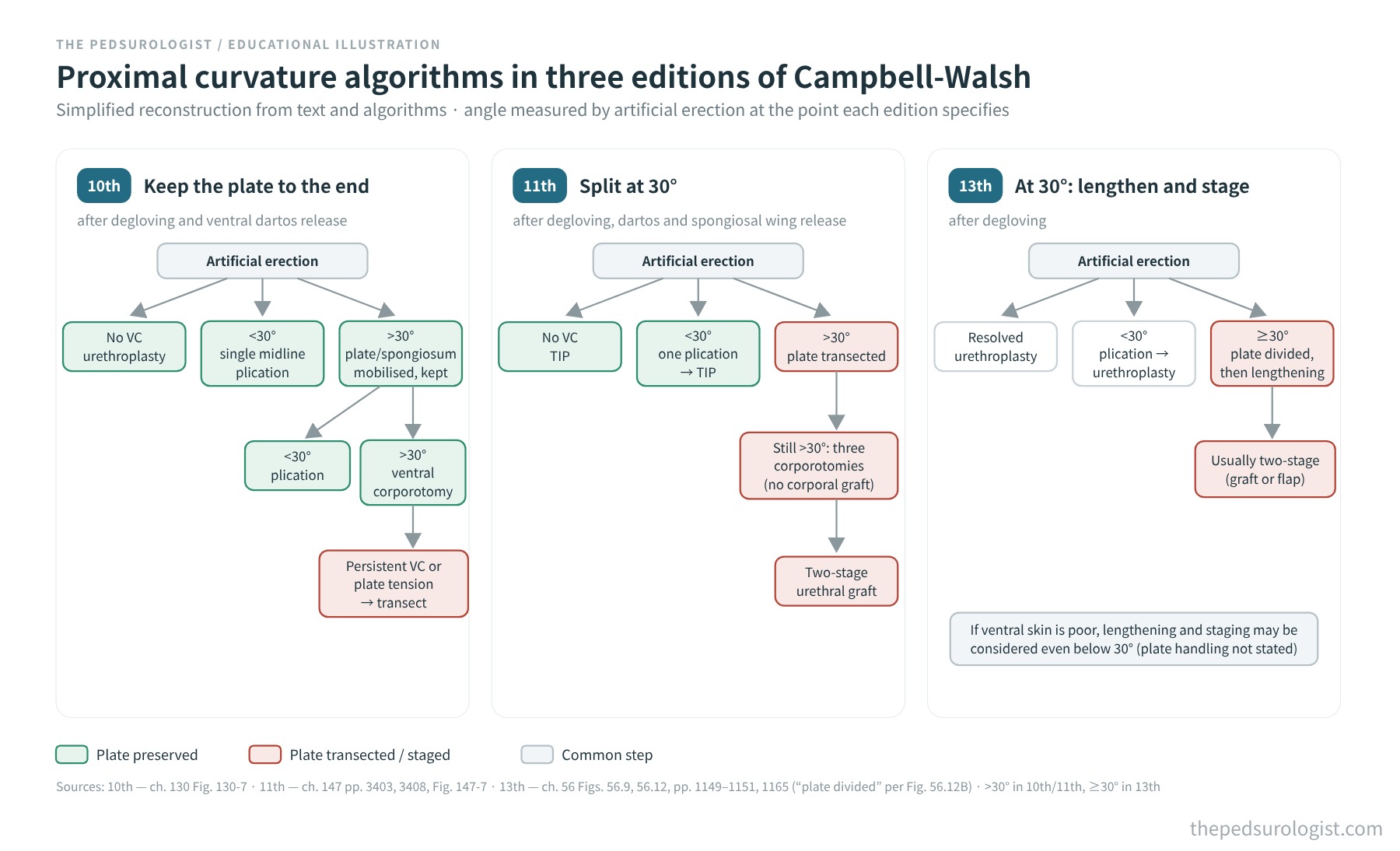
The change is visible in Campbell-Walsh Urology. The proximal curvature algorithm kept the plate to the end in the 10th edition (2012), transected it beyond 30° in the 11th (2016), and the 13th-edition (2026) authors’ algorithm leads from residual curvature of 30° or more after degloving to ventral lengthening and two-stage reconstruction. This note is about proximal hypospadias, particularly with marked curvature; distally, TIP remains a widely used plate-preserving repair.
Swipe sideways to read the whole diagram
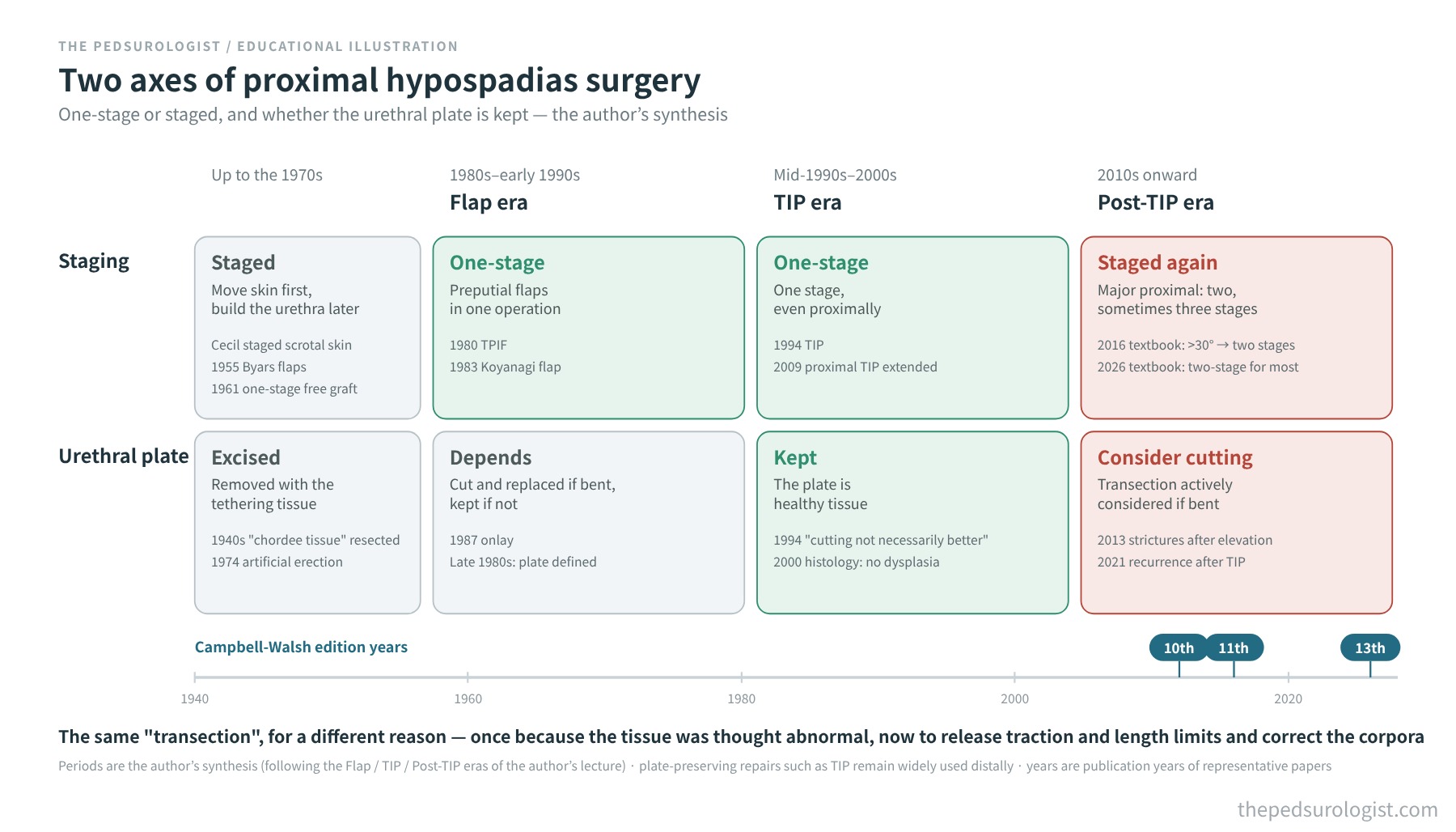
From staged to one-stage repair
Until the mid-20th century proximal hypospadias was usually repaired in stages: the penis was straightened and skin moved ventrally first, and the urethra was built at a later operation — Cecil’s staged scrotal technique and Byars flaps (1955) are typical.2,3 Curvature was attributed to traction from fibrous tissue on the ventral penis. As the Campbell 10th edition summarises, by the 1940s the belief that this tissue was dysplastic corpus spongiosum had become entrenched, and this “chordee tissue”, now recognised as the urethral plate, was resected to straighten the penis. The urethral plate was recognised as a distinct structure only in the late 1980s.3
From the 1960s, surgeons tried to finish in one stage — first with full-thickness preputial grafts (1961)2 and then, in 1980, with Duckett’s transverse preputial island flap (TPIF), inner preputial skin moved on its vascular pedicle and tubularised.4 With marked curvature the plate was cut and replaced by a long flap, so the more proximal the meatus, the longer the urethra to be reconstructed. Intraoperative artificial erection, introduced in 1974,5 showed that curvature often corrected with degloving of the penile skin alone.
One-stage repair that keeps the plate
The shift began in Duckett’s group. In 1987 they reported the onlay island flap, suturing a preputial island flap to the edges of a preserved plate in mid and distal hypospadias without chordee;6 in 1990 they extended it proximally, noting that many mid and proximal cases show little curvature once skin tethering is released.7 In 1994 Baskin and Duckett described straightening by dorsal plication with the plate kept, writing that “curvature correction is not necessarily enhanced by division of a healthy urethral plate.”8 TIP was reported the same year,9 and in 2000 urethral plate biopsies showed no fibrous bands or dysplastic tissue.10
TIP became a widely used plate-preserving repair distally, but proximal hypospadias was different. In a 2011 worldwide survey, 43.3–76.6% preferred two-stage repair for proximal cases and 0.9–16.7% TIP.11 Meanwhile, the group that introduced TIP had already been extending it proximally through the 2000s. In 2009, by dissecting the corpus spongiosum, plate and urethra off the corpora in proximal cases with more than 30° of curvature, they reduced plate transection from 54% to 15%12 — the basis of the 10th-edition algorithm.
Three editions of Campbell
Swipe sideways to read the whole diagram
| 10th (2012) | 11th (2016) | 13th (2026) | |
|---|---|---|---|
| When the plate is transected | Last resort — only if curvature or plate tension persists after plate/spongiosum (± urethral) mobilisation and ventral corporotomy | If curvature still exceeds 30° after degloving, dartos release and release of the spongiosal wings; corporotomies if still >30° | At ≥30°: corporal lengthening (the three approaches in Fig. 56.12B all follow plate division), two-stage repair |
| Below 30° | Dorsal plication, plate kept | Dorsal plication, plate kept → TIP | Dorsal plication, plate kept; lengthening considered if ventral skin is poor |
| Straightening with the plate kept, above 30° | Central to the algorithm | Not described (plate/urethral mobilisation discontinued because of strictures) | Mentioned as a way to extend proximal TIP (plate mobilisation, corporotomies), with stricture and recurrence risks noted |
| Chapter authors | The group that introduced TIP | Same group | Authors from another institution (Philadelphia) |
Side by side, the three editions show that the criterion for cutting the plate moved from “if curvature remains after straightening aimed at preservation” to “the angle at a defined point”.
The 10th edition called optimal management of curvature above 30° “uncertain” and recommended elevating the plate and adjacent spongiosum off the corpora, transecting only for curvature that persists (p. 3510, Fig. 130-7).3
The 11th edition transects beyond 30°: “We do not use multiple plications to straighten VC greater than 30 degrees out of concern that results may not be durable into adulthood” (p. 3403). Of the plate and urethral mobilisation that was central to the 10th edition, it notes strictures in 17% and says “we have discontinued this maneuver and not described it in this chapter”, while citing a report without strictures and adding “we cannot explain the difference” (p. 3421).13,14
The 13th edition’s algorithm (Fig. 56.9) goes directly from curvature of 30° or more on artificial erection after degloving to “corporal lengthening procedure, 2-stage repair”. The chart does not show plate division, but the three ventral lengthening approaches shown in Fig. 56.12B are each “performed after division of the urethral plate and incision of the tunica albuginea” (p. 1151), and the authors’ stated preference — a single full-thickness corporotomy from 9 to 3 o’clock with grafting — is one of them (p. 1152). The text also mentions a sequence of dividing the plate first beyond 30° and lengthening only if curvature greater than 30° persists, but this is what “some suggest”, citing a specialist survey, not the authors’ algorithm (p. 1150).15
A lengthening branch also appears below 30°, but as an option when ventral skin quality is a concern (p. 1149), and lengthening can be combined with urethroplasty in one stage (p. 1164), so lengthening does not always mean staged repair.
Its verdict on plate preservation needs to be read within its scope. The 13th edition says that extending proximal TIP to curvature beyond 30° by adding plate mobilisation and corporotomies “has since fallen out of favor” because of stricture and recurrent curvature (p. 1164). Yet the legend of Fig. 56.26 on the same page says proximal TIP can be considered when curvature is below 30° and corrected with plication. Proximal TIP as a whole is not excluded.15
The 10th and 11th-edition chapters were written by the group that introduced TIP; the 13th has authors from another institution. The direction held after the authors changed.
Why transection came back
The key data came from the group behind the 10th-edition algorithm itself.
Mobilisation and stricture (2013). In proximal TIP, strictures developed in 5 of 29 (17%) patients whose plate and urethra were elevated off the corpora, and in none of 47 without this manoeuvre.16 This report underlies the move to the 11th edition.
Recurrent curvature after plate-preserving straightening (2021). Among 58 proximal TIP patients whose curvature had been straightened, 26% had recurrent curvature (another 10% suspected), and the authors concluded, “we now only perform proximal TIP when there is little (<30°) or no VC.”17 The 13th edition cites this report.
There are data from other centres as well. In Toronto, among 100 proximal cases followed for more than five years on average, recurrent curvature occurred in 27.9% after dorsal plication and 9.4% after ventral lengthening;18 citing this, the 13th edition adds that not dividing the plate is itself an independent risk factor.15 A 2010 systematic review concluded that, “contrary to former practice”, plate division seems to have more of a role when significant curvature persists after mobilisation.20
A high overall complication burden of proximal repair has also been reported. In Philadelphia, 167 boys with proximal hypospadias had a median follow-up of about 32 months and a complication rate of 56%: 62% after one-stage and 49% after staged repair, a difference that was not statistically significant, although more one-stage patients experienced two or more complications.19 These results do not by themselves show a benefit of plate transection.
Back to staged repair
In severe proximal hypospadias needing plate division and ventral lengthening, a staged approach that separates straightening from urethral reconstruction is widely used: a urethroplasty graft or preputial flap is placed at the first operation and the urethra is built at the next. The 13th edition summarises: “as the management of severe ventral penile curvature has migrated toward corporal lengthening procedures, the two-stage repair has emerged as the approach of choice for the majority of surgeons in management of proximal hypospadias” (p. 1165). Its reasons are that curvature is corrected at the first stage while supple ventral tissue is provided for the next, and concern about urethroplasty failure when it is combined with a corporotomy in one operation (p. 1164).15 Bracka set out the two-stage free-graft repair.21
A three-stage repair (STAC) has since been proposed.22 Its core is to separate straightening and penile skin rearrangement from placement of the urethroplasty graft. The 13th edition gives the reason as concern that a free graft placed directly over corporotomies may contract (p. 1165).15 The first stage therefore only straightens and rearranges skin, and the graft is placed after healing.
Rechecking curvature with artificial erection at the next operation is not unique to three-stage repair; the 13th edition asks for it before urethroplasty in two-stage repair too (p. 1166).15 Proponents of three-stage repair emphasise this reassessment, citing data that curvature can persist after any straightening method.23
Swipe sideways to read the whole diagram
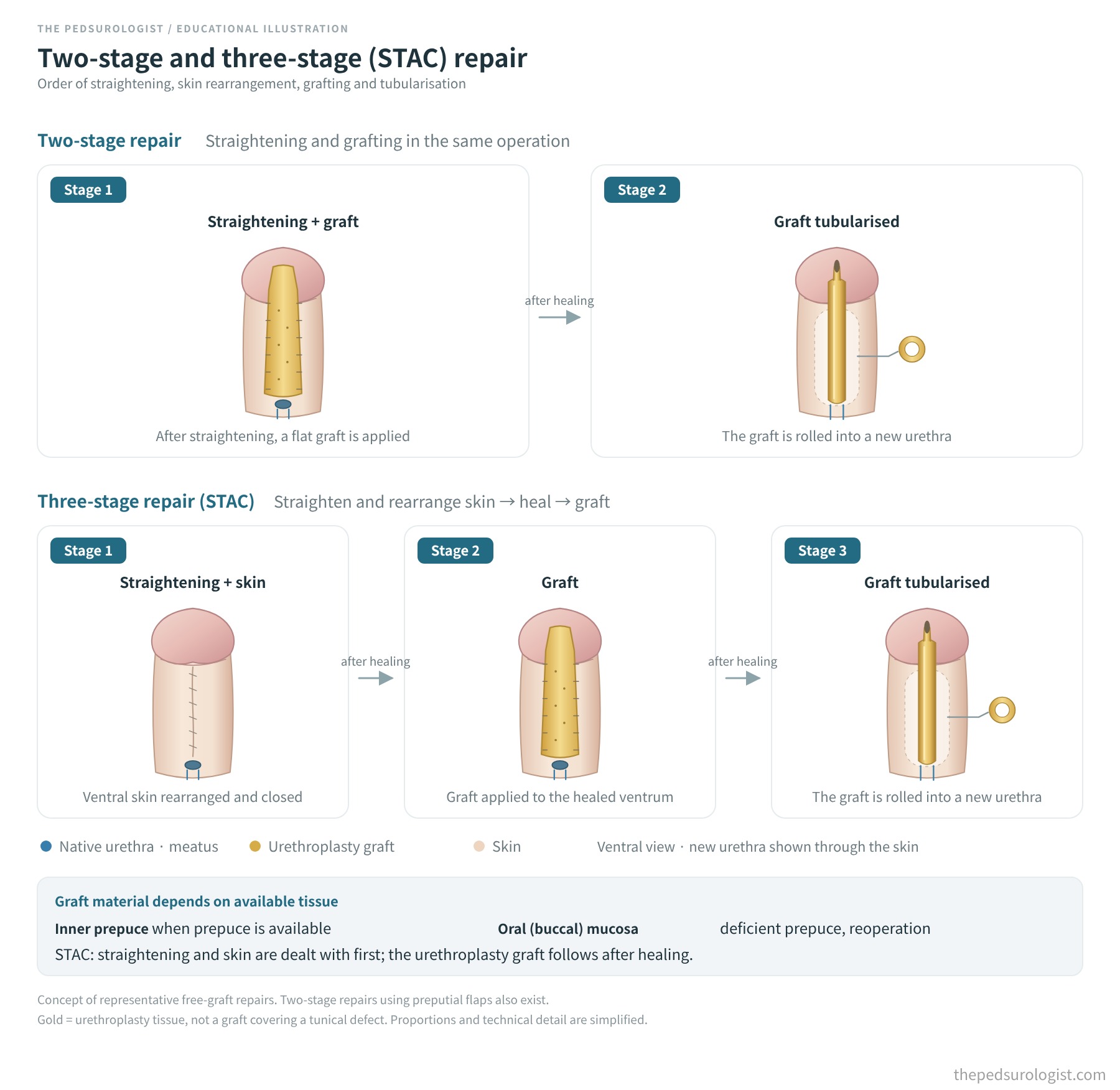
Staged repair does not remove the burden of further surgery. The 13th edition gives 25–75% for additional procedures after planned two-stage repair (p. 1166), and also presents the one-stage argument: even with somewhat more urethroplasty complications, fewer children undergo multiple operations.15
What changed — the author’s reading
The urethral plate itself has not changed. In the author’s view, three things did.
First, how curvature is measured. The 10th edition itself notes that reported degrees of curvature, “including those by this author, most likely were subjectively determined by visual estimate” (p. 3510).3 With repeated artificial erection and measured angles, many penises thought to be straight turned out not to be.
Second, how long results are followed. In one analysis of complications after TIP repair, 81% of urethroplasty complications were diagnosed within a year,24 but recurrent curvature can take years. The early optimism about proximal TIP changed as follow-up lengthened.
Third, the reason for cutting. The plate used to be cut as abnormal tissue. Now it is cut to release traction and length constraints from the plate and surrounding ventral tissues and to allow corporal correction; being histologically normal and not limiting straightening are different questions. If curvature persists after transection, corporal disproportion must be corrected separately (Part 6).
Swipe sideways to read the whole diagram
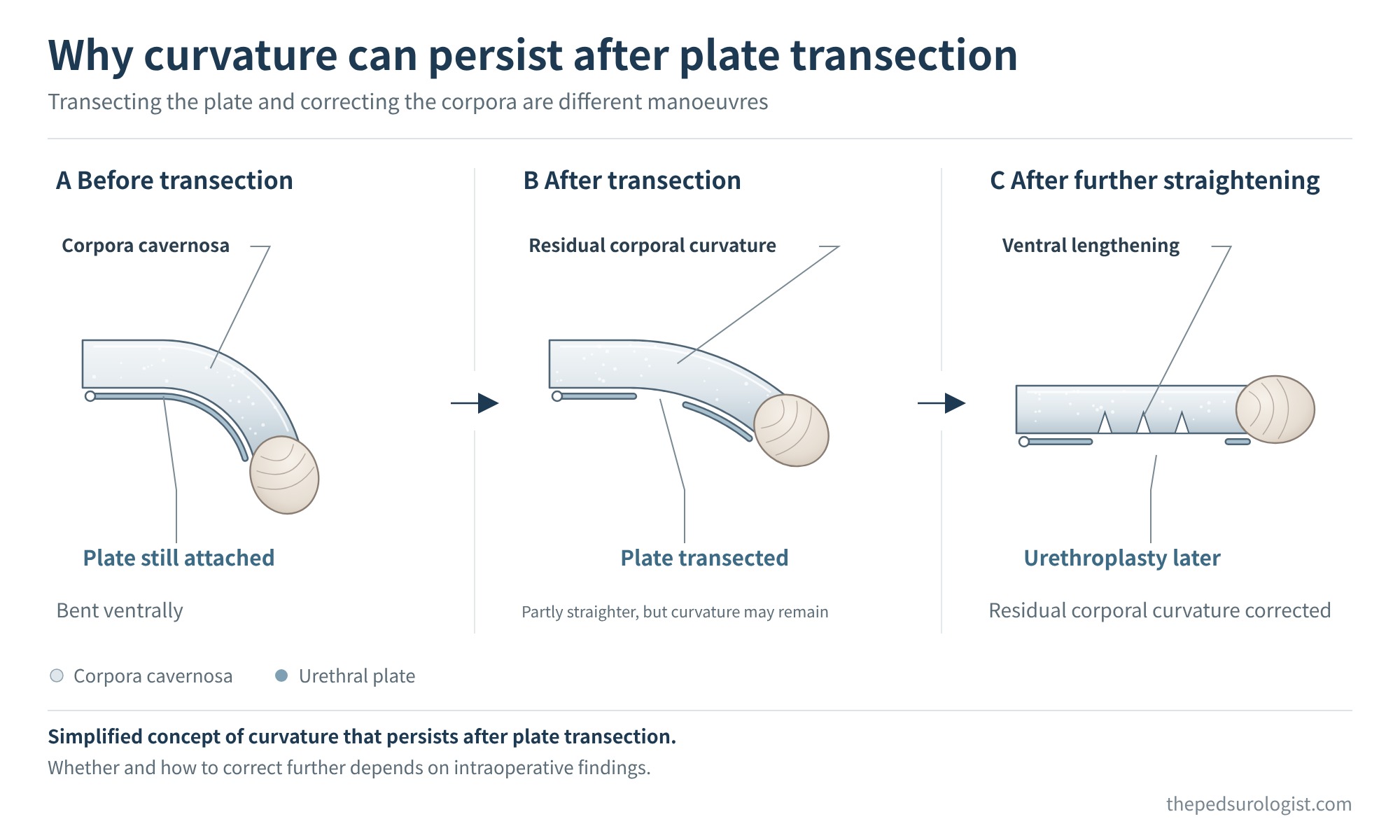
The evidence behind this shift is still limited: most of it comes from retrospective single-centre series, and much of the case for widening and then narrowing proximal TIP came from the same group.
In hypospadias with mild curvature below 30°, the author considers separating and mobilising the urethra off the corpora and performing ventral corporotomy or corporoplasty with the plate kept to be a possible option. What proved problematic earlier was wide elevation of the plate and proximal urethra to straighten curvature beyond 30° while keeping the plate. What the author has in mind here are cases where ventral correction is possible with limited dissection that preserves the plate. The 13th edition uses dorsal plication in this range and does not discuss this approach.
Hypospadias, Part 7 — How much curvature to correct, and in what order
Hypospadias technique — what is standard and what is still debated
References
- 1. Kim SW. Management of Penile Curvature in Hypospadias. Lecture, 2nd surgical workshop of the Korean Society for Genitourinary Trauma and Reconstruction, 2026.
- 2. Hadidi AT. Men behind principles and principles behind techniques. In: Hadidi AT, Azmy AF, eds. Hypospadias Surgery: An Illustrated Guide. Springer; 2004:19-21 (Table 2.1).
- 3. Snodgrass WT. Hypospadias. In: Wein AJ, et al., eds. Campbell-Walsh Urology. 10th ed. Elsevier; 2012. Chapter 130 (Fig. 130-3, 130-7, 130-8; p. 3510).
- 4. Duckett JW. Transverse preputial island flap technique for repair of severe hypospadias. Urol Clin North Am. 1980;7(2):423-430. PubMed 7404875
- 5. Gittes RF, McLaughlin AP. Injection technique to induce penile erection. Urology. 1974;4(4):473-474. doi:10.1016/0090-4295(74)90025-9
- 6. Elder JS, Duckett JW, Snyder HM. Onlay island flap in the repair of mid and distal penile hypospadias without chordee. J Urol. 1987;138(2):376-379. doi:10.1016/s0022-5347(17)43152-1
- 7. Hollowell JG, Keating MA, Snyder HM, Duckett JW. Preservation of the urethral plate in hypospadias repair: extended applications and further experience with the onlay island flap urethroplasty. J Urol. 1990;143(1):98-100. doi:10.1016/s0022-5347(17)39878-6
- 8. Baskin LS, Duckett JW. Dorsal tunica albuginea plication for hypospadias curvature. J Urol. 1994;151(6):1668-1671. doi:10.1016/s0022-5347(17)35341-7
- 9. Snodgrass W. Tubularized, incised plate urethroplasty for distal hypospadias. J Urol. 1994;151(2):464-465. doi:10.1016/s0022-5347(17)34991-1
- 10. Snodgrass W, Patterson K, Plaire JC, Grady R, Mitchell ME. Histology of the urethral plate: implications for hypospadias repair. J Urol. 2000;164(3 Pt 2):988-989. doi:10.1097/00005392-200009020-00017
- 11. Springer A, Krois W, Horcher E. Trends in hypospadias surgery: results of a worldwide survey. Eur Urol. 2011;60(6):1184-1189. doi:10.1016/j.eururo.2011.08.031
- 12. Snodgrass W, Prieto J. Straightening ventral curvature while preserving the urethral plate in proximal hypospadias repair. J Urol. 2009;182(4 Suppl):1720-1725. doi:10.1016/j.juro.2009.02.084
- 13. Bhat A. Extended urethral mobilization in incised plate urethroplasty for severe hypospadias: a variation in technique to improve chordee correction. J Urol. 2007;178(3 Pt 1):1031-1035. doi:10.1016/j.juro.2007.05.074
- 14. Snodgrass WT, Bush NC. Hypospadias. In: Wein AJ, Kavoussi LR, Partin AW, Peters CA, eds. Campbell-Walsh Urology. 11th ed. Elsevier; 2016. Chapter 147 (pp. 3403, 3405, 3408, 3421).
- 15. Long CJ, Zaontz MR. Hypospadias. In: Campbell-Walsh-Wein Urology. 13th ed. Elsevier; 2026. Chapter 56 (pp. 1148-1166; Figs. 56.9, 56.12).
- 16. Snodgrass WT, Granberg C, Bush NC. Urethral strictures following urethral plate and proximal urethral elevation during proximal TIP hypospadias repair. J Pediatr Urol. 2013;9(6 Pt B):990-994. doi:10.1016/j.jpurol.2013.04.005
- 17. Snodgrass W, Bush N. Recurrent ventral curvature after proximal TIP hypospadias repair. J Pediatr Urol. 2021;17(2):222.e1-222.e5. doi:10.1016/j.jpurol.2020.11.030
- 18. Braga LH, Lorenzo AJ, Bägli DJ, et al. Ventral penile lengthening versus dorsal plication for severe ventral curvature in children with proximal hypospadias. J Urol. 2008;180(4 Suppl):1743-1747. doi:10.1016/j.juro.2008.03.087
- 19. Long CJ, Chu DI, Tenney RW, et al. Intermediate-term followup of proximal hypospadias repair reveals high complication rate. J Urol. 2017;197(3 Pt 2):852-858. doi:10.1016/j.juro.2016.11.054
- 20. Castagnetti M, El-Ghoneimi A. Surgical management of primary severe hypospadias in children: systematic 20-year review. J Urol. 2010;184(4):1469-1474. doi:10.1016/j.juro.2010.06.044
- 21. Bracka A. Hypospadias repair: the two-stage alternative. Br J Urol. 1995;76(Suppl 3):31-41. doi:10.1111/j.1464-410x.1995.tb07815.x
- 22. Snodgrass W, Bush N. 2-stage STAG vs 3-stage STAC for primary proximal hypospadias repair. J Pediatr Urol. 2025;21(2):522-525. doi:10.1016/j.jpurol.2024.10.023
- 23. Snodgrass W, Bush N. Efficacy of three corporotomies to correct ventral penile curvature. Experience in 400 patients with severe hypospadias. J Pediatr Urol. 2026;22(2):105722. doi:10.1016/j.jpurol.2026.105722
- 24. Snodgrass W, Villanueva C, Bush NC. Duration of follow-up to diagnose hypospadias urethroplasty complications. J Pediatr Urol. 2014;10(2):208-211. doi:10.1016/j.jpurol.2013.11.011