
The previous note showed that the current hypospadias chapter carries only five graded recommendations. Of those five, exactly one concerns how to operate — "use the treatment algorithm to select the surgical technique" (Strong). The other four are about distinguishing DSD, counselling parents, correcting curvature beyond 30 degrees, and long-term follow-up.
So what do the decisions actually made in the operating room rest on? How wide a urethral plate can be preserved, which side the curvature is corrected from, whether a proximal repair is done in one stage or two. This note follows the chapter's technical text together with the form each statement takes in the document.
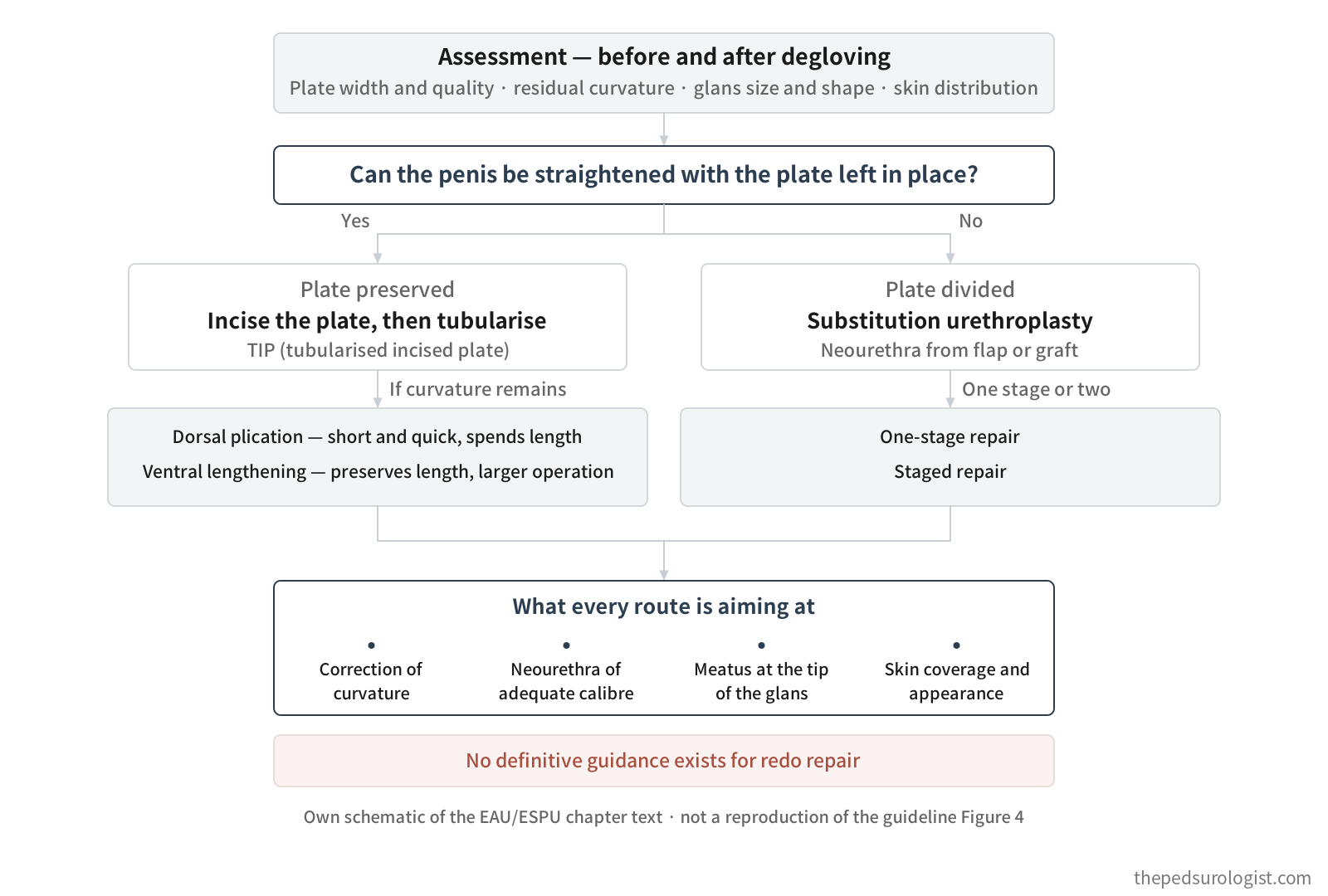
What is the surgery aiming at?
The chapter lists four objectives for hypospadias repair.
- Correction of penile curvature
- Formation of a neourethra of adequate calibre
- Bringing the meatus to the tip of the glans
- Satisfactory skin coverage and an overall acceptable cosmetic result
Set side by side, one thing becomes clear. Moving the meatus to the tip is one objective of four, and the item at the top of the list is curvature. It is the same structure as the severity argument in the previous note: the operation, like the assessment, is not about the meatus alone.
These objectives also compete with one another. Preserve the urethral plate and tubularisation is easier, but ventral shortness may remain; divide the plate and curvature correction becomes straightforward, but the urethra has to be built from other tissue. Most of the technical debate sits on top of that trade-off.
The evidence behind technique, at a glance
| Decision | Current EAU/ESPU chapter | Form in the document | How to read it |
|---|---|---|---|
| Choice of technique | Use the treatment algorithm (Figure 4) | Strong | The only technical recommendation |
| When the plate can be preserved | TIP (tubularised incised plate) is the treatment of choice — the chapter words this as distal and mid-shaft | Narrative text | Broadest consensus |
| TIP for proximal disease | "Currently subject of debate" | Narrative text | No consensus |
| Measuring curvature | A goniometer or smartphone angle measurement appears to improve accuracy | Narrative text | Not standardised |
| Correcting curvature | Recurrent curvature reported in 5% after ventral lengthening and 25% after dorsal plication | Narrative text | The harder cases went there, and it still recurred less |
| Proximal: one-stage vs staged | Overall complications 42% versus 21% | Narrative text | No selection criteria given |
| Redo repair | "No definitive guidelines can be provided" | Explicit absence of guidance | Surgeon judgement throughout |
| Severity and complications | Complication rates correlate with severity and are not limited to childhood | LE 1a | The strongest evidence in the chapter |
Swipe sideways to read the whole diagram
1. TIP — when the plate can be preserved
Snodgrass's tubularised incised plate (TIP) incises the urethral plate in the midline to gain width and then tubularises it. The manoeuvre itself is simple, yet it displaced a large part of the flap repertoire that preceded it. The current chapter describes it as the treatment of choice wherever the plate is preserved.
The chapter words that indication as distal and mid-shaft. Set against the point that severity is not a question about the meatus alone, the wording looks inconsistent — but it reads better as a proxy for plate quality and for the curvature left after degloving than as the condition itself. What actually decides is whether the penis can be straightened with the plate left in place; distal and mid-shaft simply name the range in which that condition usually holds.
For the same technique applied proximally, the wording changes. The chapter calls it "currently subject of debate." Two questions sit behind that phrase. Can a plate that is narrow and of poorer quality proximally yield a neourethra of adequate calibre? And does leaving the plate in place return later as ventral shortness and recurrent curvature?
This is where the trade-off set out at the start is sharpest. Divide the plate and curvature correction becomes easier while urethral reconstruction becomes harder; preserve it and the reverse holds. Because no figures yet show which cost is the larger, two surgeons can look at the same proximal anatomy and perform different operations.
2. Curvature — measuring it and correcting it
Curvature splits into two separate problems: measuring the angle, and correcting it.
Measuring
Visual estimation varies considerably between observers. The chapter notes that a goniometer or smartphone angle measurement appears to improve accuracy. The cautious verb is itself informative: more accurate, probably — but nothing has been settled as the standard.
The timing of measurement is also unresolved. The angle differs before and after degloving, and differs again with the pressure used to induce an artificial erection. Without agreement on which measurement to record, it is hard to claim that one centre's "30 degrees" is the same as another's. That is part of why the previous note described 30 degrees as a working clinical threshold rather than a boundary drawn by nature.
Correcting
There are broadly two routes. Dorsal plication is short and quick but spends penile length. Ventral lengthening — incising the ventral tunica and grafting — preserves length but is a larger operation with a different complication profile.
In the data the chapter cites, recurrent curvature was reported in 5% after ventral lengthening and 25% after dorsal plication: a fivefold difference.
The two techniques are not applied to the same patients, so this compares two groups selected by different indications. Ask which arm the comparison favoured, though, and the picture changes. Larger curvatures are usually taken to ventral lengthening, so the harder anatomy was probably concentrated in that arm. Put plainly: ventral lengthening took the harder cases and still recurred less. The arm with the worse starting conditions had the better result, so the gap between 5% and 25% may be smaller than the truth rather than larger. On recurrent curvature alone, the direction is clear.
So the open question is not which technique recurs less. It is whether that advantage is worth what it costs. Ventral lengthening means incising the tunica and placing a graft; what plication spends is penile length. Recurrence alone cannot weigh the two against each other. Until penile length after growth, erectile function and the patient's own satisfaction have been compared on the same terms, the choice stays open.
Nor are these the only two options. Faced with the same curvature of around 30 degrees, a good many surgeons divide the plate instead. An angle on its own does not narrow the technique. Plate width and quality, glans size, and which cost the surgeon regards as the greater all enter into it — which is why no numerical band can be drawn with "from here on, this operation" written beside it.
3. Proximal repair — one stage or two?
Proximal hypospadias is where the chapter's numbers are most candid. In the comparison it cites, overall complications were 42% after one-stage repair and 21% after staged repair. The individual complications point the same way.
| Complication | One-stage | Staged |
|---|---|---|
| Fistula | 19% | 12% |
| Meatal stenosis | 17% | 8% |
| Urethral stricture | 13% | 8% |
On the numbers alone, staged repair looks better. Yet the chapter does not recommend staged repair on the strength of them — and could not.
Which route is taken depends on the width and quality of the plate, the curvature remaining after degloving, glans circumference, the state of the scrotal skin, and the surgeon's experience. And that choice feeds straight back into the complication rate. With no comparison adjusted for whether the difficult anatomy went one-stage or staged, the effect of the technique cannot be separated from the effect of patient selection in the gap between 42% and 21%.
In one sentence: staged repair is reported with fewer complications proximally, but whether that means staged repair should be chosen is not something these data can tell us.
4. Redo repair — "no definitive guidelines"
One sentence in the chapter reads: "No definitive guidelines can be provided for redo hypospadias repair."
It is not often that a guideline records its own inability to guide, and the reason is not hard to see. Redo cases arrive under one label with different previous operations, different scar distributions, different amounts of remaining skin and plate, strictures of different site and length, and different numbers of fistulae. What cannot be classified cannot be compared, and what cannot be compared cannot be recommended.
Practically, the sentence means one thing: the outcome of a redo repair is not underwritten by any guideline. Which makes how tissue is left at the first operation — how much dartos and skin is spent and how much is kept — a condition of the next one.
Complications track severity
The statement carrying the highest level of evidence in this chapter is not about technique at all. Complication rates correlate with the severity of the hypospadias and are not limited to childhood — and that carries LE 1a.
One line, two messages. First, that describing severity accurately comes before saying anything about prognosis; severity is therefore not a problem of taxonomy but of whether prognosis can be discussed at all. Second, that "there were no problems straight after surgery" does not underwrite the result. That single line is why long-term follow-up was the one durable Strong recommendation in the previous note.
Questions that remain in the operating room
| Question not yet settled | Current state |
|---|---|
| How narrow or poor a plate can still be preserved | No quantitative threshold |
| Where the limit of TIP lies proximally | Debated (stated in the chapter) |
| Which measurement of curvature to record and compare | No agreement |
| Whether lower recurrence after ventral lengthening still wins once length, function and satisfaction are counted | Nothing beyond recurrence compared |
| What should decide one-stage versus staged proximally | No adjusted comparison |
| Which technique to choose at redo repair | Guidance absent (stated in the chapter) |
What I take from the technical text
- Plate-preserving TIP, wherever the plate can be kept, has reasonably broad consensus. Most other technical decisions are left to narrative text and to the surgeon.
- Curvature is the first of the four operative objectives. Recording the angle as objectively as possible — and together with the point at which it was measured — is the best available practice today.
- Ventral lengthening generally takes the harder curvatures and still recurred less, so on recurrence alone it comes out ahead. What has not been compared on the same terms is penile length and long-term function.
- Proximally and at redo repair the guideline does not answer. What remains is surgeon judgement, and judgement has to be recorded before it can be compared.
- Complications track severity and do not end in childhood. That line carries the strongest evidence in the chapter.
The closing sentence of the previous note applies to technique as well. Hypospadias surgery is still closer to evidence-informed surgical judgement than to guideline-based surgery. What can be done is to keep clear which parts of that judgement rest on evidence and which do not.
A note on currency
The EAU Paediatric Urology guideline currently published is the 2026 edition, and hypospadias is not among the sections marked as updated for 2026. The statements and figures here follow the current chapter text, and the percentages quoted are as the chapter summarises them. The source series differ in case mix and length of follow-up, so the direction of the difference is safer to read than the absolute values.
Guideline text last checked: 13 October 2026.
Guideline Notes — What the hypospadias guidelines say, and what they do not
Hypospadias, Part 1 — What are we aiming at · Part 2 — What counts as a good result · Part 3 — How should severity be described
References
- EAU Guidelines on Paediatric Urology. Hypospadias. European Association of Urology, 2026 edition.
- EAU Guidelines on Paediatric Urology. Congenital penile curvature. European Association of Urology, 2026 edition.
- EAU Guidelines on Paediatric Urology. Summary of changes, 2026 edition.
- Snodgrass W. Tubularized incised plate urethroplasty for distal hypospadias. J Urol. 1994;151(2):464-465.