
Many parents first notice it at bath time or during a nappy change: their son's penis looks very small and seems to sit down inside the surrounding skin. Press on the skin around it and it appears; let go and it sinks back. If you have found yourself searching "is this only my child," this page is for you.
The short answer is that in many children this is a condition that can be watched and allowed to grow. But there are also cases where waiting does not help — and the two can look alike from the outside while having different causes. This page explains how the two are told apart, and when surgery is considered.
What is a concealed penis?
A concealed penis is one that sits hidden within the surrounding skin and fat, so that it does not show as much as it should. A penis that is itself abnormally small — micropenis — is a different condition and is not included here. Micropenis follows a separate pathway involving hormonal evaluation and treatment; concealed penis is what remains once micropenis has been ruled out.
The condition was first described in 1919, yet more than a century later doctors still do not agree on what to call it. Buried penis, hidden penis, concealed penis and inconspicuous penis are all in use; the form in which the scrotal skin runs up onto the underside of the penis is sometimes called a webbed penis. You may hear different terms at different clinics.
The reason the naming has never settled is that this is not one condition but a spectrum, produced by several contributing factors overlapping. Which factors are present, and how strongly, shapes how each child looks.
Why does it look this way?
It helps to think of the causes along two axes: the size of the penis, and anatomical abnormalities. In practice, most children who come to clinic have both to some degree. Which one dominates is what guides the decisions that follow.
The first axis — penile size
When the fat pad above the penis is thick, the penis sinks into it. But the important point is this: the problem is not the thickness of the fat by itself, but the ratio between penile size and the fat around it. The same fat pad will not hide a larger penis, and a smaller penis will be hidden by a pad that is not especially thick.
In fact, among children seen for concealed penis, it is not unusual for the penis to be somewhat smaller than average for age. Not small enough to be called micropenis, but below the mean.
There is a reason this is rarely spelled out in clinic. Penile size in children is usually judged by stretched penile length — the length measured with the penis gently pulled straight. In concealed penis, the very anatomy that hides the penis also makes it hard to stretch and measure accurately. Size is therefore assessed by examination findings taken together rather than by a single number.
When this axis is the main cause, the logic runs in reverse as well: as the penis grows, exposure improves with it. Children who can safely be watched are mostly in this group.
The second axis — anatomical abnormalities
These are structural causes that prevent the penis from coming out regardless of its size. When this axis is prominent, waiting does not resolve it.
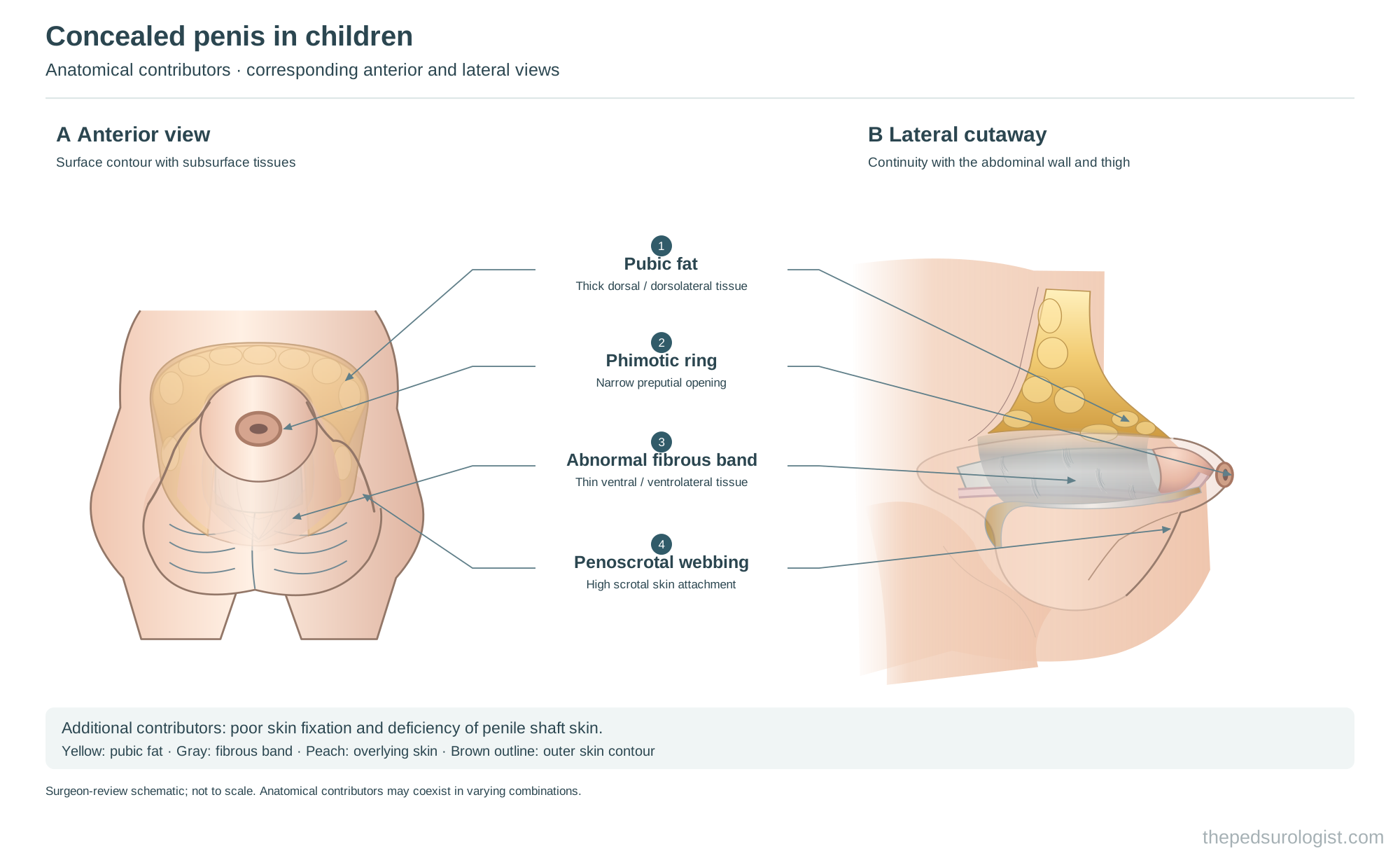
A fibrous band pulling the penis inward (③ in the figure). A band of tissue running from above the pubic bone down beneath the penis toward the scrotum tethers the shaft inward. With this band present, the penis cannot come out to its full length. Higher up it is continuous with thick fat; lower down it appears as a thin cord.
Fusion of penile and scrotal skin (④). When scrotal skin attaches high on the underside of the penis, the angle between penis and scrotum is lost and the penis appears short. This is the form called webbed penis.
A narrow foreskin opening (②). When the opening of the foreskin is tight, urine pools inside before it drains. The balloon-like swelling seen during voiding comes from this.
Less commonly, there may be too little skin to cover the shaft, or the skin may not be properly anchored in place. The fat labelled ① in the figure belongs to the first axis — the ratio to penile size.
When the issue is a mismatch between penile size and fat thickness with no anatomical abnormality, things may well improve as the penis grows. Anatomical causes such as a fibrous band or skin fusion do not resolve with waiting. Which axis is the main problem can be judged on examination — and that judgement is the starting point for deciding about surgery.
What problems can it cause?
A concealed penis is not in itself harmful. It can, however, come with the following difficulties.
Trouble voiding. Urine sprays, or the child struggles to hold the penis to direct the stream. In some children the foreskin balloons during voiding and urine trickles out afterwards — sometimes it has to be pressed out by hand. Pooled urine makes infection more likely.
Recurrent inflammation. A hidden penis is hard to wash and keep clean. Inflammation of the glans and foreskin can recur.
The child's own awareness. Children compare themselves with others earlier than we expect. Some become self-conscious once they start kindergarten or school.
Ballooning of the foreskin or pooled urine during voiding · recurrent inflammation of the glans or foreskin · pain on voiding · a past urinary tract infection · a child who is distressed or self-conscious about it
How is surgery done?
More than thirty operations have been described, and the incisions and stitches vary. But four things matter in nearly all of them.
- Releasing the fibrous band — removing the tissue that was pulling the penis inward
- Repositioning the skin — re-arranging the skin so that it covers the shaft properly
- Relieving the narrow foreskin opening — removing the cause of pooling and ballooning
- Fixation stitches — anchoring the penis so it does not retract again
Depending on the child, the fat above the penis may also be trimmed and the junction between penis and scrotum reconstructed.
The differences between operations and the evidence behind them, together with the technique I use and how I came to choose it, are set out separately on the page for clinicians.
What surgery fixes — and what it does not
This is worth understanding before surgery. Satisfaction afterwards depends less on surgical skill than on what was expected going in.
What surgery fixes. When there is a clear anatomical problem — a fibrous band, skin fusion, a narrow foreskin opening — correcting it restores the appearance and improves exposure. Voiding difficulties and hygiene problems usually improve alongside.
What surgery does not fix is size. Surgery reveals what was hidden; it does not make the penis larger. In a study that followed 61 boys for several years, actual penile length was unchanged by surgery — and remained so a decade later.
For that reason, when the main concern is "it looks small" and there is no clear anatomical problem, surgery is not the recommended first step. These children have a first-axis problem — a mismatch between penile size and fat thickness — and the better course is to secure penile growth first and then reassess whether exposure still needs correcting.
There are reports of the penis looking well exposed immediately after surgery and then sinking back over time. This mostly happens when surgery is pushed through despite a poor ratio between penile size and fat thickness. Fat trimmed at surgery regrows as the child grows, and the penis is buried again. This operation is done to improve exposure now. A child should not have surgery only to be told afterwards that things will improve with time. That is why I explain this beforehand and recommend surgery only for children who can genuinely benefit from it.
When is surgery done?
To be direct: there is no international standard that says "operate at this age." The European paediatric urology guideline contains no recommendation on the timing of surgery for concealed penis. You may therefore hear different advice from different doctors depending on their philosophy of care, and in practice the timing is often decided by the symptoms and the discomfort the child is experiencing.
The things that actually influence timing are these.
Whether there are symptoms. Pooling urine or recurrent inflammation reduces the case for waiting.
How pronounced the anatomical problem is, and how large the penis is. This is the two-axis assessment again. The clearer the anatomical problem, the more predictable the benefit of surgery; the more adequate the penile size, the better the result holds up.
The child's stage of development. One study found that parents were more consistently satisfied when surgery was done in infancy than in adolescence; another survey found that parents preferred an age at which the child could take part in the decision — before secondary school.
In other words, this is not a question with a single fixed answer but one decided together with your doctor, weighing the severity of the anatomical problem and the size of the penis.
This may be the most practical point on this page. Having a routine circumcision while a concealed penis is present is not recommended. The European paediatric urology guideline states this explicitly and with a strong recommendation. There are two reasons: the foreskin may be needed for a later corrective operation, and circumcising an unrecognised concealed penis can leave the shaft trapped behind the scar. If you are considering circumcision, please see a paediatric urologist first.
Frequently asked questions
Will a concealed penis improve on its own as my child grows?
If the issue is a mismatch between penile size and the surrounding fat with no anatomical abnormality, exposure may well improve as the penis grows. If there is an anatomical cause — fused penile and scrotal skin, or a fibrous band pulling the penis inward — waiting will not resolve it. The two can be distinguished on examination.
Will surgery make the penis bigger?
No. Surgery reveals a penis that was hidden; it does not enlarge it. Long-term follow-up studies show no change in actual penile length before and after surgery. If size itself is the main concern, surgery is unlikely to be the answer.
My son has a concealed penis. Can he have a circumcision first?
It is not recommended. The European paediatric urology guideline strongly advises against routine circumcision when a penile abnormality such as a concealed penis is present. The foreskin may be needed for later reconstruction, and an ill-judged circumcision can leave the shaft trapped behind scar tissue.
At what age is surgery best?
There is no internationally defined age. The decision is made with your doctor, taking into account whether there are symptoms, how pronounced the anatomical problem is, how large the penis is, and whether the child has become aware of it.
The tip of the penis balloons when he urinates. Is that a concern?
This means urine is pooling inside the foreskin before draining; sometimes it has to be pressed out by hand. Pooled urine makes recurrent inflammation more likely, so it is worth having it assessed.
Will losing weight help?
If the main problem is the ratio between penile size and fat, it can. But a child is still growing, and aggressive weight loss is not advised. The better approach is to let the body's proportions change naturally with growth.
Can the penis sink back after surgery?
If surgery is done while the ratio between penile size and fat thickness is poor, the fat can regrow as the child grows and bury the penis again. That is why this is explained beforehand and surgery is recommended only for children who can genuinely benefit. When the anatomical problem is clear and the penis is of adequate size, the result holds up well.
A series for clinicians covers this subject with the evidence behind it.
Part 1 — Terminology, aetiology, classification, and penile size
Part 2 — Indications, timing, and technique
Written for clinicians.
References
- EAU Guidelines on Paediatric Urology. Phimosis and other abnormalities of the penile skin. European Association of Urology, 2026.
- Hadidi AT. Buried penis: classification surgical approach. J Pediatr Surg. 2014;49(2):374-379.
- Herndon CDA, Casale AJ, Cain MP, Rink RC. Long-term outcome of the surgical treatment of concealed penis. J Urol. 2003;170(4 Pt 2):1695-1697.
- Cimador M, Catalano P, Ortolano R, Giuffrè M. The inconspicuous penis in children. Nat Rev Urol. 2015;12(4):205-215.
- Kim SW. Concealed penis from the perspective of pediatric urology. Urology Digest. 2021;2(2). (in Korean)