
On the night you come home after hearing the diagnosis, this is the question most parents arrive at. Why did this happen? Was it something I did during the pregnancy?
The short answer first: in most cases a single cause cannot be identified, and it was not something a parent could have avoided. Here is why that can be said.
The urinary channel is built in early pregnancy
A boy's urinary channel is built in early pregnancy. The urethra within the shaft of the penis does not start out as a tube: a band of tissue along the underside opens into a long groove, and the two edges of that groove then meet in the middle and close into a channel. The urethra within the glans is completed by a somewhat different route, but what matters here is that all of it takes place in early pregnancy.
If that closing does not run to completion, the groove stays open underneath. The opening ends up lower down instead of at the tip, and the foreskin, which closes last on the underside, is left only on top. In hypospadias the position of the opening, curvature of the penis and an uneven distribution of foreskin often appear together. Rather than three independent problems coinciding, they are best understood as several traces left by a disturbance of genital development in the same period.
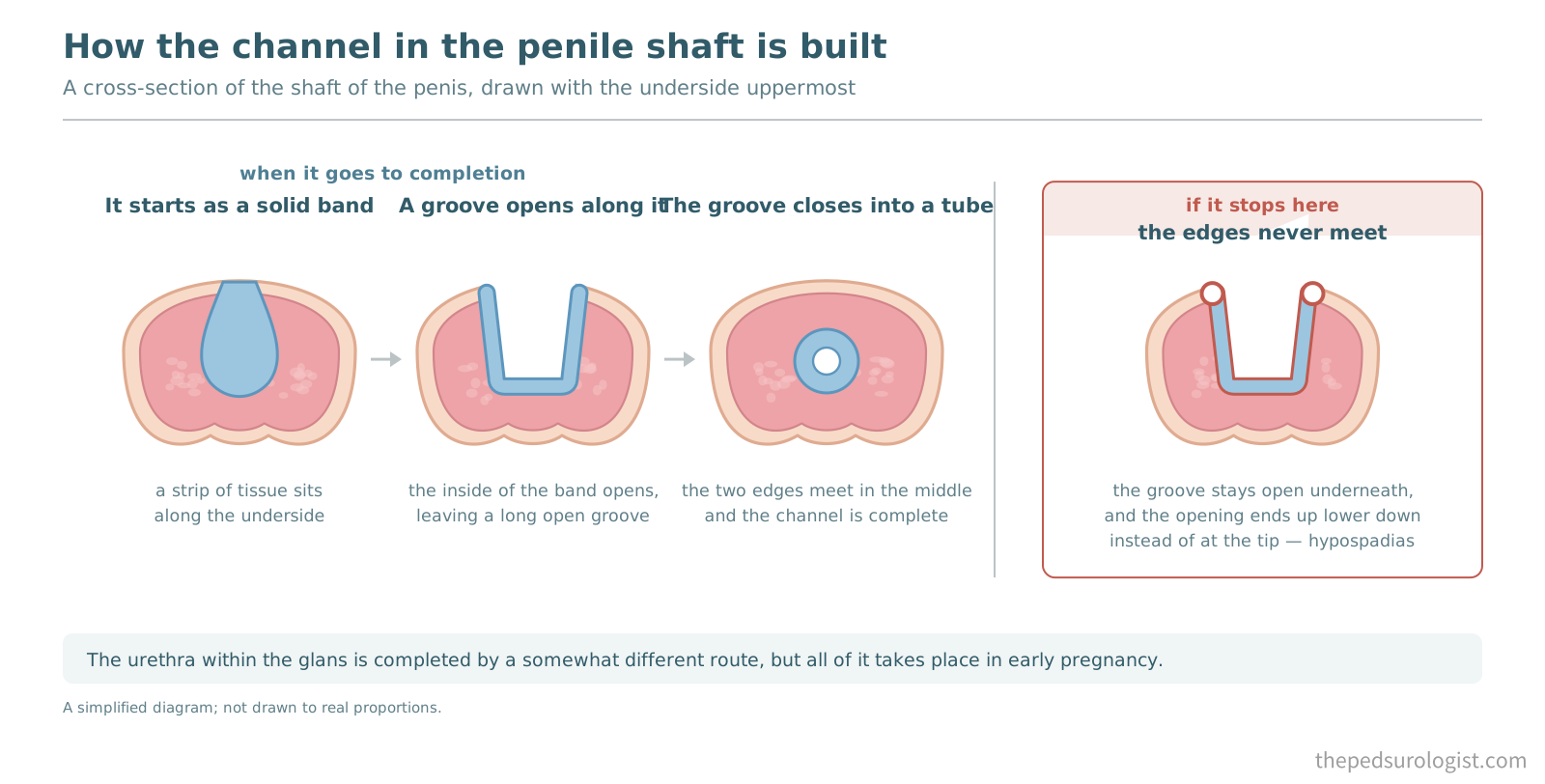
This takes place mainly in early pregnancy. The sickness that kept you from eating, a food you could not manage, a medicine taken before you knew, folic acid started late — there is no evidence that any of these directly causes ordinary hypospadias. There is no need to go back through the pregnancy looking for the moment it happened.
What is known about causes
Some things do come up repeatedly in research. But none of them is at the level of "this is what caused it." Being associated with something is not the same as being caused by it.
What is observed most repeatedly are conditions related to placental function. Hypospadias is reported more often when a baby was born small, when growth in the womb was slow, or when there was gestational hypertension or pre-eclampsia. The placenta and the baby's hormonal environment have been proposed as the link, but in any individual child this cannot be confirmed as the direct cause.
What matters here is that these are conditions of a pregnancy, not choices made during one. They are not easily within a parent's control through how they lived.
This comes up often. In some animal studies, exposure to particular endocrine-disrupting chemicals interferes with androgen signalling and produces changes resembling hypospadias.
In humans the evidence for naming any one substance as a direct cause is much weaker. Pooling the studies gives only a small increase in risk, and the findings disagree with one another. These substances are everywhere in ordinary life, which makes it very hard to study any one of them on its own.
So: possible, but nowhere near the point of naming a particular product or exposure. There is no basis for blaming yourself for something you used.
Was it the IVF?
Hypospadias has been reported more often after assisted reproduction, but the studies disagree. Some find an association; others find none.
Part of why this is hard to read: parents who conceive through treatment tend to be older, and twins and preterm birth are more common. Those conditions carry their own associations, so separating the effect of the treatment from the effect of what led to the treatment is not straightforward.
Is it inherited? What about a next child?
It is somewhat more common where there is a family history. Figures vary between studies, but in roughly 10% of boys with hypospadias another family member is reported to have had it too. That does not make it a mostly inherited condition: in most boys no single causative gene can be found.
A great deal of work has gone into looking for the genes involved, but a clear genetic abnormality is found in only a minority. It does not appear to be a single gene passed down, but several predispositions combining with the conditions of a particular pregnancy.
So the chance for a next boy is higher than in the general population, but it varies with the family history and the degree of hypospadias, and there is no single recurrence figure that applies to every family.
One thing worth checking
Where hypospadias occurs together with neither testis being palpable in the scrotum, testing is needed to look for an underlying difference in sex development. In that situation the team caring for your baby will plan further assessment soon after birth.
This is uncommon and will not apply to most children. But where it does apply, finding out early matters, so this is the one point worth asking your doctor about directly.
To put it together
Hypospadias happens because the building of the urinary channel in early pregnancy did not run to completion. Why it stopped is, in most cases, not knowable.
What has been associated with it concerns the placenta and the conditions of the pregnancy; it is not caused by something done or left undone during pregnancy. Endocrine disruptors remain a possibility but not one that can be pinned to any particular exposure, and heredity is a predisposition rather than an inheritance — most boys have no family history.
Being told the cause is unknown can sound unsettling. But hypospadias is generally understood as a condition in which several genetic, developmental and pregnancy-related factors act together, so not finding one cause is the usual outcome rather than a gap. There is no basis for going back over the pregnancy and settling on one thing you did.
What the operation actually corrects, and what to know beforehand, is set out in Hypospadias: a guide for parents; severity is covered in Is my son's hypospadias a severe case?
The embryology and the evidence behind each proposed cause are covered in detail in the clinical series.
Part 4 — How the urethra is built
Part 5 — Is it really increasing, and why does it happen?
Written for clinicians.
References
- van der Zanden LFM, van Rooij IALM, Feitz WFJ, Franke B, Knoers NVAM, Roeleveld N. Aetiology of hypospadias: a systematic review of genes and environment. Hum Reprod Update. 2012;18(3):260-283.
- Li Y, Sinclair A, Cao M, et al. Canalization of the urethral plate precedes fusion of the urethral folds during male penile urethral development: the double zipper hypothesis. J Urol. 2015;193(4):1353-1359.
- Schnack TH, Zdravkovic S, Myrup C, et al. Familial aggregation of hypospadias: a cohort study. Am J Epidemiol. 2008;167(3):251-256.
- EAU Guidelines on Paediatric Urology. Hypospadias. European Association of Urology, 2026.