
Many parents are startled to discover — during a newborn exam or somewhere along the way — that they can't feel one of their baby's testicles in the scrotum. Undescended testis is one of the most common conditions seen in pediatric urology, affecting an estimated 2 to 3 out of every 100 newborn boys. With every child's health mattering more than ever in an era of falling birth rates, early detection and treatment at the right time matter more than anything else.
What Is an Undescended Testis
The testis forms near the kidney (inside the abdominal cavity) during fetal development, and descends into the scrotum through a process that begins around week 8 of pregnancy and continues around the time of birth. When this process doesn't happen normally, the testis is left in the groin or abdomen rather than the scrotum — this is called an undescended testis, or cryptorchidism. It's more common on one side only (roughly 70-90% of cases), but 10-25% of cases affect both sides.
Why Does It Happen
This used to be explained mainly as a problem with male hormone secretion or action, but structural causes are now considered more important. A structure called the gubernaculum needs to attach normally to the floor of the scrotum for the testis to descend properly. In an undescended testis, the distal end of this structure attaches to the upper scrotum or groin instead of the scrotal floor, which is the main reason the testis fails to reach the scrotum.
Curious how our understanding of this mechanism has evolved over the past half-century? See In depth: The Shifting View of Pathogenesis and Prognosis (For Clinicians)
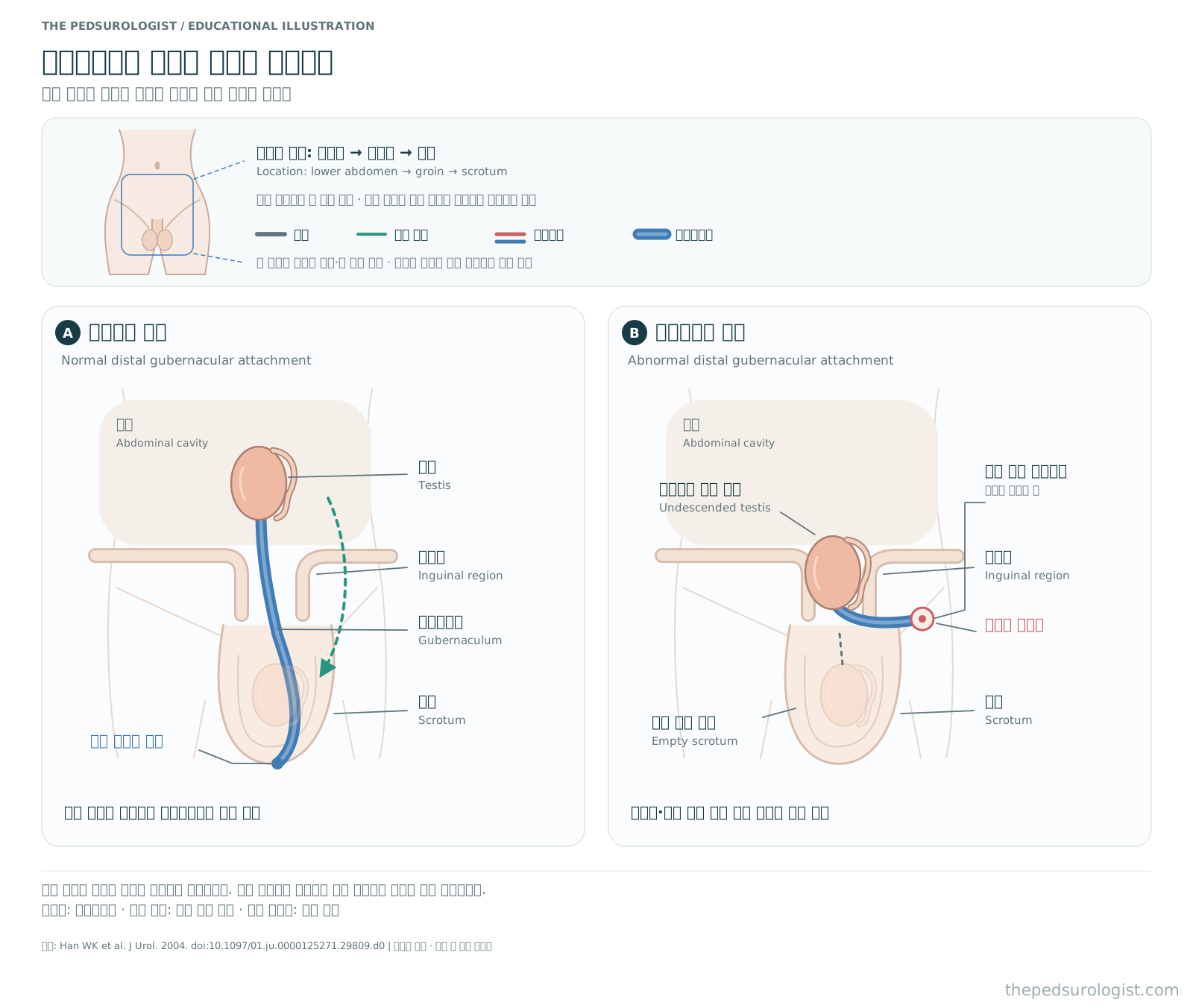
A Condition Often Confused With It — Retractile Testis
As well-child checkups have become more common, more families are being referred for a suspected undescended testis — but a substantial share of these turn out to be a retractile testis instead. This happens when the muscle that pulls the testicle upward (the cremaster muscle) becomes overactive around 12 months of age, causing the testis to move up and down with each contraction. The cause and outlook are entirely different from a true undescended testis, and it almost always resolves on its own without surgery. If your child has been diagnosed with this, there's no need for serious concern — though some cases do progress to a true undescended testis later, so periodic follow-up is still recommended.
Can We Just Wait and See If It Comes Down?
There's a brief window, roughly 2 to 3 months after birth, when male hormone levels temporarily rise — sometimes called "mini-puberty." During this window, milder cases of undescended testis have a genuine chance of descending further.
But if the underlying structural problem — the gubernaculum attached in the wrong place — is still there, a testis that descends temporarily under this hormonal push will almost inevitably ascend again. So it's reasonable to watch and wait until around 3 months of age, but after that the position needs to be tracked continuously rather than left to chance.
Even a testis that was in a normal position at birth can gradually move upward as the child grows. It's worth checking periodically through 6 to 12 months of age to make sure the testis is staying where it should.
Treatment — Orchiopexy
Both the American Urological Association (AUA) and the European Association of Urology / European Society for Paediatric Urology (EAU/ESPU) recommend surgery between 6 and 12 months of age, no later than 18 months. Hormone injections were once tried as a way to bring the testis down, but as the understanding shifted toward a structural cause — an abnormal gubernacular attachment rather than a hormonal one — and as it became clear that testes which descended temporarily under hormone treatment tended to ascend again, this approach has largely been abandoned. Surgery is effectively the only treatment today.
Curious why this specific window — 6 to 12 months — was chosen? See Guideline Analysis and the Pathophysiology of Surgical Timing (Evidence & Papers)
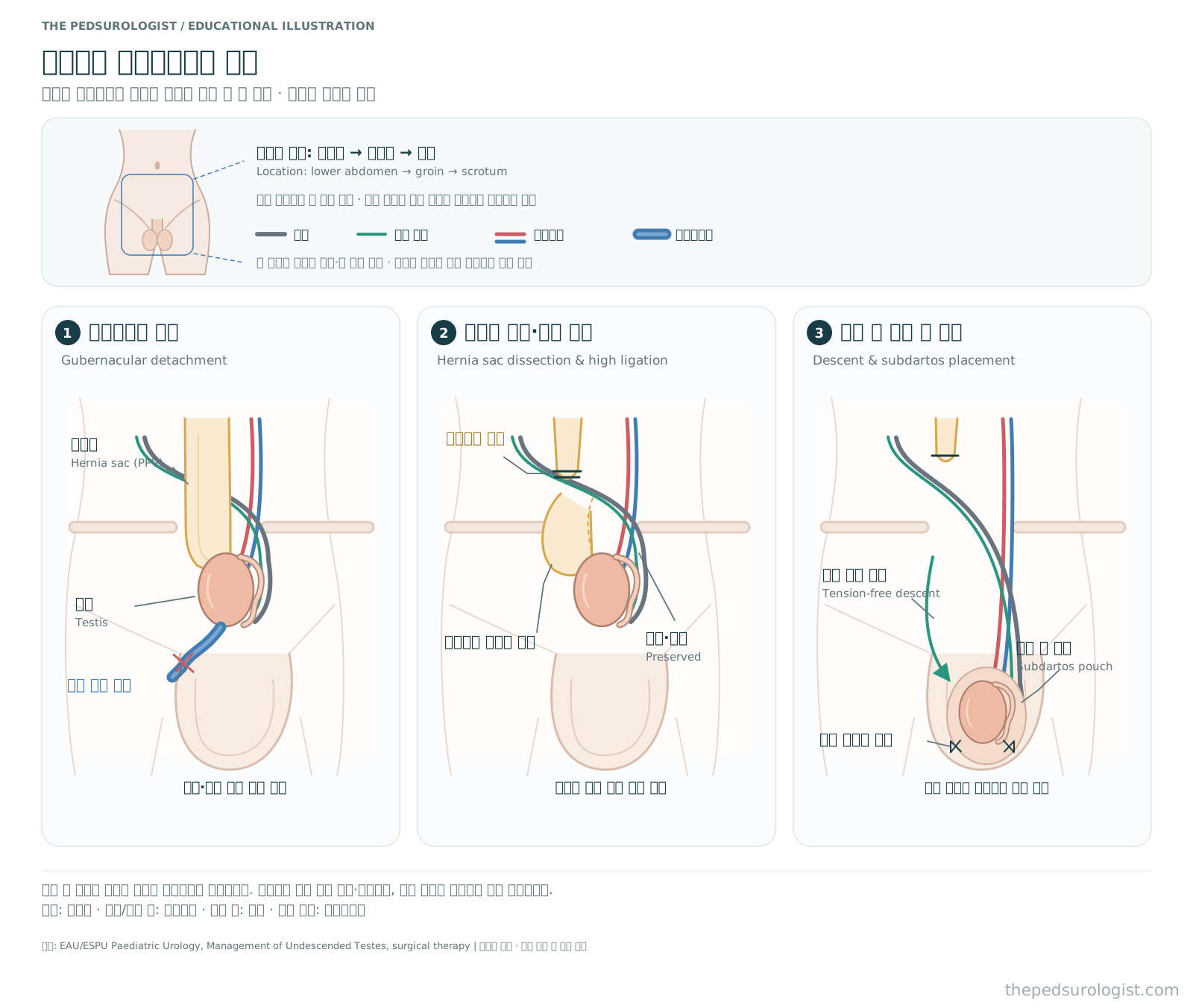
The operation typically involves three steps. First, the gubernaculum pulling on the testis is divided to free up enough length for it to reach the scrotum. Second, since a hernia is present in a large share of cases (reported as high as 95% in the literature), this hernia sac is separated from the testis to create room for the vessels to stretch. Third, a tunnel is created into the scrotum and the testis is moved into place.
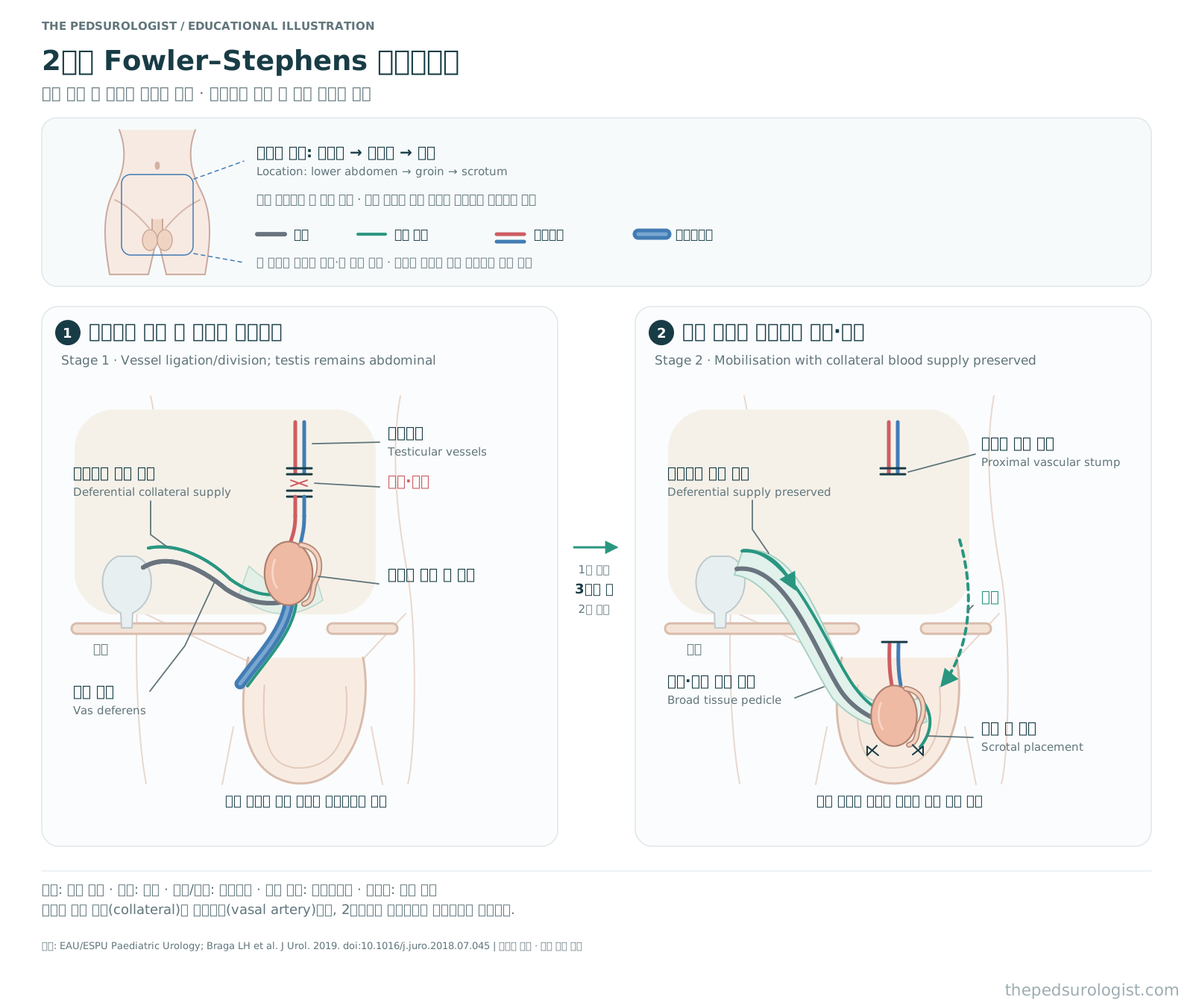
When the testis sits inside the abdomen, the blood vessels can be too short to bring it all the way down to the scrotum in a single operation. In these cases, the main vessel is tied off and the surgery is split into two stages, usually 3–6 months apart, giving other vessels time to grow before the testis is brought down in a second operation. At that second operation, some surgeons keep the gubernaculum and the vessels within it instead of dividing them.
For how the gubernaculum and its vessels can be preserved at the second operation, and the evidence behind it — In depth: two-stage surgery for the intra-abdominal testis — does preserving the gubernaculum reduce atrophy? (For Clinicians)
On Anesthesia and Scarring
Surgery for an undescended testis is relatively brief, usually finishing within 30 minutes, and is carried out under the care of an anesthesiologist who specializes in pediatric anesthesia. The incision sits low, along a natural skin crease below the underwear line, at about 1.5cm — smaller still if done laparoscopically. As the child grows, the scar generally fades to the point of being barely noticeable.
What Happens If Treatment Is Delayed
The two things parents worry about most are infertility and testicular cancer.
For a unilateral undescended testis, the infertility rate is estimated at roughly 10-20%; for bilateral cases, it can run as high as 30-60% (for reference, about 5% of men without a history of undescended testis are infertile too). This risk is closely tied to the timing of surgery — the longer surgery is delayed, the greater the chance of damage to testicular tissue, particularly the sperm-producing function.
This connection between timing and outcome shows up in our own research team's work as well. In a systematic review and meta-analysis we published, men who later developed azoospermia and needed testicular sperm extraction (TESE) for assisted reproduction were compared by cause. Those with a history of childhood orchiopexy for undescended testis had a significantly higher sperm retrieval success rate than those with azoospermia of unknown cause (63.3% vs. roughly 38%). Notably, those who had surgery before age 10 had significantly higher success rates than those who had it later — reaffirming that surgery at the right time in childhood can meaningfully affect fertility decades later.
Testicular cancer risk is likewise tied to timing. Studies report that surgery performed after age 10 is associated with a 6- to 30-fold increase in testicular cancer risk, underscoring how much treatment timing matters.
Frequently Asked Questions
Will an undescended testis come down on its own?
During the "mini-puberty" window at around 2 to 3 months of age, milder cases have a chance of descending naturally. But if a structural problem remains, the testis often ascends again, so the position needs to be tracked continuously.
My baby isn't even a year old — is general anesthesia safe for brain development?
Large global clinical studies (the PANDA, GAS, and MASK studies) have shown that a single, roughly hour-long general anesthetic in early childhood does not leave long-term effects on neurodevelopment or cognitive function. It is carried out safely under the care of a pediatric anesthesiologist, and the risk of delaying surgery — irreversible testicular damage and germ cell loss — is far greater than the theoretical risk of anesthesia.
When is surgery performed?
Both the AUA and EAU/ESPU guidelines recommend orchiopexy between 6 and 12 months of age, no later than 18 months.
What happens if it's left untreated?
Infertility risk can run 10-20% for unilateral cases and 30-60% for bilateral cases. Testicular cancer risk is also reported to rise 6- to 30-fold if surgery is delayed past age 10.
How is this different from a retractile testis?
A retractile testis moves up and down because the muscle that pulls the testicle is overactive, and it usually resolves on its own without surgery. The cause and outlook differ from a true undescended testis, though some cases do progress to a true undescended testis later, so regular follow-up is still needed.
Is an ultrasound necessary for diagnosis?
Usually not. A hands-on exam by a specialist comes first; ultrasound or laparoscopy is only added when the testis is inside the abdomen and can't be felt, or its position is unclear.
Can hormone injections treat it instead?
Hormone therapy is rarely used today, now that the cause is understood to be structural (an abnormal gubernacular attachment) rather than purely hormonal, and because testes that descend temporarily with hormone treatment have a high rate of re-ascending. Surgery is effectively the only treatment.
Will my child need to stay in the hospital after surgery?
It's almost always done as day surgery, and same-day discharge is possible if there are no complications.
Will there be a noticeable scar?
The incision is usually small, about 1.5cm, made low along a natural skin crease below the underwear line, and it typically fades and becomes barely noticeable as the child grows. Laparoscopic surgery leaves even smaller incisions.
References
- Kolon TF, Herndon CDA, Baker LA, et al. Evaluation and Treatment of Cryptorchidism: AUA Guideline. American Urological Association, 2014 (reaffirmed 2025).
- European Association of Urology (EAU) / European Society for Paediatric Urology (ESPU). Paediatric Urology Guidelines, 2026 (annually updated).
- Kim SW, Lee J, Lee TH, Kim DS, Song SH, Kim DK. Azoospermic Men with a History of Cryptorchidism Treated by Orchiopexy Have Favorable Outcomes after Testicular Sperm Extraction: A Systematic Review and Meta-Analysis. World J Mens Health. 2023;41(1):81-93.
- Sun LS, et al. Association Between a Single General Anesthesia Exposure Before Age 3 and Neurocognitive Outcomes in Later Childhood (PANDA Study). JAMA. 2016.
- McCann ME, et al. Neurodevelopmental Outcome at 5 Years of Age after General Anaesthesia or Awake-Regional Anaesthesia in Infancy (GAS Study). Lancet. 2019.
- Warner DO, et al. Neuropsychological and Behavioral Outcomes after Exposure of Young Children to Procedures Requiring General Anesthesia: The Mayo Anesthesia Safety in Kids (MASK) Study. Anesthesiology. 2018.