
Hypospadias has been operated on for long enough that the number of described techniques runs into the hundreds. Yet the agreement on what we are trying to correct is surprisingly simple. In opening this series, I want to set out that framework and where the series will place its weight.
Three problems, three requirements
Hypospadias is a urethral meatus opening somewhere on the ventral penis rather than at the tip of the glans. The meatal position is rarely the only thing out of place; three features usually appear together — the abnormal meatal position, ventral curvature, and abnormal skin distribution, with ventral deficiency and a dorsal excess (the dorsal hood). These are not separate anomalies that happen to coincide but three marks left by a single developmental event, which is why an operation correcting only one of them is, in principle, incoherent.
Techniques differ; the requirements a result must satisfy are likewise three.
- A natural stream from the tip of the glans — the calibre and shape of the meatus, not only its position
- No curvature on erection — the standard is the erect state, not the flaccid one
- A cosmetically satisfactory appearance — assessed by the patient, not the surgeon
Each requirement breaks down further. On the voiding side there are fistula, stenosis, diverticulum and spraying. All are common and troublesome, but all can be dealt with without changing the fundamental strategy of the operation. A fistula is closed, a stenosis is opened, a diverticulum is reduced and tightened, spraying is addressed by reshaping the meatus. Reoperation may be needed, but what needs doing is clear.
The appearance side holds more items. Beyond penile size, curvature and the adequacy of the skin, it includes penile exposure — including penoscrotal transposition — and a natural reconstruction of the glans. The more proximal the defect, the further the scrotum rides up onto the shaft; however well the urethra is built, appearance is not solved while the penis sits buried in scrotum. Nor is covering the glans the same as coning it into shape with a vertical meatus at its tip.
Dissatisfaction with size is reported at substantial rates in adult surveys, but hypospadias repair uncovers what was hidden and straightens what was bent; it does not enlarge the corpora. Setting aside size, which surgery cannot change, the rest — exposure, glans, skin — is addressable. Skin is both a matter of redistribution and the material for urethral reconstruction. It is largely manageable provided tissue is not spent carelessly at the first operation, and where it falls short, skin grafting remains as a last resort.
But none of these can be judged properly while curvature remains. A bent penis looks less exposed, invites skin to be set too short to match, and hides the shape of the glans behind the angle.
Curvature, then, acts in three directions at once. It governs much of the appearance, it dictates the surgical approach, and it leaves the largest share of the functional problems later on. Whether to preserve or transect the urethral plate, whether to do it in one stage or two, turns on the degree of curvature — and what returns in adulthood as difficulty with intercourse is curvature too. Where the other items each cause trouble in their own place, curvature cuts across all of them.
Why curvature sits at the centre
The three do not carry equal weight. What persists into adulthood when the first operation chose wrongly is the curvature. Fistula, stenosis and diverticulum, if they occur, usually declare themselves within a few years, when there is still a chance to correct them. And as noted above, several appearance items are hostage to curvature. Exposure, the placement of the skin, the shape of the glans — each is only worth what it is once the penis is straight.
Curvature is hard to find, for several reasons. The penis itself is small, which makes the angle difficult to judge, and once the nappy years are past, parents and surgeons alike stop thinking about that item. It does not announce itself by wetness as a fistula does, or by the stream as a stenosis does. It is invisible unless looked for, and it is mostly not looked for.
Meanwhile the boy grows, and the problem surfaces only after puberty — by which time a decade or more has passed since the first operation. In a series of patients referred after failed proximal repair, the commonest complication was persistent or recurrent curvature, and nearly 40% of their parents were unaware their son had any curvature at all.
The "success rate" reported in most series means no fistula and no meatal stenosis. In counselling too, the weight of the explanation falls on urethral reconstruction and fistula. All of these are judged by the surgeon, are binary, and are established within months. The problem that lasts longest is the one whose seriousness is least explained. Curvature is therefore often left — and curvature left arrives as a bill ten years later.
Which makes the first operation's judgement heavy
That curvature declares itself a decade later means two things. The first is that the assessment at the first operation has to be accurate. Meatal position does not indicate severity; an angle estimated by eye before degloving is not the angle after it; and surgeons consistently underestimate curvature. Put those three together and underestimation becomes the default.
The second is the choice of straightening technique. In principle there are two ways to straighten a bent penis: shorten the long side, or lengthen the short one.
- Dorsal plication — a shortening procedure: the dorsal tunica is folded and fixed. Quick and simple, though it can shorten the penis.
- Ventral lengthening — incising the ventral tunica, with grafting where needed, to lengthen the short side; described as corporotomy or corporoplasty.
- Urethral plate transection — dividing the plate that is tethering the penis, releasing the tension directly. The resulting gap is bridged with a preputial skin graft or flap.
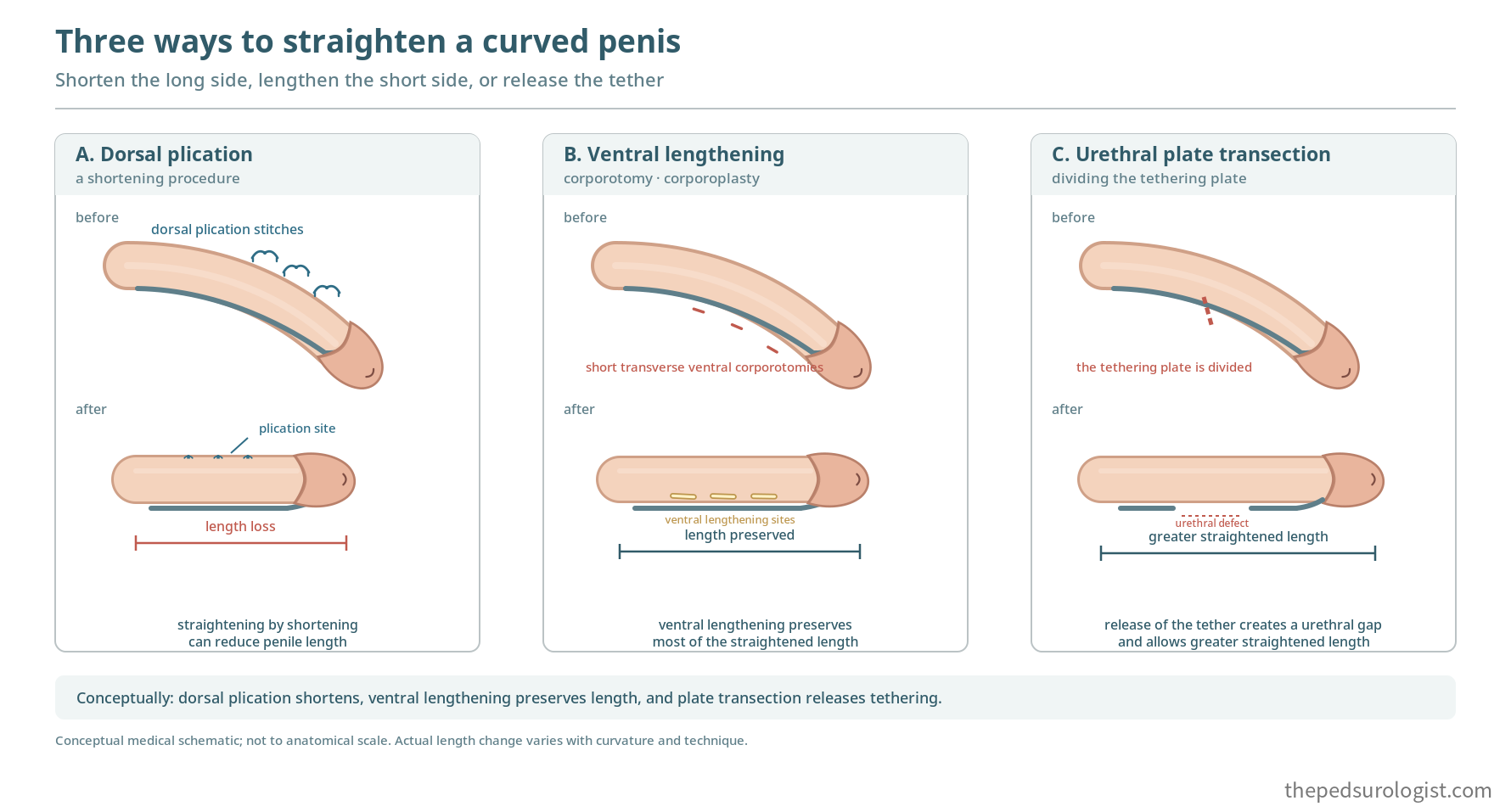
The threshold for transection has been falling compared with earlier practice, to the point that transection is considered even below 30°, and the role of plication is narrowing (the steps and thresholds of correction are covered in Part 7) — a view ranking efficacy as dorsal plication < ventral lengthening < urethral plate transection. The grounds are recurrence: 9.4% after ventral lengthening against 28% after dorsal plication in severe curvature, and the finding that residual curvature was more common where the plate had been preserved.
The difficulty is that the more effective a technique is at straightening, the more burdensome it is for the surgeon. Transecting the plate commits the child to staged repair, raises the number of operations, lengthens what must be explained to parents, and may worsen the near-term complication rate. As long as the standard is the indicators in front of you, the pull toward plication is hard to resist.
And to be honest, taking the harder road for the sake of the long-term result is not an easy choice for the surgeon either. The labour falls now; the return goes to the patient at a time the surgeon will not see. The short-term record may look worse for it. That such a choice nonetheless has to be made is where the real difficulty of this operation lies.
Which way to go with a given patient is not settled by technical skill. It is a question of whether one can judge by the patient at a time when the result will not be observed. It takes a certain firmness, and a sense of responsibility that puts the patient's adulthood ahead of one's own short-term record. The hardest part of hypospadias surgery, I think, is not the suturing but this judgement.
What this series will cover
From this footing the later instalments go into specifics. Part 2 asks what counts as a good result — why complication rate does not stand in for outcome, and the problem of measurement. What follows: the problems that emerge in adulthood, embryology and aetiology, classification and preoperative assessment, distal and proximal techniques, and complications.
References
- EAU Guidelines on Paediatric Urology. Hypospadias. European Association of Urology, 2026.
- Snodgrass W, Bush NC. Persistent or recurrent ventral curvature after failed proximal hypospadias repair. J Pediatr Urol. 2019;15(4):344.e1-344.e6.
- Braga LHP, Lorenzo AJ, Bagli DJ, et al. Ventral penile lengthening versus dorsal plication for severe ventral curvature in children with proximal hypospadias. J Urol. 2008;180(4 Suppl):1743-1747.
- Pediatric urologists’ confidence and accuracy in estimating penile curvature. J Pediatr Urol. 2023;19(1):76.e1-76.e7.
- Rynja SP, de Jong TPVM, Bosch JLHR, de Kort LMO. Functional, cosmetic and psychosexual results in adult men who underwent hypospadias correction in childhood. J Pediatr Urol. 2011;7(5):504-515.