
Part 1 argued that curvature cuts across appearance, the choice of technique and long-term function alike. On what, then, does that argument rest — and more basically, what are we using to judge whether an operation went well?
This is the first wall one meets in reading the literature on this condition. The "success rate" reported in most series in fact means the absence of complications: no fistula, no meatal stenosis, no dehiscence. All three are judged by the surgeon, are binary, and are established within months of surgery. The three requirements set out in Part 1, by contrast, are experienced by the patient, are matters of degree, and emerge over decades. Complication rate and outcome are not measuring the same thing.
Several instruments already exist
Three lines of tools have developed to close this gap.
HOSE (Hypospadias Objective Scoring Evaluation, Holland et al., 2001) scores meatal position and shape, the urinary stream, straightness on erection, and the presence of fistula. It looks at function and form together, but the assessor is the surgeon.
HOPE (Hypospadias Objective Penile Evaluation) standardises the assessment of appearance alone, based on photographs. It is an attempt to measure cosmesis separately from complications — again scored by surgeons.
PPPS (Pediatric Penile Perception Score, Weber et al.) is different in kind. Satisfaction with the meatus, glans, penile skin and overall appearance is rated by the patient himself or by a parent. Crucially it has been validated in controls, so one can ask what "normal" scores.
What the three instruments have in common
Their starting points and their assessors differ, yet what they measure overlaps a good deal. Set out with the item names as they appear in the original papers:
| Domain | HOSE (Holland 2001) | HOPE (van der Toorn 2013) | PPPS (Weber 2008) |
|---|---|---|---|
| Meatal position | meatal location | position of meatus | meatus |
| Meatal shape | meatal shape | shape of meatus | |
| Glans | — | shape of glans | glans |
| Penile skin | — | shape of penile skin | shaft skin |
| Curvature | straightness of erection | penile axis (torsion included) | — |
| Fistula | urethral fistula | — | — |
| Urinary stream | urinary stream | — | — |
| Overall appearance | — | — | general appearance |
| Penile size | — | — | — |
The shared core is the meatus (position and shape), the glans, and the penile skin. That three instruments developed independently converged on the same items suggests there is at least agreement about what counts as the visible result.
Taking the curvature item on its own
The three handle curvature quite differently, and the difference matters enough to set out separately.
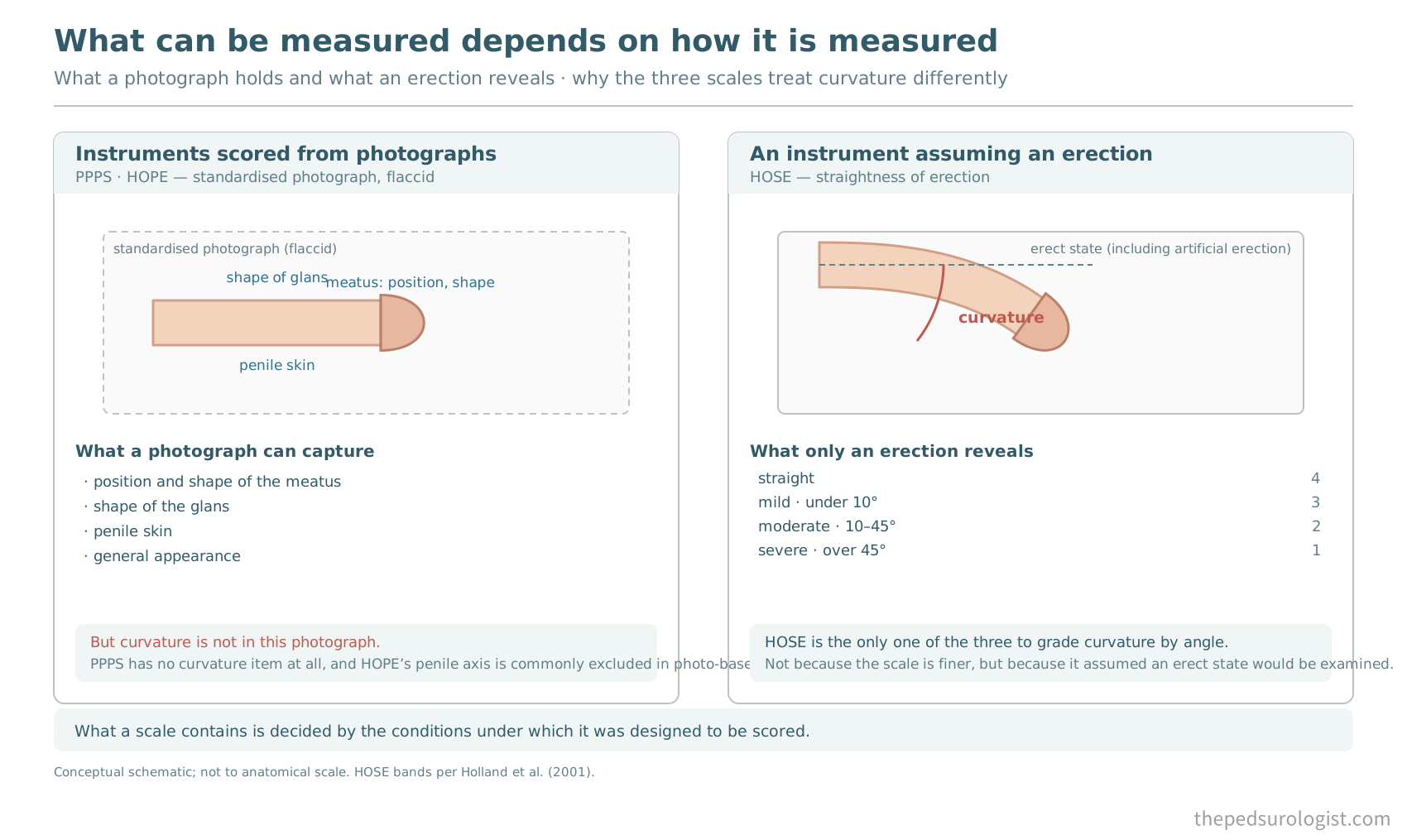
HOSE grades curvature in degrees. The item is straightness of erection, scored 4 for straight, 3 for mild angulation under 10°, 2 for moderate between 10° and 45°, and 1 for severe beyond 45°. It is the only one of the three to put a number on curvature, and as the name says, it takes the erect state as the standard.
HOPE folds curvature and torsion into a single item, penile axis. It looks at how far the axis deviates, without grading curvature separately by angle.
PPPS has no curvature item at all. Its four items are meatus, glans, shaft skin and general appearance.
No instrument measures penile size — excluded because surgery cannot change it, yet it accounts for a substantial share of dissatisfaction in adulthood. And curvature is absent from PPPS, the instrument scored by patients and parents. The item Part 1 called the most important is missing from the one tool that carries the patient's point of view.
The omission of size is the sharper irony. PPPS presents itself as a patient-reported outcome, yet size is what these patients most often raise once they are adults. It was left out because surgery cannot change it — but an instrument that sets out to ask what the patient is dissatisfied with, and then asks only about what the surgeon can alter, is not carrying the patient's perspective; it is having the patient voice the surgeon's. That alone shows how early a stage patient-reported outcomes are still at in this field.
That PPPS carries no curvature item is less an oversight of design than a consequence of its being built to be scored from photographs. A standardised photograph captures appearance at rest; curvature declares itself on erection. It cannot be measured even if one wished to. HOSE could grade it precisely because it assumed the opposite — an erect state assessed in the clinic.
The same constraint bears on HOPE. HOPE does have a penile-axis item, yet it is often dropped in practice: the 2024 validation study cited earlier excluded torsion and curvature because they cannot be judged from photographs, and measured agreement on the rest. That an item exists in a scale is not the same as that item being measured.
In 32 boys undergoing primary repair, preoperative GMS scores were set against postoperative PPPS. There was no correlation between them (r = −0.227, p > 0.05): anatomical severity did not predict perceived appearance. Two readings are possible — either surgery genuinely closed the gap between mild and severe, or PPPS does not look at the very item that separates them. Given that curvature turns out to be the predictor of complications on multivariate analysis — see Part 3 — the second is hard to rule out.
The same result scores differently depending on who is looking
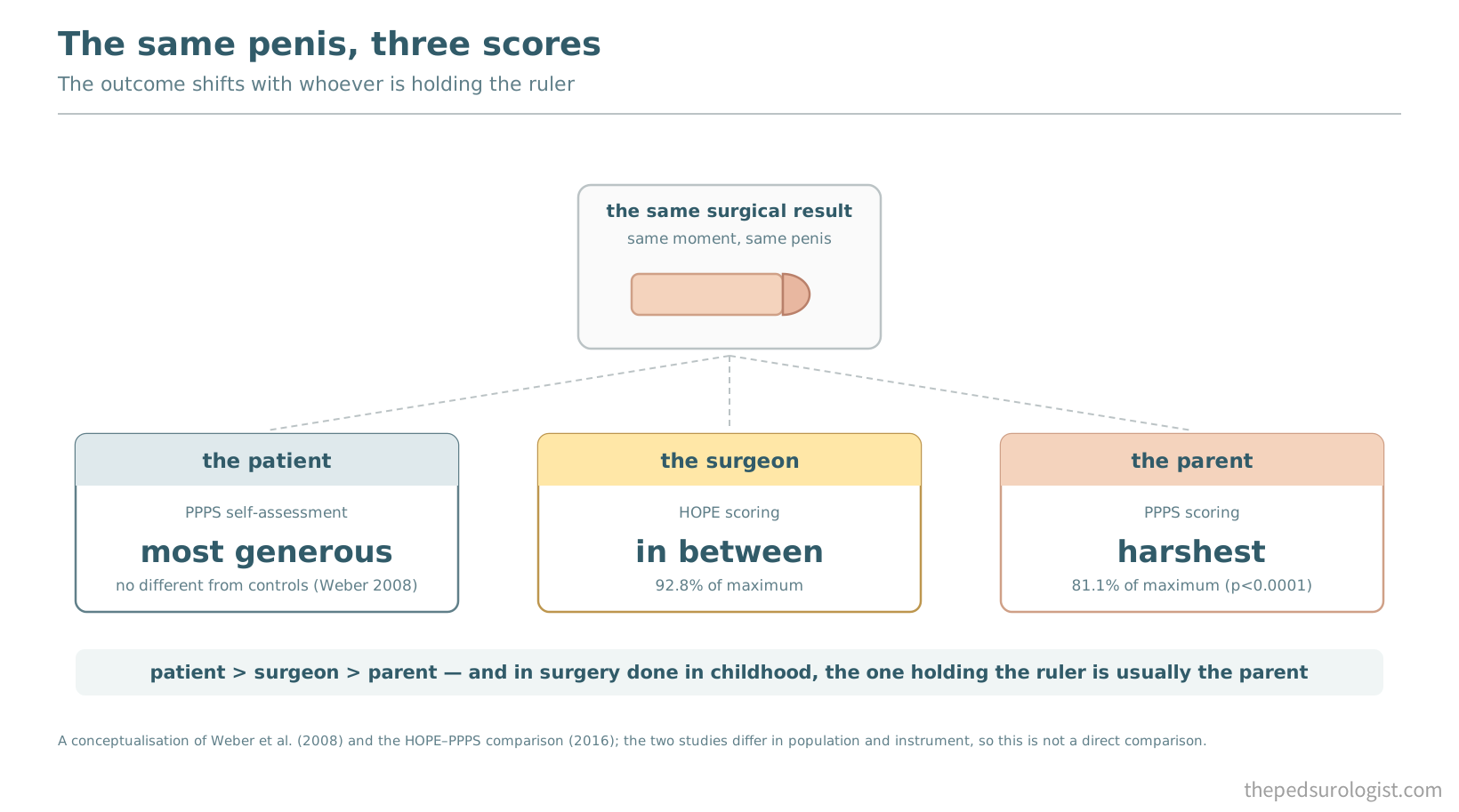
Apply these instruments to the same patients and the core of the problem appears. In a study of 42 boys after hypospadias repair, two surgeons independently scored HOPE while parents scored PPPS; the results diverged sharply — 92.8% for surgeons against 81.1% for parents (as a proportion of each instrument's maximum, p<0.0001). The authors concluded that a HOPE score cannot be transposed uncritically into the parents' view.
There is a further axis. Weber et al. (2008), who proposed PPPS, asked 77 patients aged 6 to 17 directly, and the patients themselves were more satisfied than either their parents or the urologists. More striking still, their satisfaction did not differ significantly from an age-matched control group who had undergone inguinal hernia repair.
Lay the two studies over one another and an order emerges — the patient himself is the most generous, the surgeon next, and the parent the harshest. What we call "the outcome" is a value that shifts with whoever is holding the ruler. And in surgery performed in early childhood, the person holding it is usually the parent.
Agreement between experts and parents has also been reported to depend on severity (Pérez-Brayfield et al., 2016), with concordance lower in the milder cases. Turned around, this makes sense. To the surgeon, the result of a distal repair is almost always a success; the person who looks into the gap between that "almost normal" and actual normal is the parent. The easier the operation, the higher the expectation — and the higher the expectation, the larger the remaining difference appears.
Weber's finding carries an implication one can use in the clinic directly: a parent's concern about the child's appearance may exceed what the child himself feels. Before this reading is used to reassure parents, however, it is worth turning over once.
These boys grow up being examined regularly, photographed for the record, and having the appearance of their genitals discussed in front of their parents. What that is like for a boy around puberty appears in none of the scores we collect. And the satisfaction survey itself lies on the same continuum of that experience — asking a boy of 6 to 17, through standardised items, how satisfied he is with the appearance of his penis.
A high score from the patient may mean he is satisfied, or it may mean he would like this attention to stop. We have no instrument that distinguishes the two. The absence of a difference from controls is explained the same way, if neither group was comfortable in front of that question.
The same data can therefore be read differently. Rather than evidence that the child is satisfied, it may be evidence of the age at which a child begins to find being assessed on this subject uncomfortable. And that discomfort is something we can reduce.
What has to be decided in follow-up after puberty is not only how often to examine. It is also who should be in the room, and what not to ask. Whether to set aside time with the boy alone, at what point to stop photographing, whether asking about satisfaction is still necessary at all. This is not a question about someone else's practice but about what we are doing now. Where the effort to measure an outcome becomes itself a burden on the patient is something we have never measured.
One should also resist pushing too far in this direction. Reading every patient response as "not what he really thinks" reinstates a structure in which adults reinterpret the child's words. The honest position stops at the point that these figures cannot be read at face value, with the reasons recorded. The gap between adult surveys, where dissatisfaction with appearance is pronounced, and this childhood data is taken up in the next instalment.
The functional side is emptier still
Appearance at least has validated instruments; there is no standard measure for long-term function. There is no agreement on how to combine flow rate, residual volume, post-void dribbling and spraying, and cohorts followed into adulthood are themselves scarce. What we know is largely what patients report being dissatisfied with in cross-sectional surveys, not which operation reduces that dissatisfaction.
Implications for counselling
To gather what we have seen: the indicators we actually treat as the outcome are the position and shape of the meatus, the shape of the glans, and the penile skin. Three instruments developed independently and converged on the same three, which is worth calling a consensus. HOSE adds the stream and fistula; PPPS adds an overall impression.
What is absent, though, is more striking. Curvature appears only in instruments that assume an erection, and not in the one that carries the patient's view. Penile size appears nowhere. No standard measure of long-term function has been built. In short, the criteria for what to call a success are not yet in place.
One thing is nonetheless clear. The person who finally judges the result of this operation is the patient, and that judgement only arrives with time. Whether voiding is comfortable, whether erections are unproblematic, how his own body looks to him — these are things he lives. Yet the surgery is done at an age when he cannot speak to any of it, and for the first years someone else has to judge in his place. That we are standing in for a judgement that cannot be stood in for is the structural condition of outcome assessment in this field.
So passing on the figure "90% success" to a parent is not an accurate explanation unless one also says what that 90% counted. The absence of fistula and stenosis means the operation finished safely; it does not mean this child's outcome is good. That verdict has not yet arrived, and the person who will deliver it is not in the room.
If the wavering of the ruler is half the problem, the other half is that the comparisons do not start from the same line. The same technique gives different results depending on which patients it was used on, and the classification we have relied on cannot adjust for that difference. Part 3 takes this up.
References
- Holland AJ, Smith GH, Ross FI, Cass DT. HOSE: an objective scoring system for evaluating the results of hypospadias surgery. BJU Int. 2001;88(3):255-258.
- Weber DM, Schonbucher VB, Landolt MA, Gobet R. The pediatric penile perception score: an instrument for patient self-assessment and surgeon evaluation after hypospadias repair. J Urol. 2008;180(3):1080-1084.
- van der Toorn F, de Jong TPVM, de Gier RPE, et al. Introducing the HOPE (Hypospadias Objective Penile Evaluation)-score: a validation study of an objective scoring system for evaluating cosmetic appearance in hypospadias patients. J Pediatr Urol. 2013;9(6 Pt B):1006-1016.
- Penile appearance after hypospadias correction from a parent's point of view: comparison of the hypospadias objective penile evaluation score and parents penile perception score. J Pediatr Urol. 2016;12(2):108.e1-108.e6.
- Correlation between glans, meatus, shaft score, and penile perception after hypospadias repair. J Indian Assoc Pediatr Surg. 2022;27(6):711-716.
- Pérez-Brayfield MR, Jorge JC, Avilés LA, Díaz J, Ortiz V, Morales-Cosme W. Concordance of expert and parental opinion about hypospadias surgical outcome is severity dependent. Front Pediatr. 2016;4:2.
- Rynja SP, de Jong TPVM, Bosch JLHR, de Kort LMO. Functional, cosmetic and psychosexual results in adult men who underwent hypospadias correction in childhood. J Pediatr Urol. 2011;7(5):504-515.