
A child on antibiotic prophylaxis has another febrile urinary tract infection. Or a child has stayed free of infection, but high-grade reflux has persisted for years. Parents and clinicians then ask much the same question: "Wouldn't it be better to operate now?"
Answering it means separating two decisions. First, judge whether the benefit of surgery outweighs continuing the current observation or prophylaxis. Then, if correction is needed, choose which procedure suits this child's reflux and clinical course. Start by comparing success rates, and it is easy to lose sight of why the operation is being done at all.
The first three parts covered whom to investigate, risk groups and follow-up, and antibiotic prophylaxis. This part looks at the decision to move to surgery in primary vesicoureteral reflux, and at what follows. Secondary reflux associated with neurogenic bladder or urinary tract obstruction requires treatment of the underlying condition and belongs in a separate context.
1. What are the criteria for moving to surgery?
The clearest turning point the AUA offers is a febrile breakthrough infection during continuous antibiotic prophylaxis (CAP). In such a child it recommends considering intervention with curative intent — ureteral reimplantation or endoscopic injection (Recommendation). By contrast, if a child observed without CAP develops a febrile UTI, the recommendation is to start CAP first (Recommendation). The same febrile infection leads to a different next step depending on how the child was being managed1,2.
"Consider" should not be read as "operate immediately". For a single febrile breakthrough infection with no pre-existing or new renal cortical abnormality, the AUA leaves changing the prophylactic agent before intervention as an option (Option). That is why, while treating the infection, the culture and sensitivities, actual adherence, bladder and bowel dysfunction (BBD) and renal status need to be reviewed. Extending this exception to a child with a pre-existing cortical abnormality departs from the conditions in the original text. Both the recommendation and the option are based on panel consensus1,2.
EAU/ESPU ties the surgical decision more explicitly not only to breakthrough infection but to persistent high-grade reflux and the state of the renal parenchyma. It recommends offering reimplantation or endoscopic correction for frequent breakthrough infections (Weak), and reimplantation for persistent high-grade reflux and endoscopic correction for lower grades (Strong). It also recommends offering surgical repair to children over one year with high-grade reflux and abnormal renal parenchyma (Weak). The guideline itself states, however, that there is no consensus on the timing and type of surgical correction3.
| Situation | AUA | EAU/ESPU |
|---|---|---|
| Febrile breakthrough UTI on CAP | Consider reimplantation or injection (Recommendation). For a single episode with no cortical abnormality, change of agent is an option (Option) | Frequent breakthrough infections: offer reimplantation or endoscopic correction (Weak) |
| Febrile UTI under observation without CAP | Start CAP (Recommendation) | — |
| Persistent high-grade reflux | No separate recommendation. Surgery, open or endoscopic, is an option (Option) | Offer reimplantation (Strong). Over 1 year with abnormal parenchyma: offer surgery (Weak) |
| Asymptomatic, normal kidneys, grade I–III | — | No evidence of meaningful benefit from correction |
| BBD · LUTD | Treat before surgery where possible | If LUTD is present, always treat it first |
| Family preference | Choice of modality includes "the family's desire for certainty of cure" | Offer surgery if parents prefer definitive correction to conservative management (Strong) |
These statements are therefore hard to turn into a rule such as "grade IV means surgery at age X". Even in the EAU/ESPU risk table of Part 2, initial management differs for a child before toilet training, a child with lower urinary tract dysfunction (LUTD), and a toilet-trained child without LUTD who has high-grade reflux and abnormal kidneys. That reflux persists and that there is a reason to correct it now are separate judgements3.
BBD and LUTD are not peripheral to this judgement. The AUA advises treating BBD before surgery where possible, and EAU/ESPU says to treat LUTD first when present, because voiding and bowel problems that remain after correction leave the infection risk in place. In the AUA's literature synthesis, UTI after open or endoscopic surgery occurred in 22.6% of children with BBD and 4.8% without (the AUA does not present this difference as statistically significant)2. This does not mean waiting for complete normalisation of voiding when recurrent febrile infection or concern about renal damage makes intervention urgent.
Family preference is part of the decision too. EAU/ESPU recommends offering surgical correction to parents who prefer definitive treatment to conservative management (Strong). What needs explaining then is not only the high correction rate but anaesthesia and recovery, the possibility of further procedures, and the fact that infection surveillance and kidney follow-up may still be needed after surgery3.
Where NICE and the AAP sit in this discussion
NICE NG224 says surgery should not be used routinely for VUR. That is a broad principle against correcting every reflux as soon as it is found, not a statement forbidding specialist surgical judgement in a child with recurrent infection or renal abnormality. The AAP 2026 guideline likewise lists observation, BBD treatment, CAP, endoscopic injection and reimplantation as management options and emphasises shared decision-making with paediatric urology and nephrology. Comparing these two as if they were procedure-selection guidelines on the same footing as the AUA and EAU/ESPU would miss the difference in scope4,5.
2. Endoscopic injection or ureteral reimplantation?
Once surgery is judged necessary, the first comparison is between endoscopic injection and ureteral reimplantation. Endoscopic injection places a bulking agent cystoscopically beneath the ureteral orifice and intramural ureter to reinforce the submucosal tunnel. Reimplantation rebuilds the course of the ureter within the bladder wall. The former carries the weight of a smaller procedural burden; the latter, of a higher anatomical correction rate3.
| Item | Endoscopic injection | Ureteral reimplantation |
|---|---|---|
| Reflux resolution (AUA synthesis, per patient) | 83.0% after one injection (95% CI 69.1–91.4) | Open 98.1% (95% CI 95.1–99.1) |
| Success of one injection by grade (per ureter, Elder meta-analysis) | I–II 78.5% · III 72% · IV 63% · V 51% | — |
| Overall success of procedures (EAU/ESPU summary) | — | Open techniques 92–98% |
| Repeat procedures | Re-injection after a failed first injection: 68% for the second, 34% for the third. Cumulative success with one or more injections 85% | Reoperation uncommon |
| Effect of BBD | Lowers reflux resolution | No difference in anatomical resolution observed in open series (not a claim of no effect on infection or retention) |
| Conditions with lower success | High grade, duplex systems (50% vs 73% single), dilated ureters | — |
| Complications to watch | Late ureterovesical junction obstruction (high grade, dilated ureters, especially with PPC) | Transient urinary retention after bilateral extravesical repair |
The 0.4% obstruction rate in the AUA synthesis is a pooled estimate from endoscopic and open series, not a figure for either procedure alone. The Elder meta-analysis reports per ureter; the AUA figures are per patient. Data showing lower injection success in neurogenic bladder (62% vs 74%) also exist but fall outside primary reflux, the subject of this article.
The AUA figures are a useful starting point but are not a direct comparison in which the same children were randomised to the two procedures. They pool historical data from different populations and techniques and cannot predict the result of an operation done in a particular centre today2. The grade-specific figures of the Elder meta-analysis (5,527 patients, 8,101 renal units) should not be set directly against the AUA figures either, but the direction is clear: the higher the grade, the harder it is to correct with a single injection. That is the background to EAU/ESPU recommending reimplantation for persistent high-grade reflux3,6.
When choosing injection, both "the burden of this procedure" and "the burden of the whole course of treatment" should be explained. It may be done once, or it may lead to re-injection, repeated imaging and eventually reimplantation. Conversely, a higher initial correction rate does not make reimplantation better for every child. Reflux grade and anatomy, voiding function, renal status, infection history and the treatment burden the family can accept all change the choice.
Obstruction is possible after injection too. EAU/ESPU warns of late ureterovesical junction obstruction in high-grade reflux with dilated ureters, and notes that although short-term (3–6 month) results are similar, obstruction is significantly more common in the long run with polyacrylate-polyalcohol copolymer (PPC), and subsequent reimplantation is more difficult. The word "endoscopic" does not remove the need for follow-up3.
3. If reimplantation: open, laparoscopic or robotic?
Open, laparoscopic and robotic surgery are approaches to performing reimplantation. Listing them alongside endoscopic injection as four equivalent options blurs the comparison. And whether the operation is open or robotic is a different axis from whether the reconstruction is intravesical or extravesical.
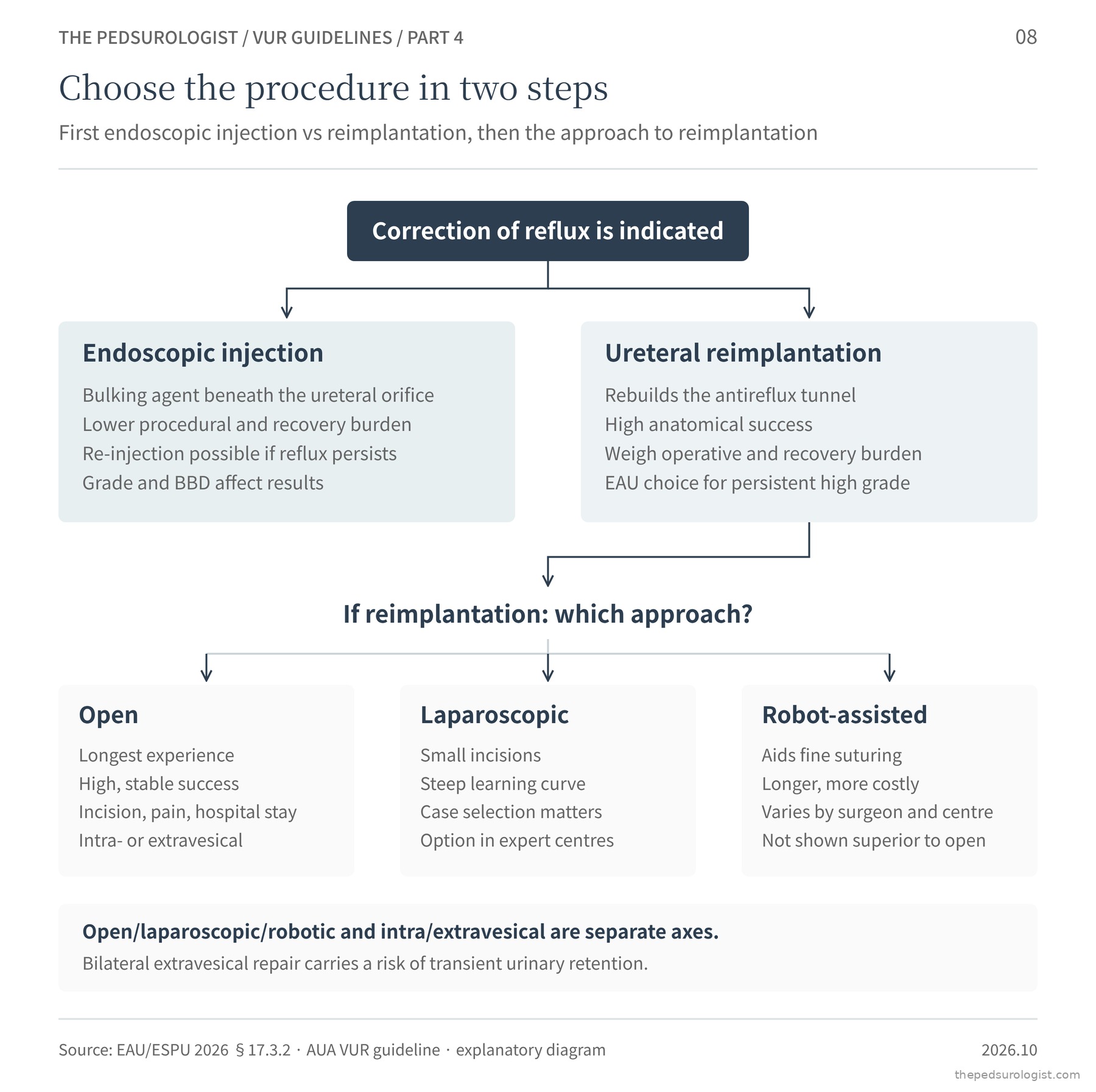
Open reimplantation is the reference procedure, with long experience and a high correction rate. EAU/ESPU summarises the success of the various open techniques as 92–98% and notes that all share the same principle of lengthening the intramural ureter. In bilateral reflux an intravesical approach may be considered, because simultaneous bilateral extravesical repair raises the risk of temporary urinary retention3.
Laparoscopic and robot-assisted reimplantation aim at the same reconstruction through small incisions, but the guidelines' assessment does not yet match that of open surgery. EAU/ESPU says that robot-assisted laparoscopic ureteral reimplantation (RALUR) showed resolution rates comparable to open surgery in early reports, yet summarises recent meta-analyses as showing wide variation in results, on average poorer than open surgery, with longer operative times, higher costs and more complications requiring secondary intervention. Where the robotic approach comes out ahead is postoperative pain and length of stay. It therefore does not recommend a laparoscopic or robotic approach as routine, states that its advantages over open surgery are still debated, and places it at the level of an alternative that may be offered to caregivers in centres with established experience. The AUA in 2010 likewise excluded laparoscopic techniques from its assessment because there were too few reports. The situations in which the robot may offer a clear advantage are named separately: older children with complex anatomy, and reoperation after failed injection or open repair, where exposure is difficult. De novo hydronephrosis after extravesical RALUR, seen in up to 30%, resolves on its own in the great majority2,3.
Data often cited for good robotic results should be read in the same frame. A prospective eight-centre US study of RALUR in 2018 operated on 143 patients and 199 ureters and reported radiographic resolution in 93.8%. But the denominator is not 199: it is the 145 ureters that had postoperative imaging (136 resolved). The results come only from surgeons past their learning curve, mean follow-up was just 7.4 months, and there was no randomised comparison with open surgery. Transient retention occurred in 7.1% after bilateral repair. These figures show only that robotic surgery can be an option in experienced centres; they are not yet evidence that it is equivalent or superior to open reimplantation7.
A comparative meta-analysis of open versus robotic surgery published in 2026 also leaves the evidence insufficient to regard robotic surgery as an established option on a par with open repair. Across eight retrospective studies (546 patients) there was no significant difference in success (92.5% vs 94.1%) or complications, and hospital stay was shorter with the robot; but all the studies were retrospective, the robotic group was on average two years older and 7 kg heavier, and median follow-up was 15 months. Open surgery remains the reference procedure, and the robot is best seen as an alternative to be chosen in experienced centres after explaining both its advantages and its uncertainties8.
In counselling, then, robotic surgery is best explained by setting its advantages — small incisions, shorter stay — beside its costs, longer operative time and results that have not yet accumulated to the extent of open surgery. What matters more than the name of the approach is what result can be expected for a child of similar age, grade, laterality and anatomy, and it helps to talk with the family about correction rates, retention and obstruction, reoperation, and hospital stay and recovery on comparable terms.
4. How is surgical success judged?
If reflux has disappeared on postoperative VCUG, the anatomical correction has succeeded. That result alone does not show that febrile UTI will not recur, that new scars will not form, or that long-term renal function will improve. Resolution of reflux, reduction of infection, and further treatment and complications need to be assessed separately.
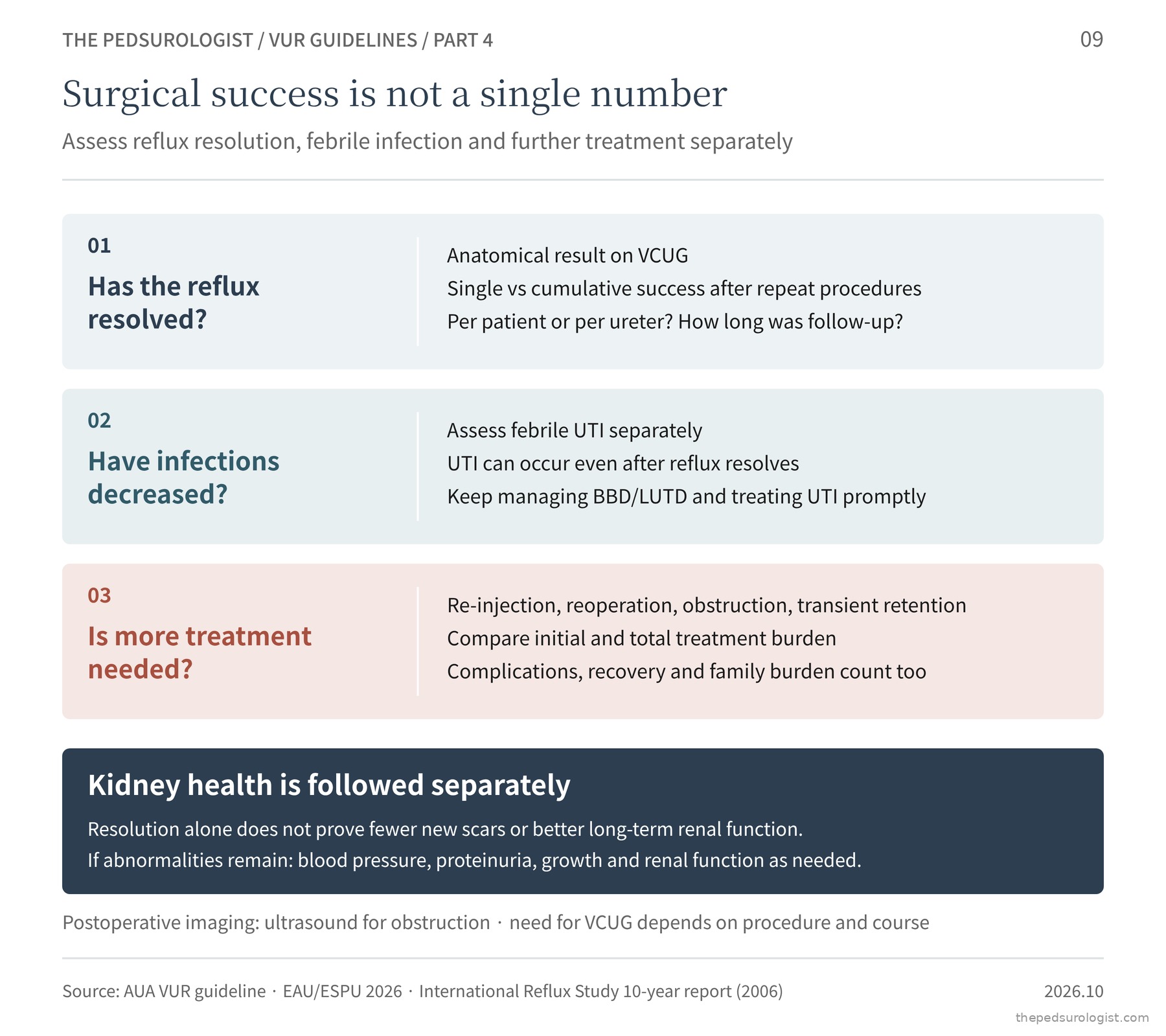
This distinction shows in the randomised trial that compared surgery with antibiotic prophylaxis. The European arm of the International Reflux Study in Children randomised 306 children under 11 years with grade III–IV reflux, a history of UTI and a GFR of at least 70 mL/min/1.73 m² to prophylaxis or reimplantation. At ten years the medically treated group had more febrile infections, but surgery showed no superiority for new renal scars (19 medical vs 21 surgical by five years), renal growth or renal function9. Still, "fewer infections, same scarring" should not be read in a single line. Scarring in this trial was judged by excretory urography, and today's DMSA is also a surrogate whose results vary with the distinction between acute inflammation and permanent scarring, inter-observer variation and the timing of the scan. Renal scarring is an important imaging finding of parenchymal damage, but a difference in scarring does not translate directly into a difference in long-term clinical outcomes such as hypertension, proteinuria or loss of renal function. Such problems can appear during follow-up (three children in this trial developed hypertension requiring treatment), and ten years of follow-up is a limited basis for judging risk across adult life. This trial is the basis on which the AUA, while listing surgery as an option, writes only that randomised trials showed open correction reduced febrile UTI compared with CAP, and that a reduction in scarring has not been proven2.
What the result says, therefore, is not "surgery does not protect the kidney" but that surgery's effect in preventing infection was confirmed, while improvement in renal outcomes was not demonstrated in that population over that follow-up. The two effects should not be bundled into one claim. At the same time, the result rests on the investigations of the time, a selected population, close follow-up and prompt treatment of infection, so it cannot be generalised unchanged to children with poorer renal function or uncontrolled recurrent infection.
Postoperative investigations also divide by what they are meant to show. Ultrasound looks at obstruction and the upper tracts; cystography at whether reflux persists. Even "postoperative imaging" carries different recommendation grades depending on the procedure. The AUA and EAU/ESPU, as reviewed here, give no separate recommendation on cystography after laparoscopic or robotic reimplantation, so applying the recommendation for open surgery unchanged has limits. What follows is my own judgement, not an explicit recommendation of either guideline: because these approaches have not yet accumulated results comparable to open surgery, I would rather confirm resolution than carry over the open-surgery Option and omit the study.
| Postoperative investigation | AUA | EAU/ESPU |
|---|---|---|
| Renal ultrasound (obstruction) | After both open and endoscopic procedures (Standard), because any method of correction can cause ureteral obstruction and silent obstruction has severe consequences | — |
| Cystography — after endoscopic injection | Recommended (Recommendation): the procedure aims at cure, so resolution is confirmed | In the high-risk surgical group of the risk table, "postoperative VCUG on indication only"; not a general rule for every operation |
| Cystography — after open reimplantation | Optional (Option): the 98% success rate was judged not to justify routine study; clinical course and family preference decide. The AUA did not assess laparoscopic or robotic surgery, so this applies to open surgery only | As above |
| Long-term evaluation after resolution | If either kidney is abnormal on ultrasound or DMSA, annual blood pressure, height, weight and urinalysis through adolescence (Recommendation); Option if both are normal | High-risk groups: follow renal status until after puberty |
| Febrile UTI after resolution | Evaluate for BBD and recurrent reflux (Recommendation) | — |
Finally, the kidney follow-up discussed in Part 2 continues after surgery. Completing the correction of reflux and completing kidney care may not happen at the same time. The AUA recommends discussing with the family, and with the child at an appropriate age, the long-term concerns of hypertension (particularly during pregnancy), loss of renal function, recurrent UTI and familial reflux in siblings and offspring2.
Closing Part 4
Both urology guidelines direct the surgical discussion around recurrent infection, persistent high-grade reflux, renal status and voiding function. But when exactly to correct asymptomatic high-grade reflux, how many injections to attempt, and which approach gives the best long-term renal outcome are not reduced to a single answer. The first sentence of surgical counselling is therefore better framed not around success rates but around "why are we proposing correction for this child now?" Only once that reason is clear can correction rates and burdens be compared.
The question of this series was how closely finding and eliminating reflux tracks with improving the outcomes that matter to patients. After four parts, the answer is closer to "only partly". Investigating for reflux and sorting children into risk groups are tools for deciding management; they have not themselves been shown to change outcomes. The interventions that might change outcomes, antibiotic prophylaxis and surgery, have shown benefit for recurrent infection, but much less clearly for renal scarring and long-term renal function. Reflux is a marker of risk before it is a target of treatment. Removing the marker and judging the child's kidneys to be safe are two things that have to be checked separately in the clinic.
Currency and scope of the evidence
- The review is based on the AUA's 2010 guideline and 2017 amended online document, and on the VUR chapter of the EAU/ESPU 2026 Paediatric Urology guideline (§17.3–17.4, Table 3). For NICE, NG224; for the AAP, the 2026 UTI guideline.
- The AUA's Standard, Recommendation and Option and EAU/ESPU's Strong and Weak are different systems and have not been mapped onto each other as equivalent grades of evidence. A strong recommendation does not always mean high-certainty randomised evidence.
- The success rates quoted vary with each source's population, denominator (patient or ureter), follow-up and definition of success. Percentages from different studies have not been combined to rank procedures.
- The figures are reconstructions to explain the structure of the argument, not official algorithms from the guidelines.
Guideline texts checked on 19 October 2026.
References
- American Urological Association. Management and screening of primary vesicoureteral reflux in children (2010, amended 2017). auanet.org
- Peters CA, Skoog SJ, Arant BS Jr, et al. Summary of the AUA guideline on management of primary vesicoureteral reflux in children. J Urol. 2010;184(3):1134-1144. doi:10.1016/j.juro.2010.05.065
- EAU Guidelines on Paediatric Urology. Chapter 17, Vesicoureteric reflux (§17.3.2 Surgical treatment; §17.4; Table 3). European Association of Urology, 2026 edition. uroweb.org
- National Institute for Health and Care Excellence. Urinary tract infection in under 16s: diagnosis and management. NG224, §1.4 Surgical intervention. nice.org.uk/guidance/ng224
- Alverson BK, Hains DS, Downs SM, et al. Clinical practice guideline for the diagnosis and treatment of urinary tract infection in children from 8 days to 5 years of age. Pediatrics. 2026;158(4):e2026078565. publications.aap.org
- Elder JS, Diaz M, Caldamone AA, et al. Endoscopic therapy for vesicoureteral reflux: a meta-analysis. I. Reflux resolution and urinary tract infection. J Urol. 2006;175(2):716-722. doi:10.1016/S0022-5347(05)00210-7
- Boysen WR, Akhavan A, Ko J, et al. Prospective multicenter study on robot-assisted laparoscopic extravesical ureteral reimplantation (RALUR-EV): outcomes and complications. J Pediatr Urol. 2018;14(3):262.e1-262.e6. doi:10.1016/j.jpurol.2018.01.020
- Gazzaneo M, Bosisio M, Mandarano G, Boroni G, Alberti D. Comparative outcomes of open and robotic ureteral reimplantation in children with vesicoureteral reflux: a systematic review and meta-analysis. J Pediatr Surg. 2026;61(3):162883. doi:10.1016/j.jpedsurg.2025.162883
- Jodal U, Smellie JM, Lax H, Hoyer PF. Ten-year results of randomized treatment of children with severe vesicoureteral reflux. Final report of the International Reflux Study in Children. Pediatr Nephrol. 2006;21(6):785-792. doi:10.1007/s00467-006-0063-0