
"Every time he pees, the tip of his penis blows up like a balloon and then goes down. Is something blocked?"
Some parents come to clinic alarmed by what they see when their son passes urine: it looks as if the urine cannot get out. But a foreskin that balloons does not, by itself, mean the urethra is blocked or that surgery is needed. What matters is whether he passes urine comfortably, how far the swelling extends, and whether a lot of urine stays trapped afterwards.
It is common for a young boy's foreskin not to retract
The foreskin is the skin covering the glans at the tip of the penis. In young boys its inner surface may still be attached to the glans, or the opening may still be narrow, so it may not pull back easily. A foreskin opening that is narrow without any scarring is called physiological phimosis. Adhesion between the glans and the foreskin is also common during growth, and the two often occur together. The foreskin usually becomes retractable gradually with growth, but the timing varies widely; there is no particular age by which it must retract.1,6
When a small space has opened between the inner foreskin and the glans but the opening is still narrow, urine can fill that space for a moment during voiding and the foreskin balloons. This is foreskin ballooning. It usually settles once he has finished.
With simple ballooning, boys are often not in pain and pass urine well. In a study of 32 boys aged 3–12 with physiological phimosis, there was no significant difference in maximum flow rate or mean residual urine between those with and without ballooning; the study found no clear evidence that ballooning obstructs voiding.2
The European Association of Urology (EAU) guideline likewise explains that simple ballooning alone is not taken to mean the urethra is blocked, nor is it a reason to decide on surgery. Pain, a change in the stream or repeated inflammation, however, call for a visit.1,6
Swipe sideways to see the whole diagram
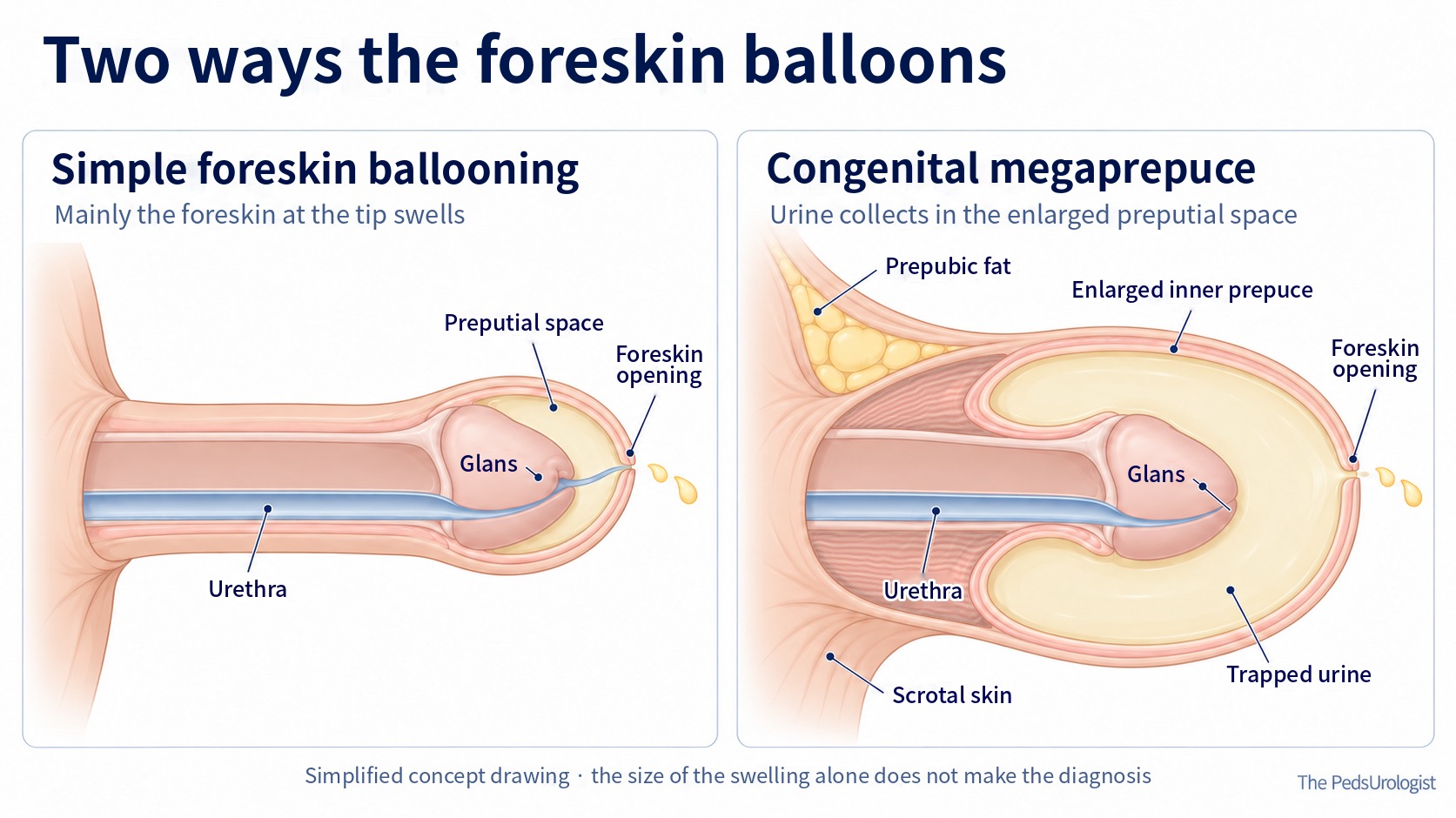
When the whole shaft swells like a pouch — congenital megaprepuce
In congenital megaprepuce the inner foreskin is excessively long and the skin covering the penis is abnormally arranged. "Mega" in the name refers to the greatly enlarged foreskin.
Whether megaprepuce is a form of concealed (buried) penis is debated. The reports that first described it as a condition held that it should be distinguished from buried penis.3 Others regard the long inner foreskin as a feature common to all buried penis and classify megaprepuce as a variant of its mildest grade (grade I); in this view the ballooning during voiding comes from a valve-like mechanism rather than a narrow opening.8 A series of 52 children likewise called megaprepuce "a specific form of buried penis".5 Whatever it is called, the examination looks at how the skin covering the penis is arranged.
Here urine collects in the enlarged inner-foreskin space, and the swelling can extend like a pouch over the shaft and around the base of the penis. Between voids the penis may look very short, hidden in the skin. Swelling may persist after voiding, or trapped urine may dribble out for a while. Some parents say they "have to press it for the rest of the urine to come out". If this keeps happening, mention it at the visit. Voiding discomfort or inflammation may come with it.3,5
| What to look at | Simple ballooning | What may be seen in congenital megaprepuce |
|---|---|---|
| Extent of swelling | Mainly the foreskin at the tip | May swell widely over the shaft and around the base |
| After voiding | Usually settles; a little may dribble | Urine remains and dribbles for a while, or does not drain well on its own |
| Usual appearance | An ordinary foreskin covering the glans | The penis may look short, hidden in the skin |
| Treatment | Usually observation if there are no troublesome symptoms | Skin anatomy and symptoms assessed, and whether and when to operate discussed |
These are points we look at together in clinic; the size or shape of the swelling alone cannot tell the two apart. Since it is hard to see a child pass urine in clinic, a photo or short video of the swelling during voiding is very helpful. The EAU guideline also notes that such material can help with diagnosis.1
When to see a doctor
Please see a pediatric urologist if:
- He is in pain or strains for a long time when passing urine.
- The stream stays thin and voiding takes longer than before.
- Swelling remains after voiding, and trapped urine dribbles for a while or does not drain well on its own.
- The swelling extends over the shaft and the penis looks buried even between voids.
- The foreskin repeatedly becomes red and swollen or discharges pus.
- A foreskin that used to retract is becoming tighter, with a white, firm, scar-like ring at the opening.
In particular, if a foreskin that used to retract is becoming tighter and scarring is visible, pathological phimosis — narrowing of the opening by inflammation or scarring — also needs to be checked. Not every sign above means megaprepuce; an examination tells them apart.1,6
If he tries to pass urine but nothing comes out, or a retracted foreskin will not go back and the glans swells (paraphimosis), seek emergency care immediately. Same-day care is also needed if he has a fever with a red, very swollen penis.6
Treatment depends on the anatomy
With simple ballooning and no troublesome symptoms, watching is usually enough. If a narrow foreskin opening is causing symptoms, steroid ointment prescribed by a doctor may be considered; where and for how long to apply it will be explained after examination. If there is inflammation, treatment suited to its cause and severity is needed as well.1,6
In congenital megaprepuce, ointment alone can hardly correct the structural problem of the enlarged foreskin and the arrangement of the skin. Surgery reduces the space where urine collects and rearranges the available skin to cover and fix the shaft. Approaches include unfurling the inner foreskin to use it, and reducing the enlarged inner foreskin while using the outer skin.4,7
The exact method and timing are decided after assessing the child's skin and any voiding difficulty. A further operation is sometimes needed to refine leftover skin or the appearance.3,5
So when megaprepuce is suspected, it is better to have a pediatric urology assessment than to decide on a routine circumcision first. Part of the foreskin may be needed as skin for the reconstruction, and removing it first can leave too little. The EAU guideline also advises against simple circumcision in buried penis or megaprepuce.1 A general explanation of timing of surgery for concealed penis is in "My Son's Penis Looks Too Small and Buried".
Do not force the foreskin back at home
A foreskin that does not yet retract on its own only needs gentle washing on the outside. Pulling it back forcibly to clean inside can cause small tears whose scarring makes the opening even tighter. Retracting it while it is inflamed can also cause paraphimosis.
If his foreskin retracts easily, pull it back gently at bath time to wash, and always return it forward over the glans afterwards.
Terminology, classification, indications and technique in concealed penis — including whether megaprepuce is a distinct entity or a variant of the long inner prepuce — are covered with the evidence here.
Concealed Penis, Part 1 — Terminology, Aetiology, Classification, and Penile Size
Concealed Penis, Part 2 — Indications, Timing, and Technique
Concealed Penis — What the Guidelines Say, and What They Do Not
Content for healthcare professionals.
References
- EAU Guidelines on Paediatric Urology. Phimosis and other abnormalities of the penile skin. European Association of Urology, 2026. uroweb.org
- Babu R, Harrison SK, Hutton KA. Ballooning of the foreskin and physiological phimosis: is there any objective evidence of obstructed voiding? BJU Int. 2004;94(3):384-387. doi:10.1111/j.1464-410X.2004.04935.x
- Summerton DJ, McNally J, Denny AJ, Malone PS. Congenital megaprepuce: an emerging condition — how to recognize and treat it. BJU Int. 2000;86(4):519-522. doi:10.1046/j.1464-410x.2000.00509.x
- Ruiz E, Vagni R, Apostolo C, et al. Simplified surgical approach to congenital megaprepuce: fixing, unfurling and tailoring revisited. J Urol. 2011;185(6 Suppl):2487-2490. doi:10.1016/j.juro.2011.01.015
- Rod J, Desmonts A, Petit T, Ravasse P. Congenital megaprepuce: a 12-year experience (52 cases) of this specific form of buried penis. J Pediatr Urol. 2013;9(6 Pt A):784-788. doi:10.1016/j.jpurol.2012.10.010
- The Royal Children's Hospital Melbourne. Clinical Practice Guidelines: The penis and foreskin. 2025. rch.org.au
- Alsamahy O, Gad D, Othman D, Fahiem-Ul-Hassan M. Byar's flaps in the management of congenital megaprepuce. Afr J Paediatr Surg. 2021;18(4):201-204. doi:10.4103/ajps.AJPS_144_20
- Hadidi AT. Buried penis: classification surgical approach. J Pediatr Surg. 2014;49(2):374-379. doi:10.1016/j.jpedsurg.2013.09.066