
Vesicoureteral reflux is often found for the first time when a child is investigated after a urinary tract infection. Parents then wonder whether the infection caused the reflux, or whether something about the urinary tract was different all along. The most common type, primary reflux, relates to the way the ureter joins the bladder — a structure present from birth. The infection is what brings it to light.
What prevents reflux is the path the ureter takes into the bladder
Urine made in the kidney travels down the ureter to the bladder. The bladder stores it and then empties it through the urethra. But pressure inside the bladder can also be transmitted back towards the ureter. To hold and empty urine without sending it back to the kidney, there needs to be a structure that prevents backflow where the two meet.
The end of the ureter passes at an angle through the muscle of the bladder wall, then runs for some distance beneath the mucosa — the lining that covers the inside of the bladder — before opening into the bladder. When pressure in the bladder rises, this segment is squeezed and its walls press together. Urine pushed down by the ureter can still enter the bladder, but urine pushed the other way is held back. What is often described as a "valve" is produced in this way by the ureter and the bladder wall working together. When this structure does not work well enough and urine in the bladder flows back up the ureter towards the kidney, it is called vesicoureteral reflux.
Scroll sideways to view
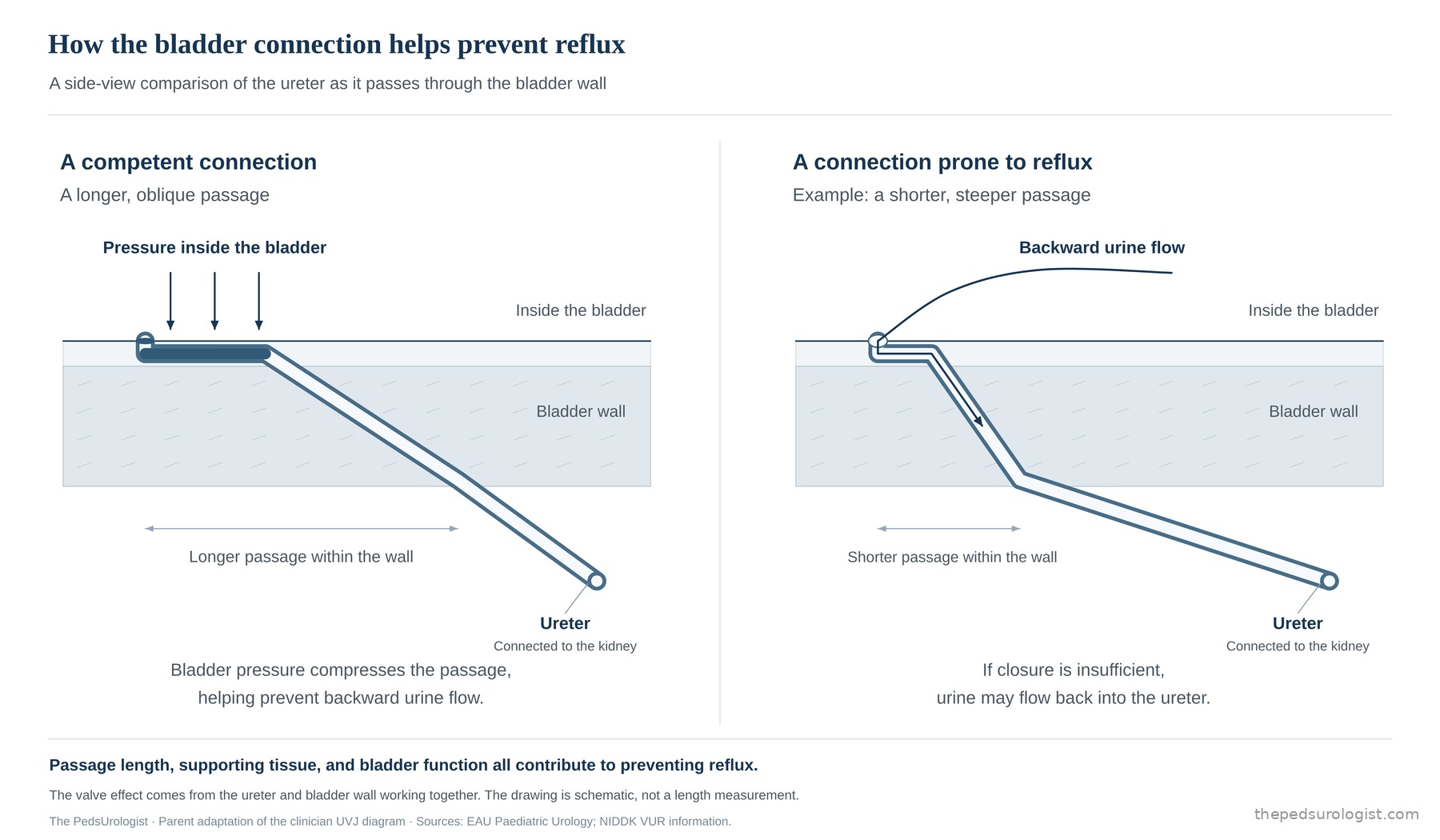
In some children the connection forms a little differently before birth
The connection between the ureter and the bladder is built before birth. During that process, where and at what angle the ureter enters the bladder, and how long its path through the wall is, are set. If the connection forms a little differently, its ability to prevent reflux can differ too. Typically, if the passage within the bladder wall is short there may not be enough length to close under pressure, and closure can also be affected if the ureter is wide or the surrounding support is weak.
So understanding reflux means thinking not only about the length of the passage but about the width of the ureter, the tissue that supports it, and how the bladder works. This is one reason children with the same diagnosis of reflux can follow different courses.
Sometimes the muscle beside the ureteral opening is weak
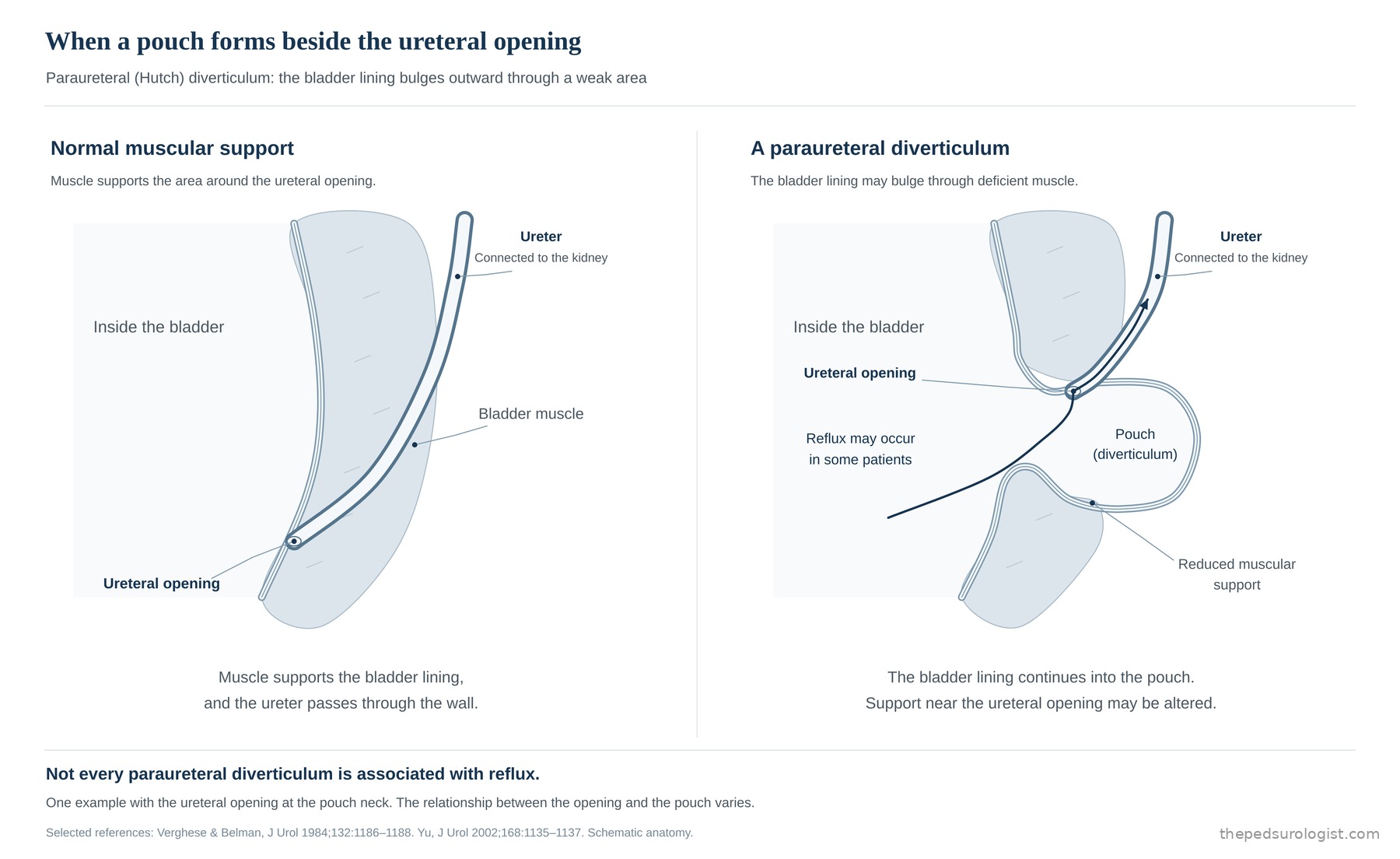
In some children, the bladder-wall muscle in one area beside the ureteral opening does not give enough support. The bladder lining can then be pushed out through that area and bulge like a pouch. This is called a paraureteral diverticulum — a pouch beside the ureter — or a Hutch diverticulum. The space inside the bladder continues into the pouch.
When a diverticulum lies close to the ureteral opening, it can affect the support around the opening and the path the ureter takes through the wall. In some children the ureteral opening sits at the neck of the pouch or even inside it. Depending on this relationship, the ability to prevent reflux can weaken — but not every child with a diverticulum has reflux.
Scroll sideways to view
It can run in families
Reflux is not uncommonly found in more than one member of a family. In the data summarised for the American Urological Association guideline, when the brothers and sisters of children with reflux were tested, reflux was found in about 1 in 4, and in about 1 in 3 of their children; the younger the child, the more often it was found.
It is not yet clear, however, that testing and treating every brother or sister without symptoms actually helps. Whether to test siblings is therefore decided with the doctors, taking into account the child's age, ultrasound findings and any history of urinary infection. Even if testing is not done, it is best not to delay a urine test when a sibling has a fever without an obvious cause.
How the bladder stores and empties matters too
Pressure inside the bladder affects the connection that prevents reflux. If the outflow of urine is blocked (for example, posterior urethral valves in boys) or there is a problem with the nerves that control the bladder (neurogenic bladder), raised pressure can overcome the connection's ability to prevent reflux. Reflux arising in this setting is called secondary reflux. In that case the bladder and the outflow of urine need to be looked at as well as the ureteral opening.
Even in children who already have primary reflux, bladder function and constipation are important. Difficulty storing and emptying urine can affect both the risk of repeated infection and the chance of the reflux improving. That is why, alongside the reflux test results, clinic visits include questions about holding on, rushing to the toilet, wetting underwear, and constipation. These questions are not meant to blame the child's habits; they are about finding and treating problems that affect how things are going.
The connection can change as a child grows
Having reflux at birth does not mean it will stay that way for life. As children grow, the connection between ureter and bladder develops and its ability to prevent reflux improves, and in some the reflux lessens or goes away. How likely this is, and how quickly, depends on the degree of reflux, the anatomy and bladder function. In general, the milder the reflux, the more likely it is to improve on its own; when it is more severe or the ureter is markedly widened, that likelihood is lower.
So in clinic, beyond the fact that reflux is seen, we look at what kind of connection and function problem this child has, whether infections keep coming back, and what state the kidneys are in. Understanding why reflux happens is the starting point for understanding why we sometimes recommend watching and sometimes explain that treatment is needed. Changes that can happen in the kidney continue in the next article, "Why can reflux affect the kidney?"
There are clinician articles covering the development of the ureterovesical junction and the natural history of reflux in detail.
Vesicoureteral Reflux, Part 1 — Why it happens, and why the kidney suffers
Vesicoureteral Reflux, Part 2 — Will it resolve, and is it safe to wait?
For healthcare professionals.
References
- Verghese M, Belman AB. Urinary retention secondary to congenital bladder diverticula in infants. J Urol. 1984;132(6):1186-1188. doi:10.1016/s0022-5347(17)50090-7
- Hernanz-Schulman M, Lebowitz RL. The elusiveness and importance of bladder diverticula in children. Pediatr Radiol. 1985;15(6):399-402. doi:10.1007/BF02388360
- Yu TJ. Extravesical diverticuloplasty for repair of a paraureteral diverticulum and the associated refluxing ureter. J Urol. 2002;168(3):1135-1137. doi:10.1016/S0022-5347(05)64610-1
- Skoog SJ, Peters CA, Arant BS Jr, et al. Pediatric Vesicoureteral Reflux Guidelines Panel Summary Report: clinical practice guidelines for screening siblings of children with vesicoureteral reflux and neonates/infants with prenatal hydronephrosis. J Urol. 2010;184(3):1145-1151. doi:10.1016/j.juro.2010.05.066
- EAU/ESPU Guidelines on Paediatric Urology — Vesicoureteric Reflux. uroweb.org
- National Institute of Diabetes and Digestive and Kidney Diseases. Vesicoureteral Reflux (VUR). niddk.nih.gov