
Sometimes a child is investigated for a urinary tract infection, vesicoureteral reflux is found, and then parents are told that one kidney is small or not working as well. It is natural to wonder: did the urine flowing backwards damage the kidney? Did this infection hurt it? Would things have been different if we had noticed the fever a little sooner?
But the moment reflux is found and the moment a kidney problem began may not be the same. To make sense of this, it helps to separate the state of the kidney from birth from the changes that can follow an infection.
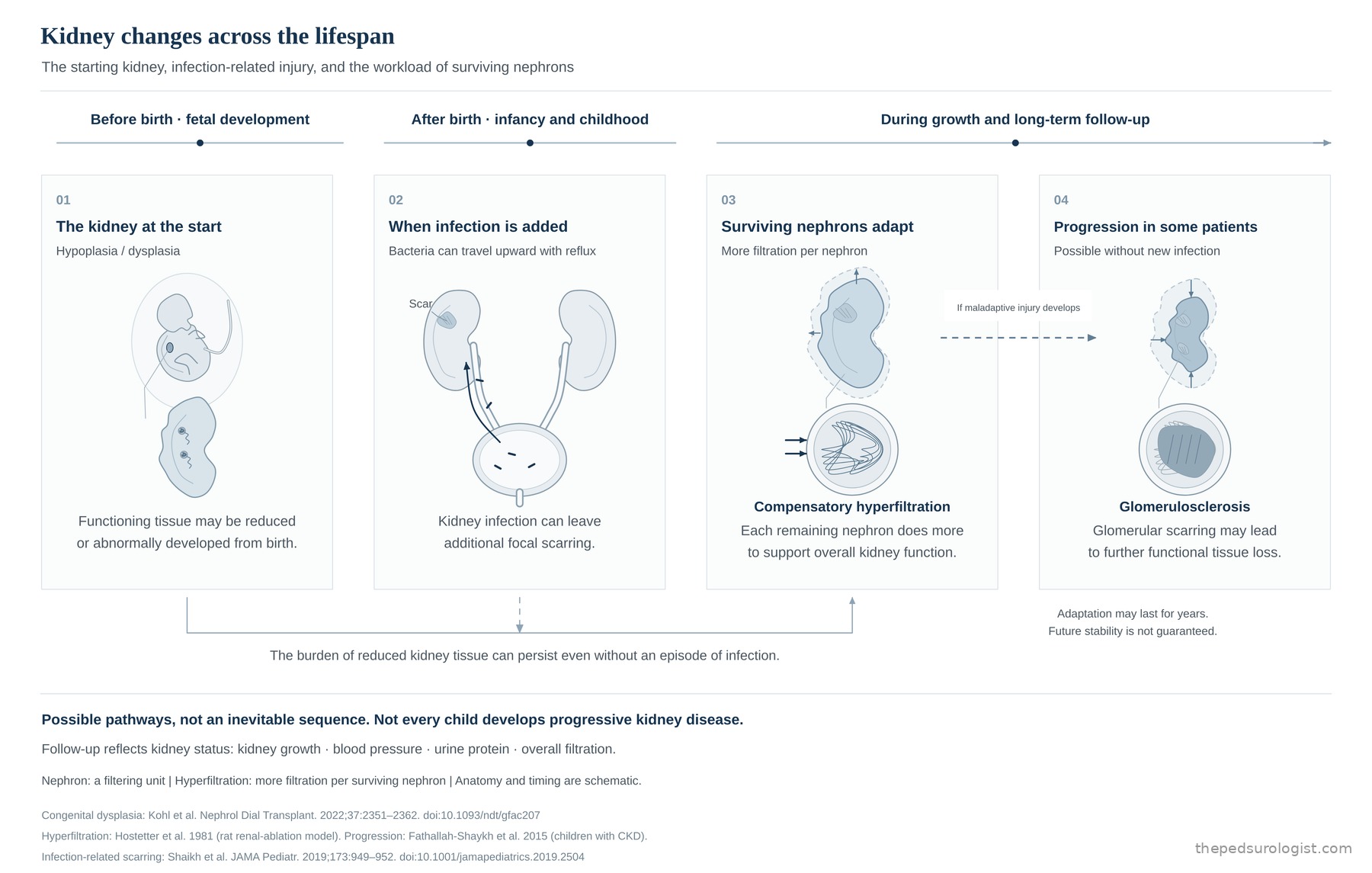
Some kidneys are formed differently from the start
The kidney and the ureter — the tube that carries urine down from it — are built together before birth. A small bud that becomes the ureter and the cells that become kidney tissue send signals to each other, so the tissue that makes urine and the path that drains it develop side by side.
If this process goes differently, both the way the ureter joins the bladder and the development of the kidney can be affected. In some children, reflux comes with a kidney that formed smaller, with less working tissue, or with tissue whose structure developed differently. These changes can be present before the first urinary infection. They are sometimes seen on pregnancy ultrasound, and sometimes found for the first time when the child is tested after an infection.
So finding a small kidney after an infection does not mean the infection destroyed a normal-sized kidney. Equally, not every child with reflux has differences of this kind.
When infection reaches the kidney, it can add damage
Reflux makes it easier for bacteria in the bladder to travel up towards the kidney. An infection may stay in the bladder, but when it reaches the kidney tissue itself it is called pyelonephritis. The bacteria and the body's own defences together cause inflammation in the tissue.
After treatment the inflammation often settles and the tissue recovers, but where damage was severe, a scar can be left in place of normal tissue. This is called a renal scar. Not every urinary infection is a kidney infection, and not every kidney infection leaves a scar. Repeated infections with fever do raise the concern of further damage, though, so reducing recurrences and having a suspected infection properly assessed matter.
Damage from infection can also be added to a kidney that had less working tissue from the start. A congenital difference and damage from infection can exist together in the same child.
One test cannot tell the whole history
Just after an infection, inflammation can make part of the kidney look as if it is working less well on a scan. Because this can recover, a scan taken just after an infection should not be read straight away as a scar that will last for life. Where needed, the kidney is reassessed after it has had time to recover.
Comparing with earlier scans helps: it shows whether the kidney was already small before the infection, whether a new change has appeared in an area that was normal, and whether things recover over time. Without earlier imaging, though, it may be hard to say exactly how much of what is seen now was there from birth and how much followed the infection. Not assuming that everything found at the first infection was caused by that infection is where an accurate explanation begins.
This question has two parts. A kidney that formed smaller from the start would not have been different however early it was known. For infection, there are studies in which scarring was somewhat more common when treatment was delayed — but a baby with a fever usually looks at first as if they have a cold, so this cannot be put down to a parent's failing. What matters is not going back over what happened, but not delaying a urine test when your child has a fever in future.
If the reflux goes away, does the kidney return to normal?
Function that dropped temporarily because of infection can recover. But tissue that formed with less working capacity from the start, or a scar that has already set, does not become normal tissue just because the reflux resolves or is corrected by surgery. In the short term, the aim of treating reflux is to prevent infections with fever; in the long term, it is to preserve the kidney function that remains. It is not a treatment that reverses changes already present.
Nor does having a scar mean kidney failure. Many children with one small kidney or a scar in part of a kidney keep good overall kidney function. How things go depends on whether one side or both are affected and how well the remaining tissue works.
The remaining kidney tissue works harder to keep overall function up. Most children do well like this for a long time, but in some whose working tissue was much reduced from the start, the extra load can build up over time — and this can happen even without a new infection. Blood pressure and protein in the urine can be early signs of this, which is why they are checked.
Scroll sideways to view
What to do from here
Where needed, kidney growth is followed along with blood pressure, protein in the urine and overall kidney function. The reason these checks can continue even after the reflux has gone is the load on the remaining kidney described above.
In future care, it helps to agree in advance with your child's doctors where to have a urine test if a fever comes without an obvious cause, and to look at issues such as constipation or a habit of holding urine for a long time. Whether preventive antibiotics or surgery are needed is decided from your child's history of infection and test results.
What parents need to know is not only the grade of reflux. It is also what state your child's kidneys are in now, what to do to reduce further damage, and what will be checked going forward.
There are clinician articles covering the two routes of renal damage, post-infectious scarring and the long-term course in detail.
Vesicoureteral Reflux, Part 1 — Why it happens, and why the kidney suffers
Vesicoureteral Reflux, Part 3 — How pyelonephritis leaves a scar on the kidney
Vesicoureteral Reflux, Part 4 — How a small or scarred kidney grows
For healthcare professionals.
References
- Hostetter TH, Olson JL, Rennke HG, Venkatachalam MA, Brenner BM. Hyperfiltration in remnant nephrons: a potentially adverse response to renal ablation. Am J Physiol. 1981;241(1):F85-F93. doi:10.1152/ajprenal.1981.241.1.F85
- Marra G, Barbieri G, Dell'Agnola CA, et al. Congenital renal damage associated with primary vesicoureteral reflux detected prenatally in male infants. J Pediatr. 1994;124(5 Pt 1):726-730.
- Lahdes-Vasama T, Niskanen K, Rönnholm K. Outcome of kidneys in patients treated for vesicoureteral reflux (VUR) during childhood. Nephrol Dial Transplant. 2006;21(9):2491-2497. doi:10.1093/ndt/gfl216
- Fathallah-Shaykh SA, Flynn JT, Pierce CB, et al. Progression of pediatric CKD of nonglomerular origin in the CKiD cohort. Clin J Am Soc Nephrol. 2015;10(4):571-577. doi:10.2215/CJN.07480714
- Shaikh N, Mattoo TK, Keren R, et al. Early antibiotic treatment for pediatric febrile urinary tract infection and renal scarring. JAMA Pediatr. 2016;170(9):848-854. doi:10.1001/jamapediatrics.2016.1181
- Shaikh N, Haralam MA, Kurs-Lasky M, Hoberman A. Association of renal scarring with number of febrile urinary tract infections in children. JAMA Pediatr. 2019;173(10):949-952. doi:10.1001/jamapediatrics.2019.2504
- Kohl S, Avni FE, Boor P, et al. Definition, diagnosis and clinical management of non-obstructive kidney dysplasia: a consensus statement by the ERKNet Working Group on Kidney Malformations. Nephrol Dial Transplant. 2022;37(12):2351-2362. doi:10.1093/ndt/gfac207
- Vali R, Armstrong IS, Bar-Sever Z, et al. SNMMI procedure standard/EANM practice guideline on pediatric [99mTc]Tc-DMSA renal cortical scintigraphy: an update. Clin Transl Imaging. 2022;10(2):173-184. doi:10.1007/s40336-022-00484-x
- National Institute for Health and Care Excellence. Urinary tract infection in under 16s: diagnosis and management. NICE guideline NG224. nice.org.uk/guidance/ng224