
Part 6 read curvature as structure rather than as an angle. Skin, fascia, the urethra and urethral plate, and the corpora each contribute their own share, and the names we use do not tell us which of them is responsible. The conclusion was that intraoperative judgement has to rest on stepwise observation. This part is about those steps.
What sets the strategy in hypospadias surgery is curvature more than the position of the meatus. Which urethroplasty, and whether to finish in one operation or two, depends on whether the urethral plate survives the straightening — and that in turn depends on how much the penis straightens when each structure is released. So this part asks three questions: how much curvature should be corrected, how it is measured, and in what order it is straightened.
From what angle do we correct?
The EAU/ESPU guideline states that curvature of 30° or more is deemed to warrant correction. The same paragraph adds that the clinically significant angle may differ between patients, and the recommendation is weak. Castagnetti and El-Ghoneimi's 2022 review makes the point more plainly: the cut-off for significant curvature remains unclear, and not every patient is bothered by the same angle. Where the number 30 comes from, and what it rests on, is discussed in the guideline note.
That does not mean smaller angles can be waved away. Among 53 adults (mean age 42) with unoperated distal hypospadias who came to a hypospadias specialty centre, 33% had ventral or lateral curvature; in the 11 measured intraoperatively with a goniometer it averaged 36° (15–65°). Seven reported pain or discomfort during sex because of the curvature. In a self-report survey recruited through social media, men with untreated hypospadias likewise reported more ventral curvature, and more difficulty with intercourse because of it, than controls. Both sources have clear limitations, but together they suggest that a distal meatus is no guarantee that curvature will not become an adult problem.
In practice, then, 30° is used less as the line between correcting and not correcting than as the line at which the method of correction changes. If the curvature left after degloving is under 30°, correction with the plate preserved — dorsal plication or ventral lengthening — can be considered; at 30° or more the plate is transected. That is the current threshold in proximal and severe hypospadias. The same number, used in a different place.
Measuring — artificial erection and the angle
Curvature shows only in erection, so intraoperatively it is assessed with an artificial erection. Injecting saline into the corpora, described by Gittes and McLaughlin in 1974, remains the standard. What matters for this part is that the test is repeated after every step, not done once. The whole flow below rests on that repetition.
There is still no standard way of reading the angle. The guideline says, cautiously, that a goniometer or smartphone app appears to improve accuracy over eyeballing, and a 2022 review of measurement tools concludes that no accurate, reproducible tool yet exists. The limits of eyeballing show up in the numbers. In a study that followed recurrent curvature after proximal TIP, curvature had been estimated by eye for most of the study period and was mostly thought to be under 45°; when recurrent curvature was later measured objectively, it averaged 52° (30–75°).
The problem of timing — the angle differs before and after degloving, and with injection pressure — is covered under “Measuring” in the technique note. Here one point is enough: which step an angle was recorded after matters as much as the angle itself.
Release, re-measure — the stepwise flow
The guideline recommends a stepwise approach to ventral curvature: begin with the least invasive measure, confirm the remaining angle with an artificial erection after each one, and stop once the penis is straight enough. The flow below follows the summary in the author's 2026 lecture. The branch point is the angle left after degloving: under 30°, correct with the plate preserved; 30° or more, transect the plate. The proximal algorithm in the 11th edition of Campbell-Walsh Urology uses this threshold, and the guideline does not recommend correcting severe cases with the plate left intact.
Decision flow
Release, re-measure,
and go only as far as needed
After each step, an artificial erection shows how much curvature remains. Once the penis is straight enough, move on to urethral reconstruction rather than to the next step.
-
1
Degloving and chordectomy
Release skin and dartos tethering, and excise the dysplastic ventral connective tissue (the ventral tethering complex).
Artificial erection Straight → urethral reconstruction Under 30° → 2 30° or more → 3 Former threshold: 30° or more → 2B first -
2
Correction with the plate preserved under 30°
A Dorsal plicationorShorten the longer dorsal side to match the two. Midline (12 o’clock) plication is widely used.
B Urethral mobilization + corporotomy or corporoplasty ± dorsal plicationSeparate the urethra and urethral plate from the corpora (urethral mobilization), then perform corporotomy or corporoplasty on the ventral tunica exposed beneath.
Artificial erection Straight → urethral reconstruction Persistent curvature · plate tension → 3 -
3
Urethral plate transection 30° or more
With 30° or more left after degloving, come straight here without plate-preserving correction. From this point the conditions for urethral reconstruction change.
Artificial erection Straight → reconstruct under the new conditions Persistent curvature → 4 -
4
Corporotomy · corporoplasty
Corporal curvature that persists after transection is treated by ventral lengthening. It is not rare in severe proximal cases.
Artificial erection Final check
The change of the last ten years or so. Previously, even with 30° or more after degloving, mobilization and ventral lengthening with the plate preserved (2B) were tried first, and the plate was transected only if the penis still would not straighten (Campbell-Walsh Urology, 10th edition). Since the mid-2010s, 30° or more remaining in proximal hypospadias has meant going straight to plate transection (Campbell-Walsh Urology, 11th edition; EAU/ESPU guideline).
Degloving and chordectomy are what the guideline names as the first step of stepwise correction. The ventral tissue removed here is the dysplastic dartos and Buck’s fascia seen in Part 6 — converging toward the splayed corpus spongiosum and attaching densely to the ventral tunica, it acts like an inelastic bowstring. So degloving is exposure for the operation and, at the same time, a diagnostic step that removes one cause to see what remains.
Of the two plate-preserving options, urethral mobilization with ventral lengthening is the one more easily overlooked. Ventral lengthening is easy to think of as something done only after the plate has been cut, but once the urethral plate, corpus spongiosum and proximal urethra are dissected off the corpora, the ventral tunica beneath can be reached with the plate intact. Mobilization alone sometimes straightens the penis; residual curvature can be treated with a corporotomy in the same field. With greater curvature one goes to mobilization and ventral lengthening from the outset, adding dorsal plication when needed.
This approach was once used more widely. The 2009 report behind the proximal algorithm in the 10th edition of Campbell-Walsh Urology tried plate-preserving mobilization and ventral lengthening first even in proximal hypospadias with more than 30° after degloving, and reduced the rate of plate transection from 54% to 15%. A 2010 systematic review likewise recommended a stepwise approach starting with ventral dissection extended beneath the plate. But follow-up in that report averaged only 11 months, and as late recurrence came to light the threshold moved toward transecting straight away at 30° or more — section 5 returns to this.
Shorten or lengthen?
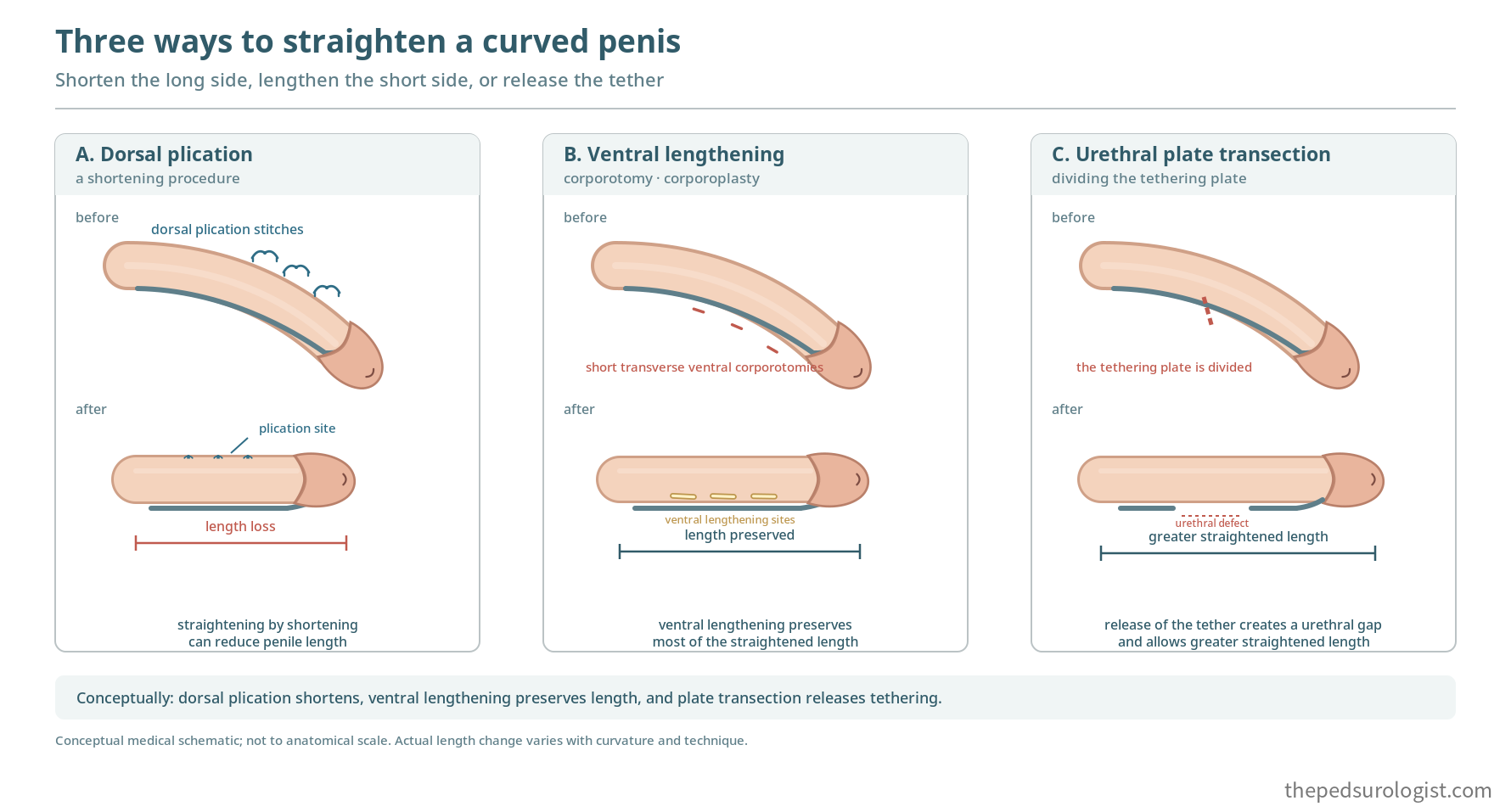
If curvature remains after all external tethering has been released, its share lies in the corpora. The only options are to shorten the longer dorsal side or lengthen the shorter ventral side until the two match.
| Approach | Typical techniques | Strengths | Costs |
|---|---|---|---|
| Dorsal shortening | Plication, Nesbit (tunical excision), Heineke–Mikulicz (longitudinal incision, transverse closure), midline plication | Simple and quick; leaves the ventral side alone | Loss of penile length; possible reduced sensation. Recurrence rises with larger angles |
| Ventral lengthening | Multiple transverse incisions (e.g. three corporotomies, uncovered); single incision with a graft (tunica vaginalis and others) | Preserves length; less recurrence | A larger operation; long-term data on erectile function are still limited |
Among dorsal shortening techniques, midline plication rests on the anatomical observation that the dorsal neurovascular bundle runs very little at the midline, the 12 o’clock position. Sutures can be placed in the midline without elevating the bundle — that is its advantage. But any dorsal technique works by shortening the longer side, so length loss cannot be avoided, and the guideline notes that penile length is one of the main reasons for dissatisfaction after hypospadias repair.
Comparisons of recurrence point in a consistent direction. In 100 cases of proximal hypospadias at SickKids, curvature recurred in 27.9% after dorsal plication and 9.4% after ventral lengthening, and plication remained an independent risk factor on multivariate analysis (OR 4.56). A meta-analysis pooling 17 studies and 582 patients found 25.4% against 5.3% — the source of the guideline’s “25% versus 5%”. A 2024 scoping review likewise found that most studies in curvature with hypospadias reported better results with corporotomy.
These comparisons need to be read with care. All are retrospective and the two groups were not alike. Braga and colleagues themselves called for studies adjusted for proximal ventral dissection and plate transection. Castagnetti’s 2022 review concluded, for the same reason, that ventral lengthening should be used selectively because long-term follow-up data are lacking.
The most recent large dataset is a 2026 single-centre report. In 400 boys with proximal hypospadias and curvature of 30–135° (mean 74° in the 237 primary repairs), three corporotomies alone at the first of three staged operations left 81% straight on artificial erection at the next operation; residual curvature was always 30° or less and was mostly corrected by a single Heineke–Mikulicz plication, for 99% overall. No bleeding required intervention, and one adult reported a 15% decrease in erection fullness. The data show that three corporotomies achieve a high correction rate on their own, but also that residual curvature can remain even after the most effective method. The authors, noting that residual curvature can follow any method of straightening, concluded that artificial erection should be repeated at the next stage of staged repairs and at reoperation.
Cutting the bowstring does not straighten the bow
Think of the urethral plate as a bowstring and the penis as the bow. If the string is pulling the bow, cutting the string straightens it. But if the stave itself is bent, cutting the string leaves the bow as it is. If the real cause lies in a ventral fibrous band or in corporal disproportion, plate transection solves only part of the problem.
Operative results show this. In 43 boys with proximal hypospadias and 30° or more after degloving (mean 70°), the plate was transected in all, yet 65% still needed corporotomy. In two of every three, the stave was still bent after the string had been cut. That is why, in the flow, corporotomy or corporoplasty follows plate transection.
Meanwhile, the long-term results of straightening with the plate preserved fell short of expectations. The guideline gives a recurrence rate of curvature after proximal TIP of 26%. In a single-centre study reporting the same figure, curvature recurred in 26% of 58 boys who had been straightened, and might have reached one in three if suspected cases were included. There was no difference between those treated with dorsal plication alone and those who also had plate and urethral mobilization or corporotomy. An intact plate was itself associated with recurrence, and Braga and colleagues’ data pointed the same way. The authors of that study later wrote that they now perform proximal TIP only when curvature is under 30°.
The guideline follows the same direction. In distal hypospadias the plate rarely causes curvature, but in severe cases hinging of the plate may require transection before ventral lengthening or dorsal plication, and leaving the plate untransected is not recommended because of the risk of recurrent curvature (20%) and stricture (17%).
This change is why plate-preserving correction sits on the under-30° side of the flow. Treating the corpora with the plate intact has not disappeared, but when 30° or more remains after degloving in proximal hypospadias, the plate is transected rather than preserved. That the same textbook’s algorithm changed between one edition and the next shows how far short-term and long-term results can diverge in this field.
The method of straightening is also bound up with urethral reconstruction. The guideline notes growing evidence that corporoplasty covered with a graft should not be done in the same operation as graft urethroplasty. How we straighten constrains how we rebuild, and the reverse.
When the penis bends again
Recurrent curvature tends to be found late. In the proximal TIP study above, all recurrent curvature was diagnosed before puberty; the clues were resistance to lifting the glans upward and a hunched-over appearance of the penis. In another report of 82 patients who presented after puberty with complications, 80% of complications were reported to have arisen before puberty, and all recurrent curvature before puberty. Rather than penile growth at puberty creating new curvature, curvature already present tends to show itself, or be recognized, then. The timing, though, relies on patients’ recall.
Another clue is repeated urethral complications. In the same study, the authors noted that recurring fistula or dehiscence often concealed curvature. When urethroplasty fails repeatedly, look not only at the urethra but recheck curvature with an artificial erection. It is the same point as the 2026 data — residual curvature can remain after any technique. Diagnosis and follow-up of postoperative curvature will be taken up again in the series on complications.
Straight penis first
Discussion of hypospadias surgery tends to begin with TIP, onlay or staged repair. The order is closer to the reverse. First straighten the penis. That process decides whether the plate survives, and only then is the method of building the urethra settled.
The process is not a single fixed operation but a cycle of releasing, re-measuring and going only as far as needed. Each step is treatment and, at the same time, a test that isolates one cause. If degloving straightens the penis, the share was skin and fascia; if dissecting the urethra off the corpora does, plate tethering was large; if curvature remains after transection, the share is corporal. Here is the operating-room answer to Part 6’s point that the names do not identify the causative tissue.
30° is used more as the line at which the method of correction changes than as the line between correcting and not. If the angle left after degloving and chordectomy is under 30°, correction with the plate preserved — dorsal plication, or urethral mobilization with ventral lengthening — can be considered; at 30° or more the plate is transected. Curvature that remains after transection is treated with corporotomy or corporoplasty. After every step, artificial erection confirms the remaining angle. Dorsal plication is simple but recurs more often at larger angles; ventral lengthening recurs less but long-term data are limited.
Next — to preserve the urethral plate or to cut it. The moment the plate is cut, the question changes from “how do we straighten?” to “how do we rebuild the urethra?” The next part looks at when the plate can be preserved and when it cannot, and how that leads to TIP, onlay or staged repair.
References
- EAU Guidelines on Paediatric Urology. Chapter 9, Hypospadias — 9.5.4 Penile curvature. European Association of Urology, 2026 limited update.
- Castagnetti M, El-Ghoneimi A. Surgical management of primary severe hypospadias in children: an update focusing on penile curvature. Nat Rev Urol. 2022;19(3):147-160. doi:10.1038/s41585-021-00555-0
- Castagnetti M, El-Ghoneimi A. Surgical management of primary severe hypospadias in children: systematic 20-year review. J Urol. 2010;184(4):1469-1474. doi:10.1016/j.juro.2010.06.044
- Bush NC, Snodgrass W. Complaints of men with uncorrected distal hypospadias. Res Rep Urol. 2023;15:425-430. doi:10.2147/RRU.S405901
- Schlomer B, Breyer B, Copp H, Baskin L, DiSandro M. Do adult men with untreated hypospadias have adverse outcomes? A pilot study using a social media advertised survey. J Pediatr Urol. 2014;10(4):672-679. doi:10.1016/j.jpurol.2014.01.024
- Gittes RF, McLaughlin AP. Injection technique to induce penile erection. Urology. 1974;4(4):473-474. doi:10.1016/0090-4295(74)90025-9
- Abbas TO. Evaluation of penile curvature in patients with hypospadias; gaps in the current practice and future perspectives. J Pediatr Urol. 2022;18(2):151-159. doi:10.1016/j.jpurol.2021.12.015
- Baskin LS, Duckett JW. Dorsal tunica albuginea plication for hypospadias curvature. J Urol. 1994;151(6):1668-1671. doi:10.1016/s0022-5347(17)35341-7
- Baskin LS, Erol A, Li YW, Liu WH. Anatomy of the neurovascular bundle: is safe mobilization possible? J Urol. 2000;164(3 Pt 2):977-980. doi:10.1097/00005392-200009020-00014
- Braga LH, Lorenzo AJ, Bägli DJ, et al. Ventral penile lengthening versus dorsal plication for severe ventral curvature in children with proximal hypospadias. J Urol. 2008;180(4 Suppl):1743-1747. doi:10.1016/j.juro.2008.03.087
- Snodgrass W, Prieto J. Straightening ventral curvature while preserving the urethral plate in proximal hypospadias repair. J Urol. 2009;182(4 Suppl):1720-1725. doi:10.1016/j.juro.2009.02.084
- Snodgrass W, Bush N. Staged tubularized autograft repair for primary proximal hypospadias with 30-degree or greater ventral curvature. J Urol. 2017;198(3):680-686. doi:10.1016/j.juro.2017.04.019
- Snodgrass W, Bush N. Recurrent ventral curvature after proximal TIP hypospadias repair. J Pediatr Urol. 2021;17(2):222.e1-222.e5. doi:10.1016/j.jpurol.2020.11.030
- Babu R, Chandrasekharam VVS. A meta-analysis comparing dorsal plication and ventral lengthening for chordee correction during primary proximal hypospadias repair. Pediatr Surg Int. 2022;38(3):389-398. doi:10.1007/s00383-022-05065-7
- Snodgrass W, Bush N. Do new complications develop during puberty after childhood hypospadias repair? J Urol. 2022;208(3):696-701. doi:10.1097/JU.0000000000002738
- Yadav P, Bobrowski A, Ahmad I, et al. A scoping review on chordee correction in boys with ventral congenital penile curvature and hypospadias. Indian J Urol. 2024;40(1):17-24. doi:10.4103/iju.iju_277_23
- Snodgrass W, Bush N. Efficacy of three corporotomies to correct ventral penile curvature. Experience in 400 patients with severe hypospadias. J Pediatr Urol. 2026;22(2):105722. doi:10.1016/j.jpurol.2026.105722
- Campbell-Walsh Urology, 10th and 11th editions. Hypospadias chapter — proximal hypospadias algorithms.
- Kim SW. Management of Penile Curvature in Hypospadias. Lecture, 2nd surgical conference of the Korean research society for urogenital trauma and reconstruction, 2026.