
Once reflux is confirmed the questions change. How much risk does this child carry, and what should be watched, and for how long? From here on the AUA and EAU/ESPU guidelines are at the centre; the AAP 2026 guideline joins only for the definition of risk, and NICE only for kidney follow-up.
Does labelling a child high-risk actually pick out the children who do badly? And what still needs watching after the reflux has gone?
1. What is assessed at diagnosis?
Both guidelines ask for more than the reflux grade: renal status and bladder and bowel function are assessed alongside it. The EAU/ESPU baseline is a history including family history and screening for lower urinary tract dysfunction (LUTD), blood pressure, urinalysis for proteinuria and a urine culture, and serum creatinine when both kidneys are abnormal. Imaging is based on ultrasound, VCUG and nuclear medicine, with the DMSA scan at diagnosis serving as the baseline for later comparison. The AUA makes height, weight, blood pressure and creatinine in bilateral abnormality a Standard; urinalysis and ultrasound a Recommendation; and baseline creatinine and DMSA an Option.
The clearest agreement is on BBD. EAU/ESPU rates as Strong a detailed assessment for LUTD in every child, particularly after toilet training, with LUTD treated first if present; the AUA makes looking for symptoms of BBD at the initial evaluation a Standard. In the AUA meta-analysis BBD made a large difference to the course. On antibiotic prophylaxis, reflux resolved in 31% of children with BBD versus 61% without; after endoscopic treatment, in 50% versus 89%. Only open surgery showed no difference, at 97% in both groups.
2. How do the three guidelines stratify risk?
It is EAU/ESPU that puts risk stratification at the heart of its guideline. The early risk classification proposed by Tekgül and colleagues in 2012 became Table 3 of the current VUR chapter. It uses five axes — symptoms, toilet-training status, reflux grade, renal abnormality and LUTD — to build nine rows, each with an initial treatment and a time for re-evaluation. The panel admits that the table is complex, but adds that simpler guidance underestimates the complexity of reflux.
| Risk group | Presentation | Initial treatment | Follow-up / re-evaluation |
|---|---|---|---|
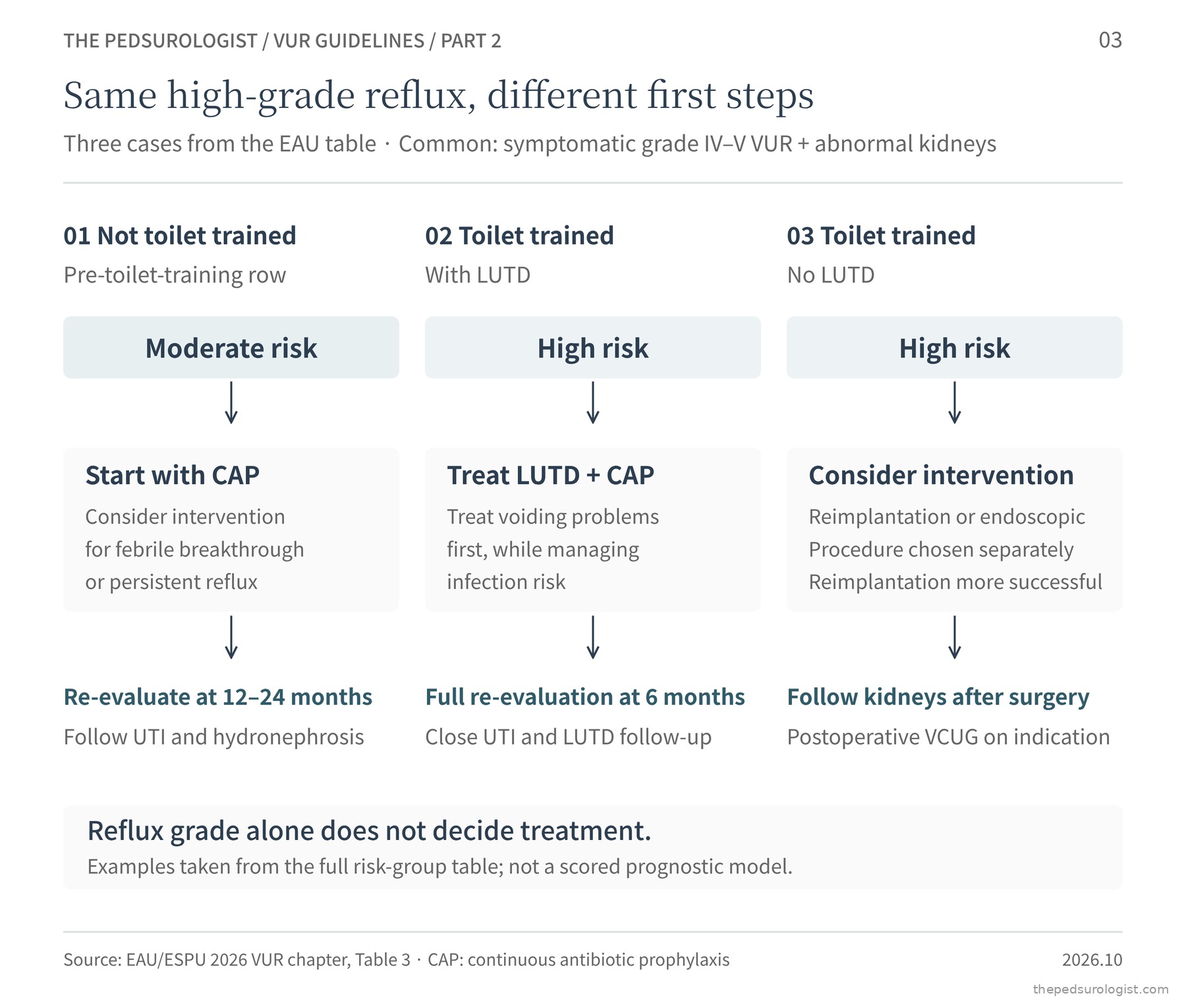
| High | Symptomatic after toilet training; high grade (IV–V), abnormal kidneys, LUTD | Treat LUTD, with CAP. Consider intervention for breakthrough infection or persistent reflux | Close UTI and LUTD follow-up; re-evaluate at 6 months |
| High | Symptomatic after toilet training; high grade, abnormal kidneys, no LUTD | Consider intervention. Reimplantation gives better results than endoscopic treatment | Postoperative VCUG on indication only; follow renal status until after puberty |
| Moderate | Symptomatic before toilet training; high grade, abnormal kidneys | CAP. Consider intervention for breakthrough infection or persistent reflux | Re-evaluate at 12–24 months |
| Moderate | Asymptomatic (prenatal hydronephrosis or sibling); high grade, abnormal kidneys | CAP. Consider intervention for breakthrough infection or persistent reflux | Re-evaluate at 12–24 months |
| Moderate | Symptomatic after toilet training; high grade, normal kidneys, LUTD | Treat LUTD, with CAP. Consider intervention if LUTD persists | Re-evaluate after successful urotherapy |
| Moderate | Symptomatic after toilet training; low grade, abnormal kidneys | Controversial. Endoscopic treatment is an option | Follow renal status until after puberty |
| Moderate | Symptomatic; normal kidneys, low grade, LUTD | Treat LUTD; CAP optional | Follow UTI and LUTD |
| Low | Symptomatic; normal kidneys, low grade, no LUTD | No treatment or CAP | Follow UTI |
| Low | Asymptomatic; normal kidneys, low grade | No treatment (CAP possible in infants) | Follow UTI |
Two keys unlock the table. The core of the high-risk group is high-grade reflux found through symptoms after toilet training, combined with abnormal kidneys. The same high grade before toilet training is moderate risk, because spontaneous resolution of high-grade reflux is more common in infants. And when LUTD is present, its treatment comes first in every risk group; in the corresponding high-risk group without LUTD, intervention is considered from the outset.
The AUA divides by age instead of by table. Under one year it recommends antibiotic prophylaxis for a history of febrile UTI or grade III–V reflux; at one year or older it recommends prophylaxis when BBD is present, for as long as the BBD exists and is being treated (Recommendation). When BBD, recurrent febrile UTI and renal cortical abnormality are all absent, prophylaxis and observation are both options (Option); if any one of them is present, observation is not recommended. Treatment in the presence of recurrent infection or cortical abnormality is decided individually under the breakthrough-infection section. The AAP 2026 guideline draws explicit boundaries for primary care. Low risk is grade I–II without BBD; high risk is any of grade IV–V, intrarenal reflux, renal scarring, structural or cortical abnormality, recurrent pyelonephritis, bacteraemia leading to intensive-care admission, or BBD. Grade III is set apart as uncertain. Note that BBD in this risk classification excludes functional constipation, so it cannot be compared directly with BBD as defined by the other guidelines.
The three classifications share their axes: grade, bladder and bowel function, and renal abnormality. What they decide differs. In EAU/ESPU the classification sets the intensity of the whole management plan; in the AUA it mainly decides whether to recommend prophylaxis; in the AAP it determines what happens in primary care and when to refer to a specialist.
3. Has the stratification been validated?
The studies that have tested the EAU/ESPU risk groups against real outcomes are, as far as I could find, retrospective series from a single country. One study of 157 children, counting a new infection or new scar as treatment failure, concluded that the low-risk group had been overtreated8; another, comparing 334 renal units before and after the risk groups were introduced, found fewer primary operations in the moderate- and high-risk groups without any change in early clinical success9. A multicentre study of 1,345 patients (1,988 renal units) at nine institutions also exists, but it examined practice patterns in surgically treated patients and reported that practice in the low- and moderate-risk groups still did not follow the guideline10. More broadly, a 2026 review found that of 17 reflux prediction tools published over 39 years, only five had been externally validated and none was suitable for general use11.
The risk table is best read as a consensus framework that organises judgement where evidence is thin, not as a prognostic model that has passed adequate external validation. Read that way, its usefulness becomes clear: it tells you what to do first for this child, but not whether this child will do badly.
4. When do reflux follow-up and kidney follow-up end?
Follow-up should be split in two. Reflux follow-up moves, once resolution is confirmed, to considering an end to routine reflux imaging (a febrile infection after resolution prompts re-evaluation for BBD and recurrent reflux). Kidney follow-up runs much longer, depending on any remaining renal abnormality.
| Item | AUA (2010/2017) | EAU/ESPU (2026) |
|---|---|---|
| Annually while reflux persists | Blood pressure, height, weight; urinalysis for protein and bacteriuria (Recommendation) | UTI, LUTD and renal status (risk table) |
| Ultrasound | Every 12 months for renal growth and scarring (Recommendation) | Part of routine imaging follow-up |
| Follow-up cystography | Every 12–24 months, longer if resolution is less likely (Recommendation). Option under observation. One normal study can establish resolution (Option) | Full re-evaluation at 6 or 12–24 months by risk group. In the relevant high-risk surgical group of the EAU table, postoperative VCUG on indication only |
| DMSA | For abnormal ultrasound, breakthrough infection or grade III–V reflux, or raised creatinine (Recommendation). Checking for new scars after febrile UTI is an Option | Baseline at diagnosis, later comparison |
| After resolution | Annual evaluation through adolescence if either kidney is abnormal (Recommendation); Option if both are normal. Evaluate for BBD and recurrent reflux if febrile UTI occurs | Children with renal abnormalities: follow renal status until after puberty |
The UTI guidelines approach follow-up differently. NICE advises no long-term follow-up for a minor unilateral parenchymal defect in the absence of recurrent infection, family history or risk factors for hypertension, with bilateral abnormality, impaired renal function, hypertension or proteinuria managed by a paediatric nephrologist. This contrasts with the AUA's annual evaluation through adolescence for any abnormality, even in one kidney. EAU/ESPU adds that there is no evidence that small scars, even bilateral ones, cause hypertension or renal failure, and that problems in pregnancy are possible with severe bilateral damage. That should not be read as meaning other patients carry no risk; it is better treated as a matter for individual assessment according to the extent of scarring, renal function, blood pressure and proteinuria.
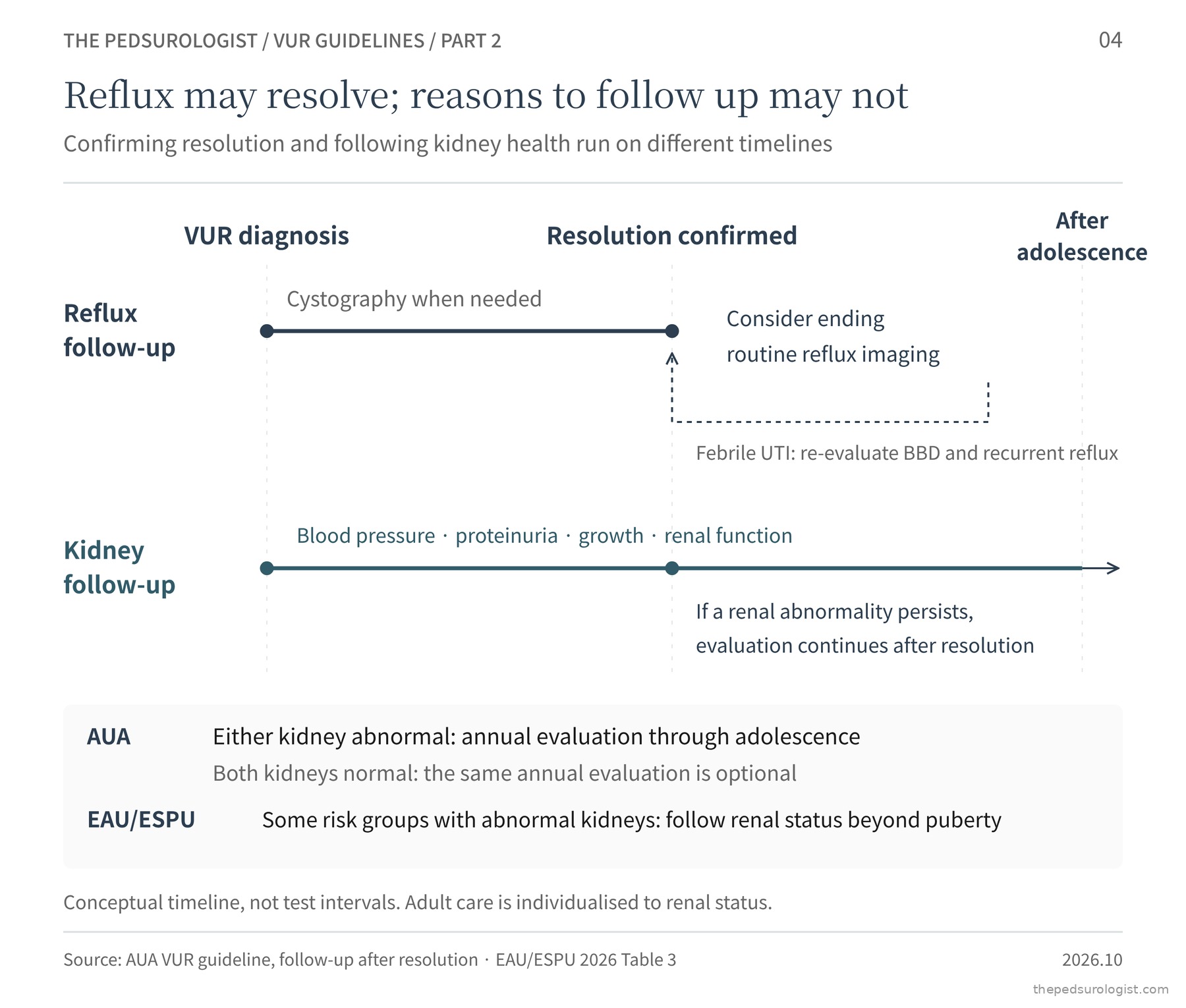
So it is not accurate to say that "the guidelines do not say when to stop." Reflux follow-up has an end point, and the duration of kidney follow-up is set by whether an abnormality exists. The gap lies in between: neither guideline sets an individual schedule for how many more cystograms to perform, nor says who should look after people with renal abnormalities beyond adolescence, and how.
Closing Part 2
Whether the boundaries of the risk groups predict the actual course, how many times cystography should be repeated, and who should look after renal abnormalities beyond adolescence are gaps left open by both guidelines. If the question of Part 1 was "is finding reflux the same as changing the prognosis?", Part 2 turns it into this: sorting children into risk groups and that sorting predicting outcomes are two further, separate questions. Part 3 turns to the decision in which the classification is used most directly: antibiotic prophylaxis.
A note on currency
- The EAU/ESPU VUR chapter is not on the revision list of the 2026 edition. Its last structured revision was in 2023 (Gnech 2024).
- Comparing the 2010 J Urol summary with the current 2017 AUA text, the recommendation statements and grades were the same; the substantive change is a paragraph on the meta-analysis of antibiotic prophylaxis. The 2017 text still gives ultrasound every 12 months and cystography every 12–24 months. See Part 3.
- The AAP risk definitions come from the new UTI guideline of September 2026.
Guideline texts checked on 19 October 2026.
References
- EAU Guidelines on Paediatric Urology. Chapter 17, Vesicoureteric reflux. European Association of Urology, 2026 edition. uroweb.org
- Gnech M, 't Hoen L, Zachou A, et al. Update and summary of the European Association of Urology/European Society of Paediatric Urology paediatric guidelines on vesicoureteral reflux in children. Eur Urol. 2024;85(5):433-442. doi:10.1016/j.eururo.2023.12.005
- Tekgül S, Riedmiller H, Hoebeke P, et al. EAU guidelines on vesicoureteral reflux in children. Eur Urol. 2012;62(3):534-542. doi:10.1016/j.eururo.2012.05.059
- Peters CA, Skoog SJ, Arant BS Jr, et al. Summary of the AUA guideline on management of primary vesicoureteral reflux in children. J Urol. 2010;184(3):1134-1144. doi:10.1016/j.juro.2010.05.065
- American Urological Association. Management and screening of primary vesicoureteral reflux in children (2010, amended 2017). auanet.org
- Alverson BK, Hains DS, Downs SM, et al. Clinical practice guideline for the diagnosis and treatment of urinary tract infection in children from 8 days to 5 years of age. Pediatrics. 2026;158(4):e2026078565. publications.aap.org
- National Institute for Health and Care Excellence. Urinary tract infection in under 16s: diagnosis and management. NICE guideline NG224. nice.org.uk/guidance/ng224
- Üre İ, Gürocak S, Tan Ö, et al. Revisiting the EAU paediatric urology guideline risk grouping on vesicoureteral reflux: shall we challenge ourselves? Gazi Med J. 2016;27(4). medicaljournal.gazi.edu.tr
- Tokat E, Gurocak S, Ure I, et al. Did our current initial treatment practice change after EAU/ESPU vesicoureteral reflux risk grouping? J Pediatr Surg. 2019;54(7):1477-1480. doi:10.1016/j.jpedsurg.2018.05.004
- Tokat E, Gurocak S, Ozkan S, et al. Clinical practice in vesicoureteral reflux with respect to EAU guidelines: a multicenter study. Int J Clin Pract. 2021;75(8):e14339. doi:10.1111/ijcp.14339
- Gradwell LEF, Madaan S, Somani BK. An atlas of nomograms, scoring systems, and predictive tools to guide investigation or management in patients with suspected or confirmed vesicoureteral reflux. J Clin Med. 2026;15(1):320. doi:10.3390/jcm15010320